
Is Moz Worth It in 2026? An Honest Evaluation for B2B Marketing Teams

TL;DR
- Moz Pro is worth it for B2B teams who primarily need a simple reporting and communication tool, thanks to its clean UI and the familiarity of Domain Authority (DA).
- It is NOT worth it for teams needing deep competitive intelligence or long-tail keyword research. Its backlink index is often stale and its keyword database is significantly smaller than Ahrefs or Semrush, creating blind spots in niche B2B verticals.
- Treat Domain Authority as a communication shorthand, not a performance metric. DA inflation means scores can rise without any actual improvement in your site's search visibility or pipeline.
- The true cost of any SEO tool isn't the subscription; it's the hours your team spends turning insights into shipped fixes. Evaluate your execution capacity before you buy another dashboard.
A three-person marketing team at a B2B SaaS company subscribes to Moz Pro. They need keyword research and competitive analysis. Three months in, they have a dashboard full of Domain Authority scores and keyword difficulty numbers, but their organic pipeline hasn't moved. They aren't sure if the tool is broken or if they're using it wrong.
The answer is neither. They're asking the wrong question.
The real question isn't "is Moz good software?" — it's "does Moz close the gap between knowing what to fix and actually shipping the fix?" For lean B2B teams, this is the only question that matters.
This is not another feature walkthrough; Moz's own site does that. This is an assessment of strategic value, framed by the operational reality of B2B marketing: limited bandwidth, pressure for pipeline, and an execution backlog that never shrinks.
What Moz Pro Actually Does Well in 2026
Moz has three genuine differentiators that keep it relevant for specific types of teams. These aren't just features; they are solutions to real workflow problems.
1. Domain Authority as a Communication Metric
Domain Authority (DA) is Moz's most famous metric, and its greatest strength is as a communication tool. When a growth marketer needs to justify a link building budget to a CFO, "we need to increase our DA from 35 to 45 to compete" is a far simpler pitch than explaining the nuances of link equity and referring domain velocity. Non-technical stakeholders understand a single, relative score. While we'll discuss the dangers of treating DA as a performance metric later, its value in simplifying conversations and aligning teams is undeniable. For client reporting and internal updates, it provides a common language that tools like Ahrefs and Semrush lack a direct equivalent for.
2. An Actionable On-Page Optimization Grader
Moz's On-Page Grader is genuinely more actionable for non-technical marketers than its competitors' equivalents. It provides a simple score and a clear, prioritized checklist of fixes. A content marketer can run a new blog post through the grader, see they need to adjust the title tag and add the keyword to an H2, and make the change in minutes—without waiting for an SEO specialist. This empowers generalists to handle foundational on-page SEO, freeing up specialists for more complex tasks. It's a small thing that has a significant impact on a lean team's execution velocity for content production.
3. The Lowest Learning Curve in Its Class
Moz is arguably the only enterprise-grade SEO tool a marketing generalist can use productively within a day. For a solo marketer at a Series A company, this is a massive advantage. They can run a competitive gap analysis, build a keyword list from Moz's 500 million-term database, and present the findings to leadership in a single afternoon. The interface is cleaner and less intimidating than the data-dense dashboards of Ahrefs or Semrush. This accessibility means the tool actually gets used, which is the first step toward generating any ROI. While its 40 trillion-link index is smaller than competitors, it's adequate for foundational analysis, and the ease of use often outweighs the data depth for teams just starting their SEO programs.
Where Moz Pro Falls Short—And Why It Matters
Moz's limitations aren't minor inconveniences; they are structural constraints that directly affect the quality of decisions a B2B team can make.
1. Backlink Index Freshness and Coverage
Moz's backlink index updates significantly slower than Ahrefs or Majestic. For a B2B team running a competitive link building campaign, this is a critical failure. It means you might spend a week prospecting and crafting outreach for a high-value link, only to discover a competitor secured it three weeks ago. You're operating on stale data. This gap distorts your understanding of a competitor's referring domain velocity—the pace at which they are acquiring new links. If their velocity is high and your data is a month old, you're fundamentally misjudging their strategy and momentum.
2. The B2B Long-Tail Keyword Gap
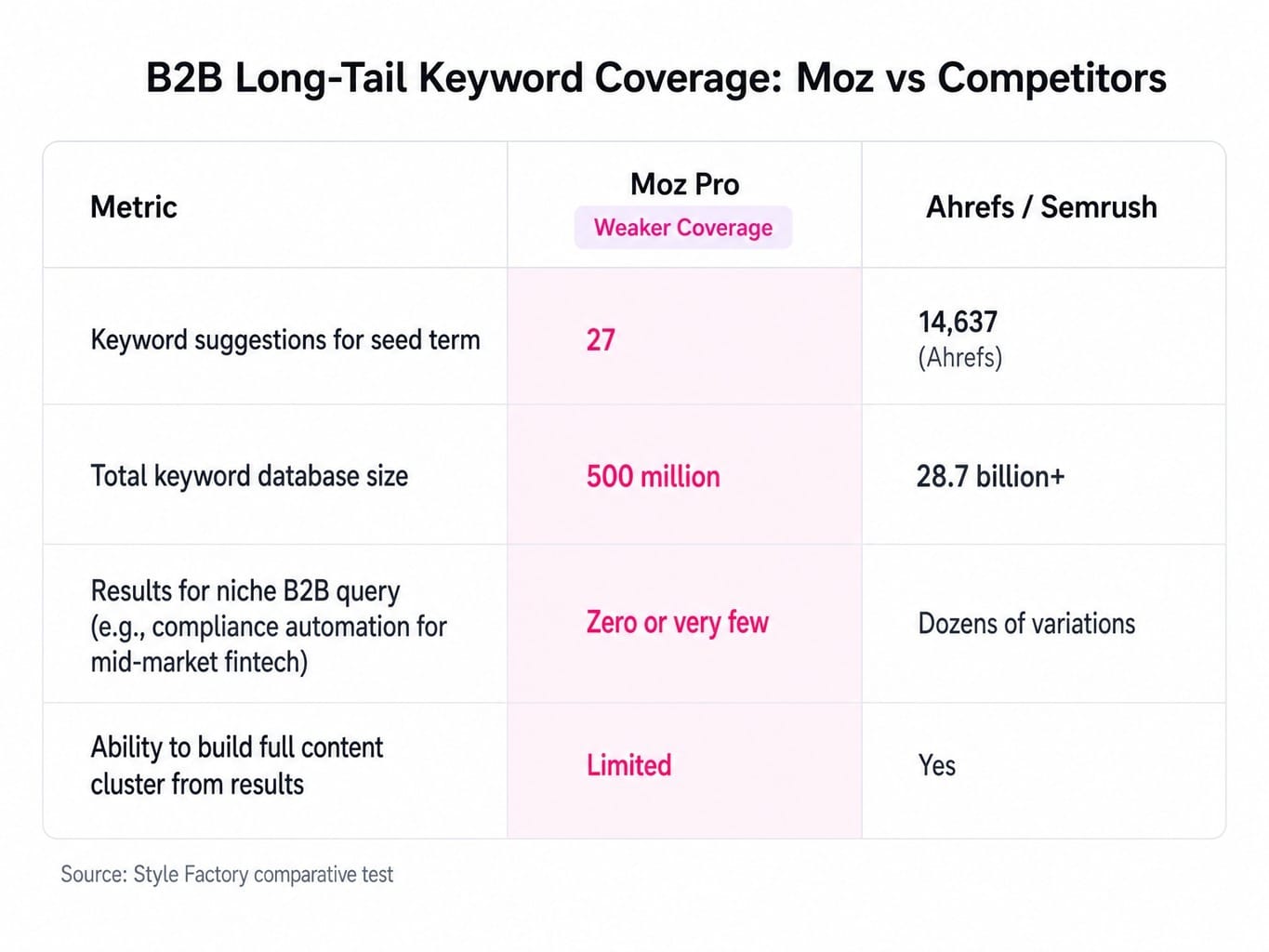
B2B marketing lives and dies on low-volume, high-intent keywords. Here, Moz's smaller keyword database becomes a structural liability. A widely cited test by Style Factory showed Moz returning 27 keyword suggestions for a seed term, while Ahrefs returned 14,637. This isn't just a numbers game. When you search for a specific B2B query like "compliance automation for mid-market fintech," Moz's Keyword Explorer will often return zero or very few relevant suggestions. Ahrefs and Semrush, with their vastly larger databases (28.7B+ keywords), will surface dozens of variations that can form the basis of an entire content cluster. For niche SaaS, this isn't a gap; it's a blind spot.
Read more: Semrush vs Moz (2026): Which SEO Tool Fits Your Team's Actual Workflow
3. No Competitor Traffic Estimation
Moz cannot estimate organic traffic to a competitor's website. This is a fundamental piece of competitive intelligence that both Semrush and Ahrefs provide. While their estimates are imperfect, they are directionally useful for sizing market opportunities, identifying a competitor's most valuable pages, and prioritizing which companies are worth a deeper analysis. Without this data, B2B teams are left guessing. You can see what keywords a competitor ranks for, but you have no model for how much traffic those rankings actually generate. This makes it nearly impossible to build a business case for targeting a specific topic cluster or to benchmark your performance against the market.
The Domain Authority Problem Nobody Talks About
Domain Authority is Moz's signature metric. It's also become a liability for B2B teams who treat it as a performance indicator.
Imagine a B2B marketing manager reporting to leadership that their DA increased from 32 to 38 over six months. Leadership asks what that means for the pipeline. The honest answer is: nothing, directly.
DA is a proprietary, predictive score of a site's ranking strength based on Moz's link data. It does not measure traffic, conversions, or revenue. The core issue is DA inflation. As Moz's link index grows and its algorithm evolves, DA scores can shift independently of any actual SEO improvement on your part. Your DA might increase simply because Moz discovered more of your existing backlinks, not because you earned new ones.
This creates a dangerous feedback loop where teams optimize for a metric that doesn't map to business outcomes. Divergence between proprietary metrics is common—a site with a Moz DA of 92 might have a Semrush Authority Score of 75. This proves they are abstract models, not objective reality. Instead of chasing a fluctuating score, teams should ground their reporting in Google Search Console data—impressions, clicks, and average position. Those metrics directly reflect real search visibility and provide a stable foundation for measuring performance.
Is Moz Worth It Specifically for B2B Teams?
For B2B teams, Moz's value is conditional. It depends entirely on your team's size, SEO maturity, and what other tools are already in the stack.
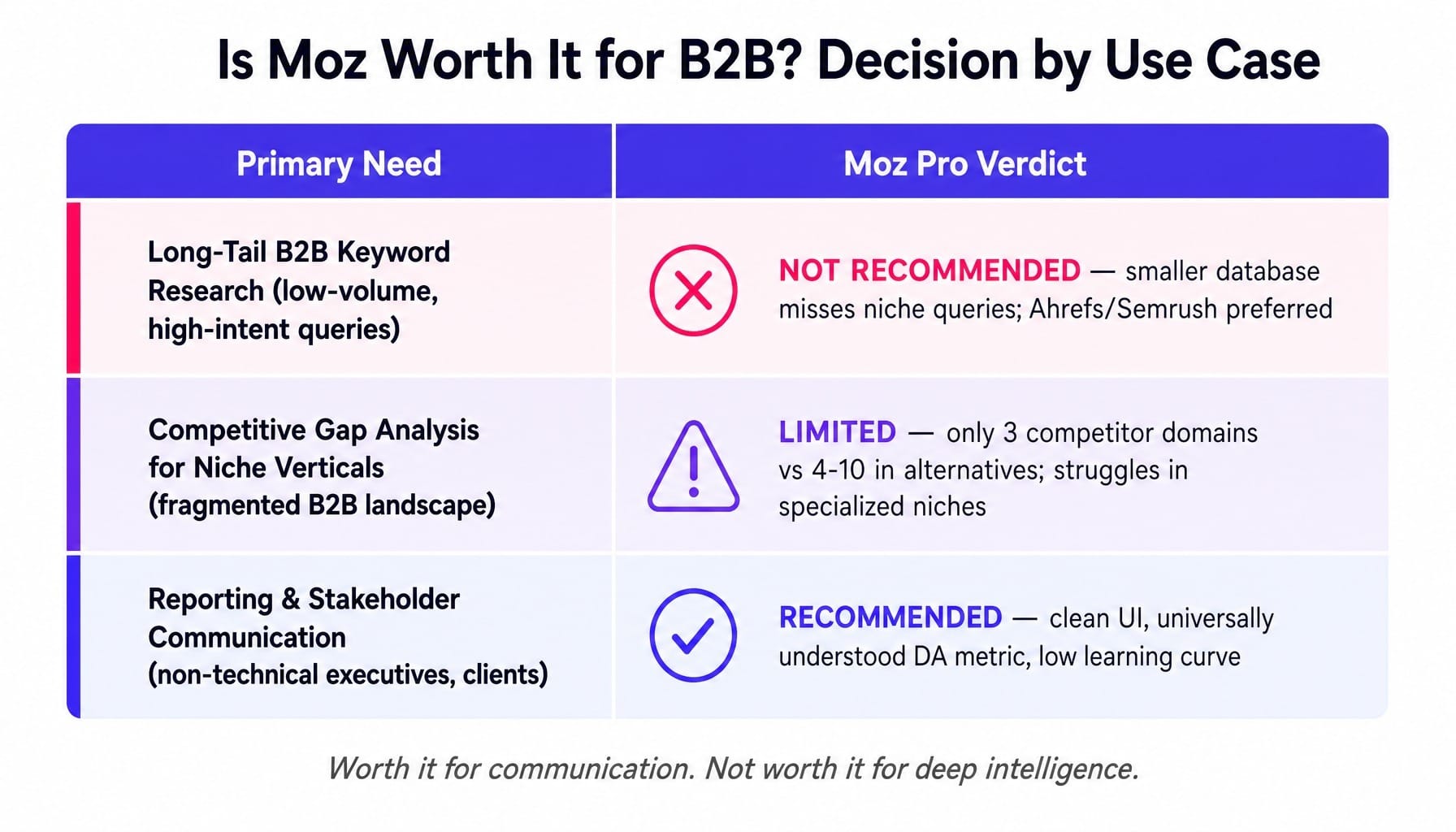
- Long-Tail B2B Keyword Research: B2B sales cycles are driven by low-volume, high-intent keywords. As discussed, Moz's smaller keyword database systematically underserves this need. If your target keywords have a monthly search volume under 100, Moz will often return no data, while Ahrefs or Semrush can help you build out a full topical map. For B2B content strategy, this is a non-negotiable requirement that Moz often fails to meet.
- Competitive Gap Analysis for Niche Verticals: Moz's tools work reasonably well for broad markets but struggle in specialized B2B niches. The platform limits you to comparing just three competing domains at a time (versus four in Semrush and ten in Ahrefs). This is a major constraint when you're trying to map a fragmented B2B landscape with multiple point solutions and platform players.
- Reporting and Stakeholder Communication: This is where Moz can genuinely earn its subscription. Its clean reporting interface and the universal recognition of DA make it an excellent tool for communicating SEO progress to non-technical executives or clients. If your primary job-to-be-done is creating simple, easy-to-understand reports for leadership, Moz is often a better choice than the more complex, practitioner-focused dashboards of its competitors.
The verdict is clear: Is Moz worth it for B2B? Yes, if your team's primary need is a reporting and communication tool with basic SEO capabilities. No, if your primary need is deep keyword research or competitive intelligence to drive your content and link building strategy.
The Cost You're Not Calculating: From Insight to Execution
Every SEO tool review makes the same mistake: it evaluates the subscription cost without accounting for the execution cost.
A Moz Pro subscription starts at $99/month. But for a lean marketing team, the real cost is the 15-20 hours a week spent interpreting the data, prioritizing recommendations, creating implementation tickets, waiting for engineering resources, and manually deploying changes.
A growth marketer runs a Moz site audit and gets 47 technical issues flagged. They prioritize the top 10, create Jira tickets for five, wait three weeks for engineering bandwidth, and ultimately ship two fixes before the next audit generates a new list. This is the execution treadmill.
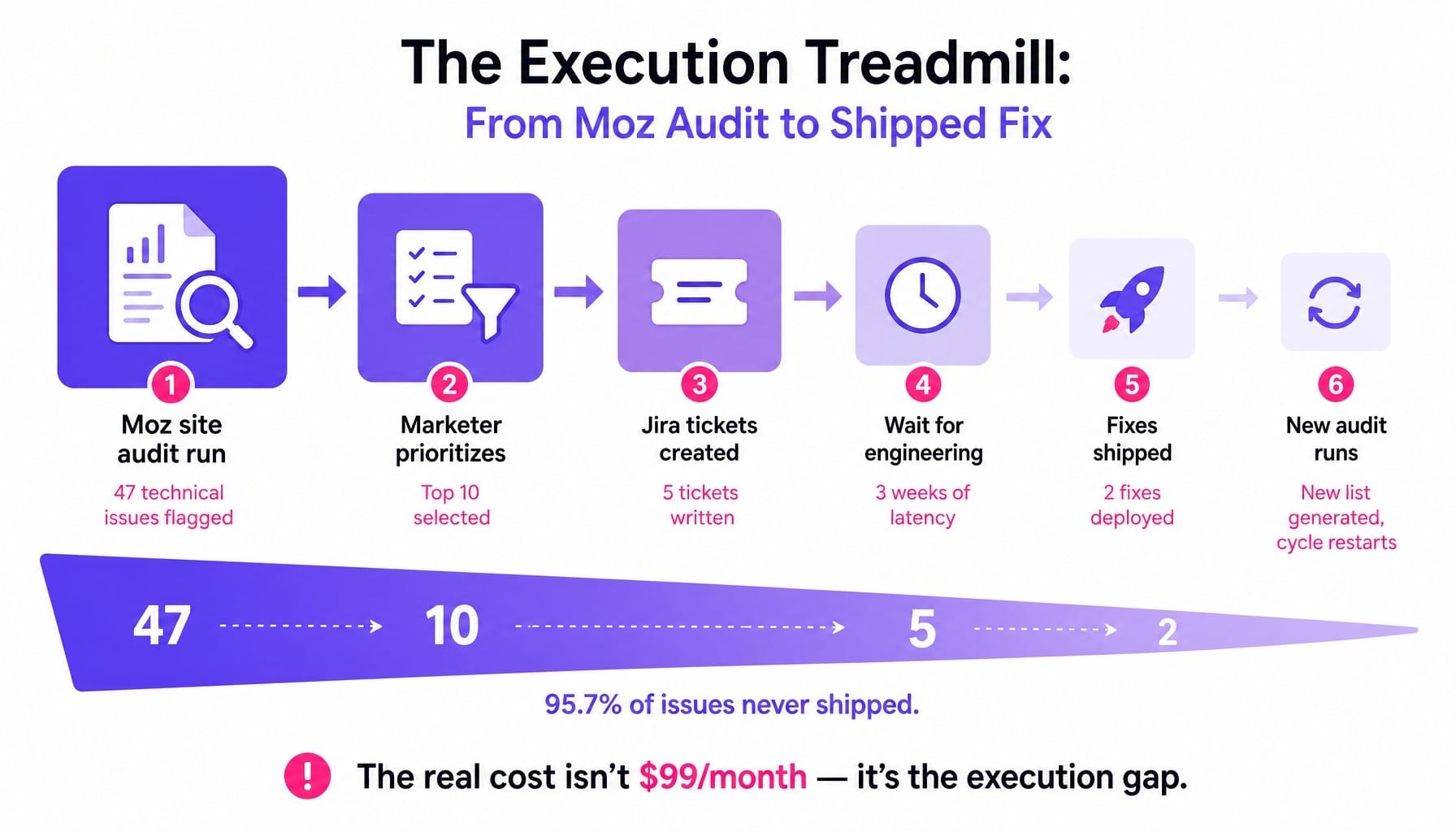
The tool surfaces a list of on-page issues, keyword opportunities, and link gaps, but none of that becomes revenue until someone acts on it. The latency between "Moz identified a problem" and "the fix is live" is where ROI evaporates. The execution backlog grows faster than the team can ship.
The real question isn't "is Moz worth $99/month?" It's "is any diagnostic tool worth its subscription if our team lacks the capacity to execute on its findings?"
What If the Tool Also Shipped the Fix?
The bottleneck for most lean B2B teams is never a lack of insight. It's the gap between that insight and a shipped improvement. You know your title tags are suboptimal or your landing page has friction. The problem is the weeks it takes to get from knowing to doing.
This is the execution gap that Spike AI is built to close. It's not another diagnostic tool; it's the execution layer that makes your entire marketing stack deliver ROI.
Spike AI doesn't just surface that a page is underperforming. It identifies the highest-impact move across your website, SEO content, or ads—and then executes it. Every week, a new release goes live. That cadence becomes the growth engine. Each release feeds the next cycle of measurement, re-prioritization, and execution, creating compound gains that quarterly pushes can never match.
The question was never about finding a better dashboard. It was about finding a way to close the gap between your strategy and your ability to ship it. Spike AI turns your marketing team from operators buried in a backlog into orchestrators who approve a weekly release.
See how Spike AI turns your SEO backlog into weekly shipped improvements
Your SEO Tool Isn't the Real Constraint
So, is Moz worth it? It's the wrong question. The right question is: "Does my team have the execution capacity to turn any SEO tool's output into shipped improvements?"
Moz is a competent diagnostic tool. Its low learning curve and clean reporting make it a viable choice for B2B teams focused on stakeholder communication. It falls short on the data depth required for serious competitive intelligence and long-tail keyword strategy in niche verticals.
But the deeper issue—one that applies to Moz, Ahrefs, Semrush, and every other platform—is that diagnostic tools only create value when an execution system is in place to act on their findings. Without that, they are just expensive dashboards.
Before you evaluate which SEO tool to subscribe to, first evaluate your team's ability to ship. That is the real constraint that will determine your ROI.
Frequently Asked Questions
Is Moz Pro accurate enough to use as your only SEO tool?
For broad keyword research and site auditing, Moz Pro provides adequate accuracy. However, its smaller keyword database means it systematically misses long-tail queries, and its backlink index refreshes slower than Ahrefs. Most practitioners find gaps when analyzing niche B2B verticals or tracking competitive link acquisition in real time.
Is Moz worth it if I only manage one website?
Moz's entry-level plans are designed for single-site management, providing rank tracking and site audits. The value depends on whether you need ongoing competitive analysis and keyword research that free tools like Google Search Console don't offer. If your needs are limited to monitoring your own site's health, GSC may be sufficient.
How does Moz's keyword difficulty score compare to Ahrefs and Semrush for B2B keywords?
Moz's Keyword Difficulty (KD) often diverges from Ahrefs and Semrush, sometimes by 20-30 points for the same term, because each uses a proprietary model. For low-volume B2B keywords, Moz's KD can be less reliable due to fewer data points. Practitioners typically cross-reference KD across at least two tools to get a more balanced view.
Does Moz Pro integrate well with Google Looker Studio for client reporting?
Moz Pro offers API access, but API call limits on lower-tier plans can be restrictive for real-time dashboards. Most teams use Moz's API with a connector tool like Supermetrics to pull data into Looker Studio. Ahrefs and Semrush generally offer more generous API limits and more mature connector ecosystems for custom reporting.
Is Moz Local worth it for B2B companies with physical offices?
Moz Local is designed for businesses dependent on local foot traffic. For most B2B companies, its value is marginal. The exception is B2B firms with a hybrid sales model where prospects might search for a local office. Even then, dedicated local SEO tools like BrightLocal or Whitespark often provide better coverage.