
Mangools Review 2026: An Honest Look at What You Actually Get

TL;DR
- KWFinder is the star: The keyword research tool is genuinely fast and intuitive, but its Keyword Difficulty (KD) score consistently underestimates actual ranking difficulty by 15-30% compared to premium tools.
- Data requires validation: Mangools' data on search volume and keyword difficulty is directionally useful, not precise. You must cross-reference its suggestions with Google Search Console data before committing to a content strategy.
- Credit limits create friction: The daily lookup and tracked keyword limits on lower-tier plans are restrictive for anyone managing more than one or two small sites, forcing you to manage your usage instead of just doing the work.
- It's for specific users: Mangools is an excellent choice for solo bloggers and new freelancers. It is insufficient for in-house marketing teams or established consultants who need site auditing, deep backlink analysis, and scalable tracking.
- You will outgrow it: The moment you start routinely double-checking Mangools' data in other tools or find yourself unable to answer stakeholder questions about site health or content gaps, you've hit the inflection point to upgrade.
Most reviews of Mangools fall into two unhelpful camps. The first, often fueled by affiliate commissions, paints it as a budget Ahrefs-killer, a scrappy underdog that delivers 90% of the value for 20% of the price. The second, usually from practitioners steeped in enterprise toolsets, dismisses it as a beginner toy you'll outgrow in three months.
Both are wrong. Both waste your time.
Mangools is a genuinely capable SEO toolset with specific strengths and very clear boundaries. The only question that matters is whether your current workflow fits inside those boundaries. This isn't a simple "yes" or "no" answer, and anyone who gives you one is selling something.
This Mangools review is different. We're going to dig into the areas other reviews gloss over: where its data actually diverges from premium tools, how its credit system creates workflow friction the pricing page obscures, and the exact inflection point where upgrading becomes a necessity, not a luxury. We're here to help you decide, not to sell you.
What Mangools Includes in 2026 (and What It Doesn't)
At its core, Mangools is a five-tool SEO suite that deliberately stays narrow rather than chasing the feature-bloat of Semrush or Ahrefs. This focus is both its greatest strength and its primary limitation.
The suite consists of:
- KWFinder: A keyword research tool for finding, analyzing, and assessing keyword opportunities.
- SERPChecker: A SERP analysis tool for manually inspecting the search results for a given keyword.
- SERPWatcher: A rank tracking tool to monitor your site's keyword positions over time.
- LinkMiner: A backlink analysis tool for reviewing your own and competitors' backlink profiles.
- SiteProfiler: A high-level domain overview tool for a quick snapshot of a site's SEO health.
This is all tied together with a genuinely useful browser extension for on-the-fly analysis.
What's immediately absent is just as important. There is no comprehensive site audit capability for technical SEO. There is no dedicated content optimization or content brief module. There is no automated competitor content gap analysis. And while the new AI Search Watcher is a welcome addition, its AI Overview tracking is basic compared to more advanced platforms. This isn't a flaw; it's a design choice. Mangools is built for a specific set of SEO tasks, and you need to know if those are the tasks you perform most.
Tool-by-Tool Verdict: What's Strong, What's Mediocre, What's Filler
We're not going to walk you through every button and metric. You can get that from their help docs. Instead, here's an honest verdict on each tool in the suite—what you can rely on, and where it falls short for a working SEO practitioner. Let's use the keyword "project management software" as our test case.
KWFinder: The Reason Most People Subscribe
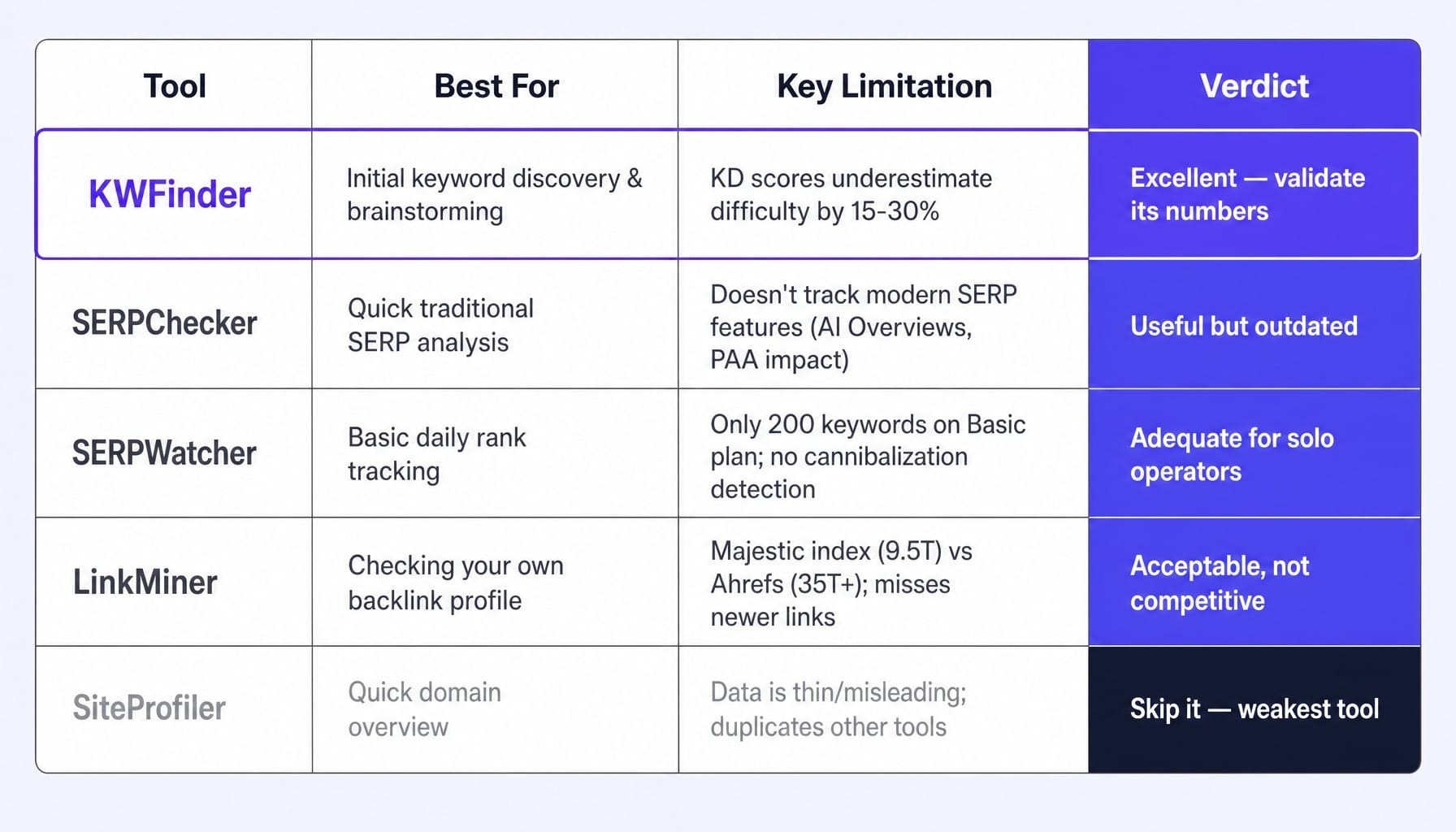
KWFinder is Mangools' strongest tool and the primary reason the product has a loyal following. Its strength is the interface. It presents keyword difficulty, search volume, trend data, and a SERP overview on a single, clean screen, avoiding the cognitive overload common in Semrush or Ahrefs. The "Questions" and "Autocomplete" modes are particularly effective, often surfacing valuable long-tail opportunities faster than manually filtering in larger, more complex tools.
But fast doesn't mean flawless. The search volume data, which uses clickstream estimates, can diverge significantly from Google Keyword Planner on lower-volume terms. More critically, the KD score consistently underestimates difficulty. For "project management software," KWFinder might show a KD of 65, while Ahrefs shows 82. This is because Mangools' algorithm weighs fewer ranking factors. This isn't just a number on a screen; it has real-world consequences for your strategy.
Verdict: Excellent for initial keyword discovery and brainstorming. Its speed and UI are best-in-class for generating ideas. However, it is unreliable as your sole source for difficulty assessment. Trust its ideas, but validate its numbers.
SERPChecker: Useful but Increasingly Outdated
SERPChecker was more valuable before SERP features became as complex as they are today. It pulls up the top search results for a query like "project management software" and lets you overlay 45+ metrics (like Domain Authority and backlink counts) for each result. This is genuinely useful for a quick competitive assessment.
The critical gap, however, is its handling of the modern SERP. A practitioner in 2026 needs to know if an AI Overview will absorb 40% of the clicks for a target keyword. You need to see the prevalence of video carousels, "People Also Ask" boxes, and other features that cannibalize organic clicks. SERPChecker's feature tracking hasn't kept pace. It notes the presence of some features, but it doesn't provide the deep analysis needed to model query-level CTR accurately.
Verdict: Still useful for a quick, traditional SERP analysis. But for making a strategic decision on whether a keyword is worth targeting in the age of generative AI, you'll need supplementary tools.
SERPWatcher: Solid Rank Tracking with Low Ceilings
SERPWatcher handles the core job of rank tracking competently. You can load in your keywords, including "project management software," and get daily updates on your position. The interface is clean, presenting a "Performance Index" score that gives you a quick glance at your overall visibility trend. It does what a basic rank tracker should do.
The problem is the low ceiling. The cheapest plan tracks only 200 keywords daily. For a freelancer managing a few small clients, that might suffice. But for any business with a serious content program, 200 keywords is a tiny slice of the pie. The tool also lacks deeper diagnostic features like cannibalization detection, SERP feature change alerts, or native integration with Google Search Console data to analyze click-through rates.
Verdict: Perfectly adequate for solo operators or freelancers tracking a handful of high-priority keywords for a few clients. It is insufficient for any team managing content at scale or requiring deep performance diagnostics.
LinkMiner: Acceptable Backlink Data, Not Competitive
LinkMiner is where the limitations of a budget tool become most visible. It pulls its data from Majestic's index, which, at 9.5 trillion links, is substantial but still only a fraction of Ahrefs' 35T+ active link index. In practice, when analyzing the backlinks for a top-ranking article on "project management software," LinkMiner will consistently miss referring domains that Ahrefs catches, particularly newer links or those from smaller blogs.
To its credit, the live preview feature—seeing the linking page directly within the LinkMiner interface—is a genuine UX advantage that competitors lack. It saves a lot of tab-switching. But for serious link-building workflows like link intersect analysis, tracking referring domain velocity, or analyzing a competitor's anchor text distribution, the data is simply too thin to be competitive.
Verdict: Fine for checking your own backlink profile or performing basic competitor research. It is not a replacement for Ahrefs or Semrush if link building is a core part of your SEO strategy.
Read more: Majestic vs Ahrefs: Which Backlink Tool Matches Your Actual Workflow (2026)
SiteProfiler: The Weakest Link in the Suite
SiteProfiler is the one tool in the suite that adds almost no value beyond what you can get from the other four combined with free alternatives. It provides a high-level overview of a domain's authority (using Majestic's metrics), top content by links, and supposed organic competitors. The problem is that the data is often thin or misleading. It's not uncommon for SiteProfiler's "competitors" list to include sites with no real topical overlap.
The "Top Content" report is somewhat useful, but it largely duplicates what you'd find by running the domain through LinkMiner anyway. And let's be honest, nobody gets into SEO to look at high-level vanity metrics. SiteProfiler feels like it exists to round out the suite to five tools, not because it solves a distinct practitioner problem.
Verdict: Skip it. Your time is better spent in KWFinder or validating data in Google Search Console.
Where Mangools Data Diverges from Premium Tools—and Which Is Closer to Reality
Most reviews treat data accuracy as a binary: "good enough" or "not." The real question is where the data diverges and if those divergences will lead you to make bad decisions. There are three common patterns.
First is KD score inflation. As mentioned, Mangools' Keyword Difficulty scores consistently run 15-30% lower than those from Ahrefs or Semrush. This is because its difficulty model is simpler and weighs fewer factors. A freelancer might see a list of keywords with a KD under 30 in Mangools and build a six-month content plan around them. They publish the content, only to find that just a few pieces crack page one because the actual difficulty, closer to Ahrefs' KD 45, required more domain authority than they had. This isn't to say Mangools is 'wrong'—all SEO tool metrics are estimations. The problem is one of calibration; if you don't know its scores run low, you'll misallocate resources.
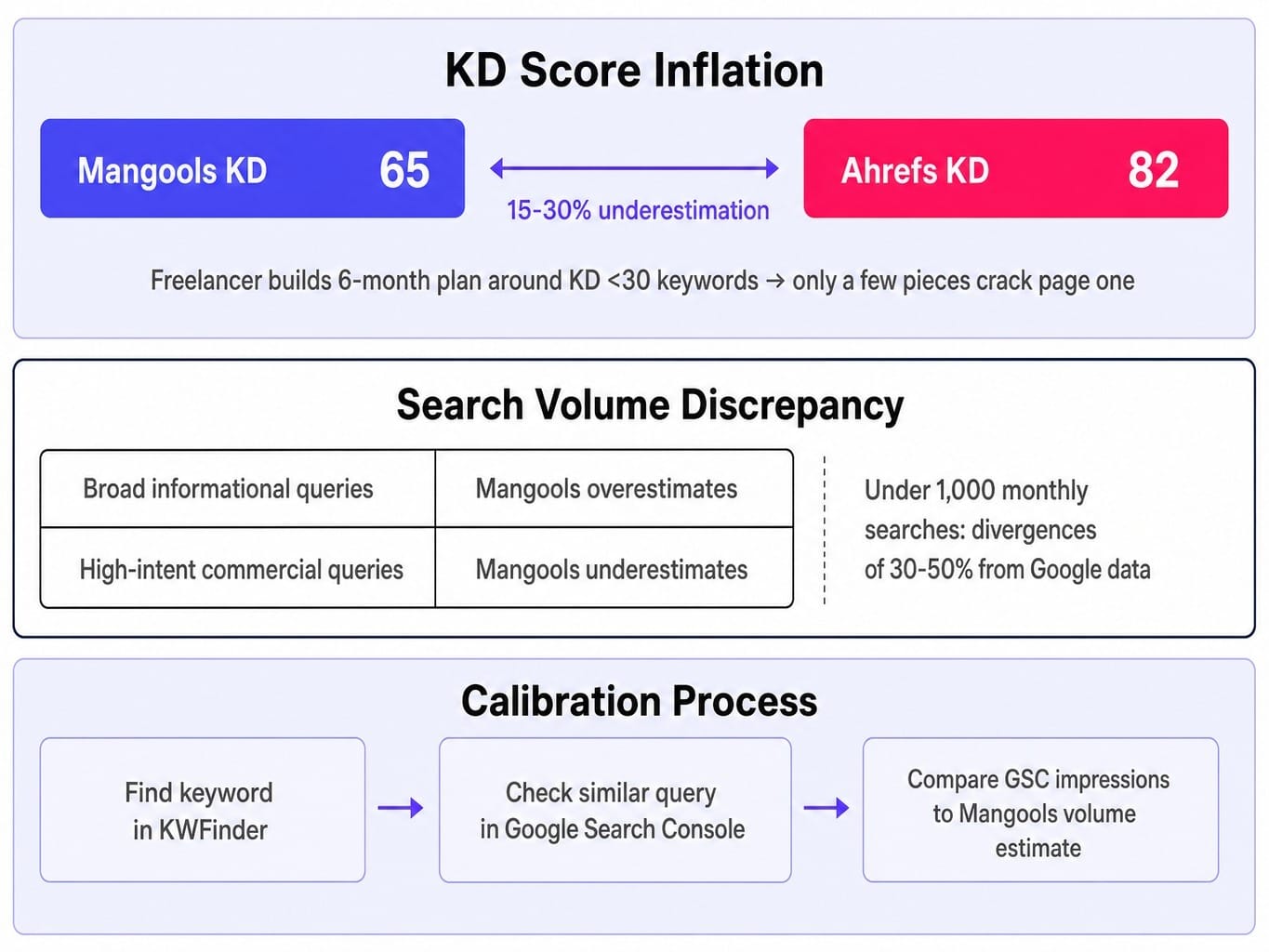
Second is search volume discrepancy. Mangools uses clickstream-adjusted data, which can be a double-edged sword. We've found it tends to overestimate volume on broad informational queries but underestimate it on high-intent commercial queries compared to Google Keyword Planner.
Third is the practical resolution: validation. The smartest way to use Mangools is as a discovery tool, not a gospel. Found a promising keyword in KWFinder? Don't just trust the numbers. Go to your Google Search Console. Find a similar query you already rank for on page two or three. Compare GSC's impression data to Mangools' search volume estimate. This dose of reality is the best way to calibrate your expectations and avoid chasing phantom traffic.
The Credit Limit Problem No One Talks About
Mangools' pricing looks incredibly attractive on the surface, but its value proposition is heavily constrained by a credit system that creates real workflow friction.
Let's walk through a concrete scenario. You're a freelance SEO consultant on the Basic plan ($49/month) managing three small client sites. That plan gives you 100 keyword lookups per 24 hours and allows you to track 200 keywords total. For one client, you need to research topics for four new blog posts this month. To find the best target for each post, you'll likely research 15-25 keyword variations. That's 60-100 lookups for just one client's monthly content plan. Multiply that by three clients, and you're at 180-300 lookups.
The 100/day limit means you can't batch-research all your clients in one dedicated session. You have to stop, wait for the reset, and come back tomorrow. The tracked keyword limit is even more constraining. With 200 keywords to spread across three clients, you're allocating ~67 keywords each. That's enough to cover the core pages and maybe 10-15 blog posts. The moment a client's site grows, you're forced into a triage situation, deciding which keywords to stop tracking to make room for new ones.
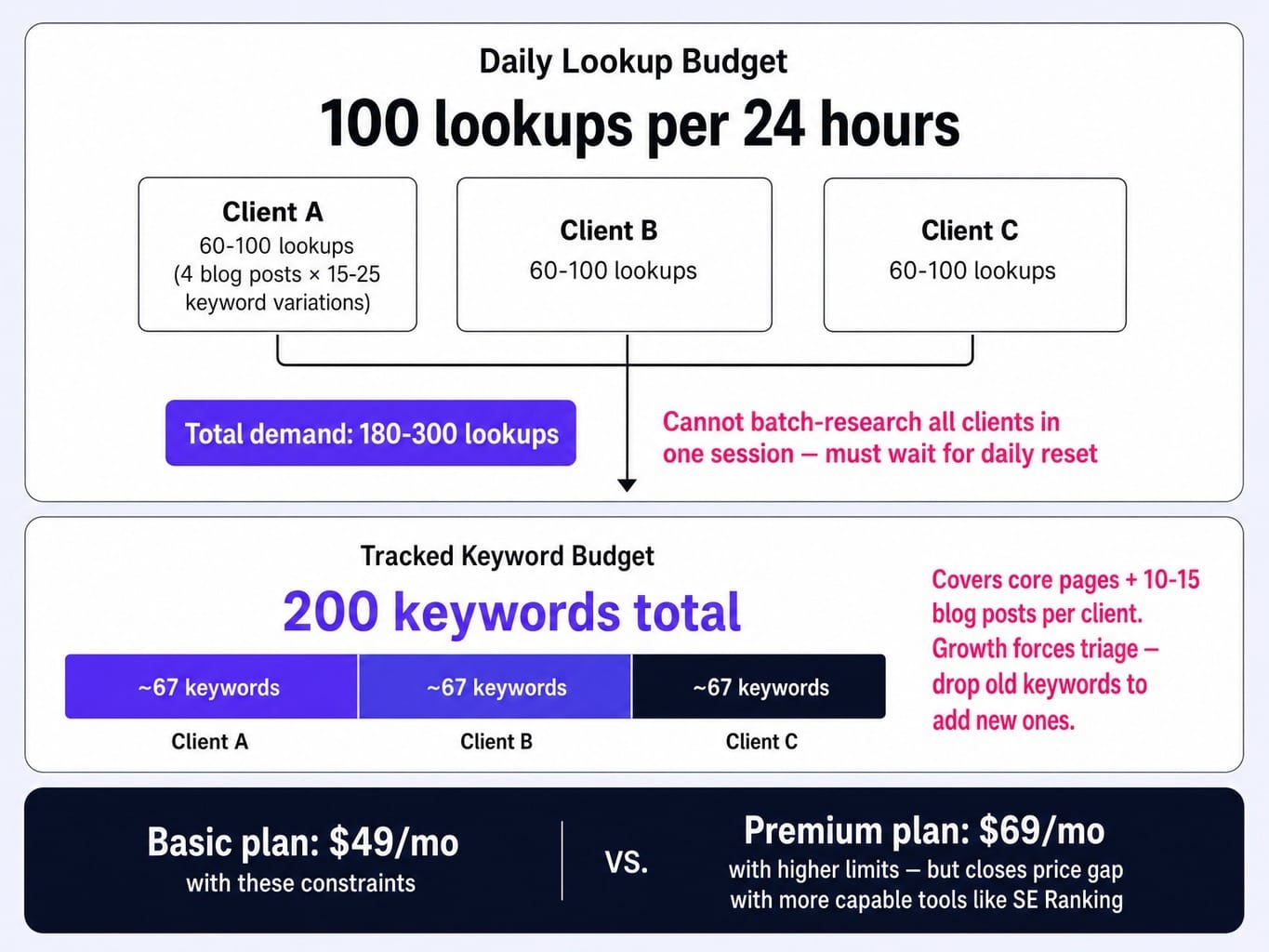
This is the hidden cost: the psychological overhead of constantly managing credit allocation rather than just doing the work. The Premium plan raises these limits, but at $69/month, it starts to close the price gap with more capable tools like SE Ranking, making the "budget" argument less compelling.
Who Should Buy Mangools—and Who Shouldn't
After assessing the tools, data, and constraints, the decision comes down to your specific profile.
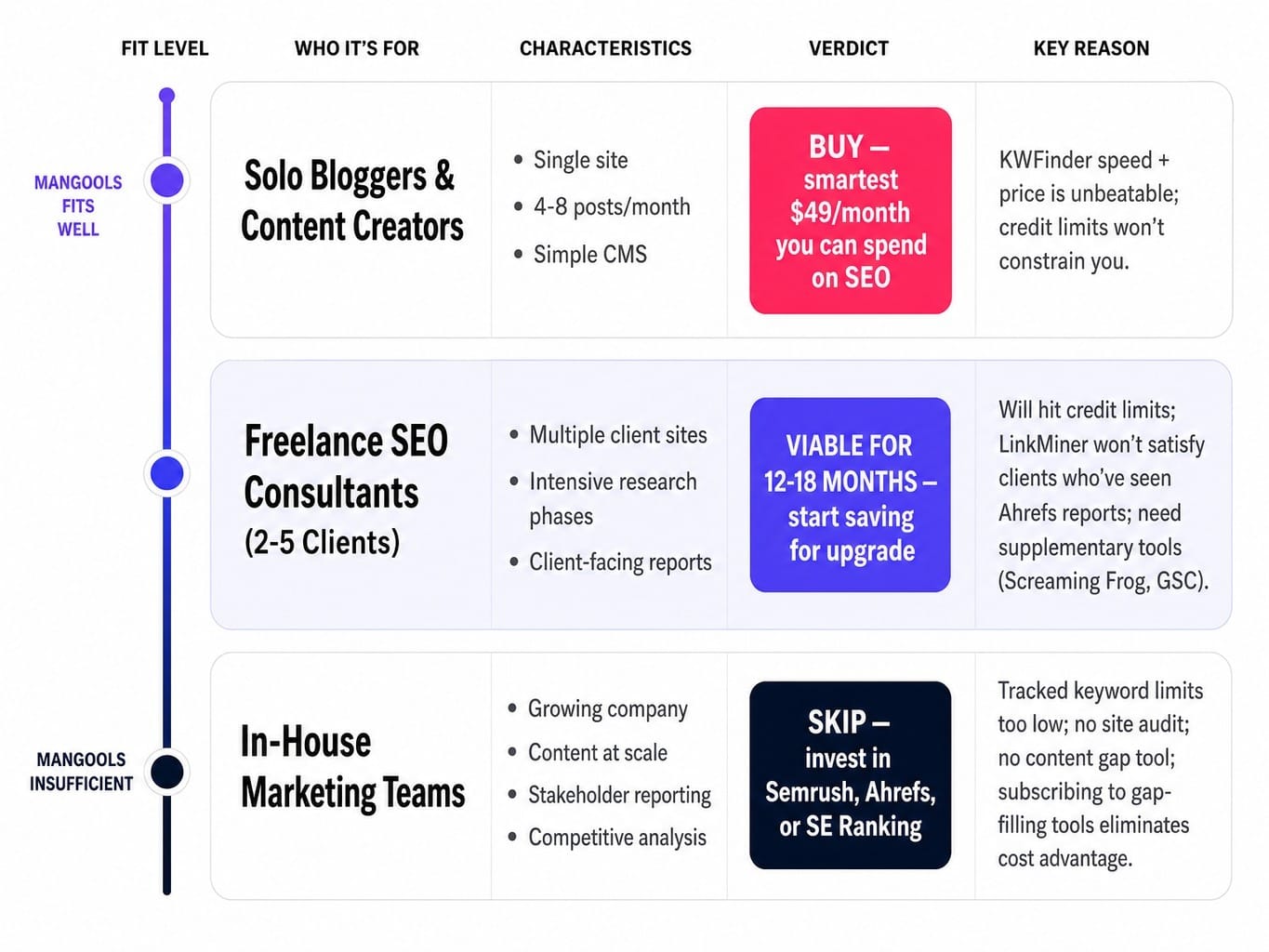
Profile 1: Solo Bloggers & Content Creators
For someone doing their own SEO for a single site, Mangools is an excellent choice. KWFinder's interface is genuinely faster for finding content ideas than wrestling with Semrush's dashboard. The price is right, and the credit limits are unlikely to constrain a workflow of publishing 4-8 pieces per month. The lack of a site audit isn't a dealbreaker if you're using a modern CMS and keeping things simple.
Verdict: Buy it. It's probably the smartest $49/month you can spend on SEO.
Profile 2: Freelance SEO Consultants (2-5 Clients)
Here, Mangools is viable but comes with friction. You will hit credit limits during intensive research phases. The thin backlink data in LinkMiner won't satisfy clients who have seen reports from Ahrefs. You will absolutely need supplementary tools, at minimum a free Screaming Frog license for site audits and deep reliance on Google Search Console for performance data.
Verdict: A viable primary tool for the first 12-18 months of a freelance practice. But start saving for an upgrade.
Profile 3: In-house Marketing Teams at Growing Companies
For this group, Mangools is insufficient. The tracked keyword limits are too low, the lack of a site audit is a critical gap, the backlink data isn't deep enough for competitive analysis, and the absence of an automated content gap tool creates too much manual work. You'll quickly find yourself subscribing to 2-3 other tools to fill the gaps, at which point the 'affordable' advantage has completely disappeared.
Verdict: Skip it. Invest in a platform like Semrush, Ahrefs, or SE Ranking that can scale with your team's needs.
Read more: Mangools vs Semrush: Which SEO Tool Actually Fits Your Workflow in 2026?
The Inflection Point: When You'll Outgrow Mangools
The question isn't if you'll outgrow Mangools—if you're successful, you will. The question is when, and how to recognize the signs before your workflow grinds to a halt. There are three clear signals.
Signal 1: You start cross-referencing everything. The moment you find yourself routinely running a keyword through Google Keyword Planner or checking a backlink profile in Ahrefs' free tool after looking it up in Mangools, the tool is no longer saving you time. It's become an extra step in a longer verification process.
Signal 2: You're managing credits more than you're doing SEO. When you start planning your research sessions around the daily 10 AM reset, or you have to explain to a client why you can't add more keywords to their rank tracker, the tool is constraining your work. Your focus shifts from finding opportunities to rationing lookups.
Signal 3: Your stakeholders ask questions Mangools can't answer. This is the big one. When your boss or client asks for a technical health score, a report on competitor backlink velocity, or an analysis of how AI Overviews are impacting traffic to key pages, you'll find Mangools comes up short. At this point, you're either buying more tools or delivering incomplete answers. That's the inflection point.
If you're weighing your options, our comparison of Mangools vs Ahrefs breaks down exactly where each tool wins and loses in a real workflow.
When the Problem Isn't Your Tools—It's the Gap Between Insight and Action
Outgrowing a tool like Mangools is a sign of progress. But upgrading to a premium platform like Ahrefs or Semrush often reveals a deeper, more frustrating problem. The new tool gives you more data, more dashboards, and more insights, but your optimization backlog continues to grow.
The real constraint in most marketing teams isn't a lack of data. It's the latency between identifying what needs to change and actually shipping that change. You can have perfect keyword data and a flawless site audit, but if it takes three weeks to get a headline updated or a new landing page deployed, you're still losing. The execution gap remains.
This is where the system needs to change. Instead of adding another tool that just surfaces more insights you don't have time to act on, Spike AI provides a different solution. It functions as a marketing execution engine that not only identifies the highest-impact change across your website, SEO, and content—it actually ships it. Weekly. This shifts the focus from building a backlog to building momentum. It's the third option beyond "buy more tools" or "hire an agency."
See how Spike AI turns your SEO backlog into weekly shipped improvements
Conclusion: A Good Tool with Honest Boundaries
After this detailed Mangools review, the conclusion is clear: Mangools is a good toolset with honest boundaries. The right decision depends entirely on whether your workflow fits inside those boundaries today.
It excels at fast, intuitive keyword research and basic rank tracking, making it a powerful asset for solo practitioners and early-stage freelancers who prioritize speed and simplicity. However, its data requires validation, and its credit system becomes a significant point of friction as your work scales. The smartest approach is to use Mangools deliberately—knowing exactly what it does well, what it doesn't, and when you'll inevitably need to move beyond it.
The best SEO tool is the one that matches your current workflow without forcing you to constantly work around its limitations. If Mangools fits that description for you today, buy it without hesitation. If your needs are already pressing against its boundaries, don't let the attractive price tag convince you to compromise on a system that will only slow you down. For a broader look at what else is out there, our guide to Mangools alternatives covers five tools worth considering and when switching actually makes sense.
Frequently Asked Questions
Does Mangools offer enough backlink data to replace Ahrefs for link building?
No. LinkMiner uses Majestic's index, which is roughly a quarter of the size of Ahrefs' crawled index. For basic competitor overviews, it's adequate. For serious link-building workflows like link intersect analysis or tracking referring domain velocity, you'll consistently find Ahrefs surfaces referring domains that LinkMiner misses entirely.
Can I run a full technical SEO audit using only Mangools?
No. Mangools has no site audit or website crawling capability. You will need a separate tool—like Screaming Frog (free for up to 500 URLs), Sitebulb, or the audit modules in Semrush or Ahrefs—to identify technical issues like crawl errors, index bloat, or broken internal links. This is a critical functional gap in the suite.
How reliable is Mangools' search volume data compared to Google Keyword Planner?
Mangools uses clickstream-adjusted data, which is directionally useful but not precise. It often overestimates volume for broad informational queries and underestimates it for specific commercial queries. For keywords with under 1,000 monthly searches, it's not uncommon to see divergences of 30-50% from Google's own data. Always validate with your Google Search Console impressions.
Does Mangools support bulk keyword analysis and content gap workflows?
KWFinder supports importing keyword lists for bulk analysis, but the suite lacks a dedicated, automated content gap tool. You can manually approximate a content gap analysis by exporting keyword lists from multiple competitors and comparing them in a spreadsheet, but this is a time-consuming process that platforms like Semrush and Ahrefs automate.
How does Mangools handle AI Overview and SGE-era SERP feature tracking?
Mangools' AI Search Watcher, launched in 2025, monitors if AI Overviews appear for your tracked keywords and if your site is cited. It's a necessary feature but remains basic. It does not quantify the click-impact of AI Overviews, track SERP feature volatility over time, or model how AI results might affect your organic CTR, unlike more specialized SERP tracking tools.