
MarketMuse Review 2026: Is the Premium Price Still Worth It?

TL;DR
- MarketMuse's core value is its domain-level content strategy for large sites (200+ pages), using its Content Inventory and Personalized Difficulty features. This is its primary defensible moat.
- For page-level content optimization, cheaper tools like Surfer SEO and Clearscope, combined with LLMs like ChatGPT or Claude, have largely closed the value gap at a fraction of the cost.
- The real cost of MarketMuse isn't just the subscription; it's the 4-8 week team onboarding period where productivity can dip before the tool starts delivering ROI.
- MarketMuse is a strong buy for enterprise teams with large content libraries, a strategic sprint for mid-market teams, and a hard pass for small teams or new sites.
- The platform delivers its highest ROI in the first 6-12 months by surfacing major content gaps and opportunities. After that, its value can become incremental, prompting a re-evaluation of the subscription.
Your three-person content team just sat through a MarketMuse demo. The content lead is impressed. The topic modeling looks robust, and the idea of a personalized difficulty score that accounts for your domain's authority is a clear step up from the generic keyword difficulty scores you've been ignoring in other tools.
Then you see the pricing page. The standard plan starts at over $6,000 a year. That's more than your entire content tooling budget combined.
This is the core tension of MarketMuse in 2026. It is a genuinely powerful content intelligence platform. This is not a hit piece. But in a world where large language models (LLMs) have commoditized much of what content optimization tools used to uniquely provide, "powerful" and "worth it" are two very different questions.
This honest MarketMuse review will give you three things:
- An assessment of where its site-aware intelligence model is genuinely superior.
- A clear view of where cheaper tools and LLMs have closed the gap.
- A framework for deciding if it actually belongs in your stack.
What MarketMuse Actually Does Differently From Other Content Tools
First, let's be clear: MarketMuse is not a content editor with an SEO score. That's a fundamental misunderstanding of the platform. Tools like Surfer SEO and Clearscope operate at the page level. MarketMuse is designed to operate at the domain level. It's a content intelligence platform that builds a model of your entire domain's topical coverage and then tells you where to invest next.
This difference is built on three structural layers:
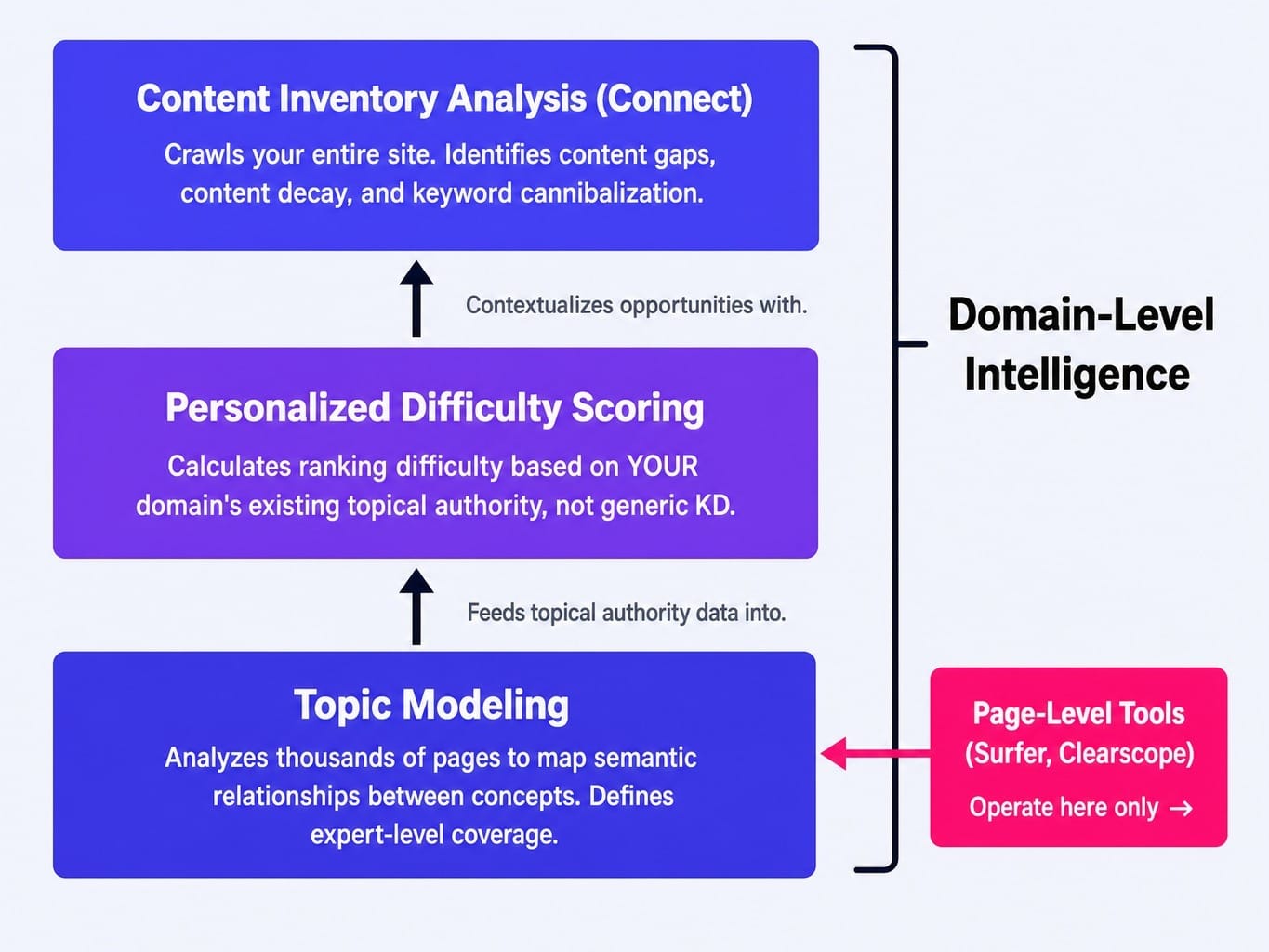
- Topic Modeling: Instead of just analyzing the top 10-20 search results for a keyword, MarketMuse analyzes thousands of pages to build a comprehensive topic model. It's not looking for keyword frequency; it's mapping the semantic relationships between concepts to define what expert-level coverage of a subject truly looks like.
- Personalized Difficulty Scoring: This is the platform's most compelling metric. It ignores generic keyword difficulty (KD) and instead calculates a score based on your domain's existing topical authority. The difficulty of ranking for "content marketing strategy" is fundamentally different for HubSpot than it is for a new startup blog. MarketMuse is one of the few tools that quantifies this reality, giving you a more honest assessment of your competitive chances.
- Content Inventory Analysis: The platform's Connect application crawls your entire site, creating an inventory that identifies content gaps, pages suffering from content decay, and opportunities for cannibalization. For example, if you have 40 articles about email marketing but zero about deliverability, MarketMuse surfaces that as a high-opportunity, low-difficulty target. A page-level tool like Surfer SEO would never see that strategic gap because it doesn't have a map of your existing territory.
Finishing this section, you should understand that MarketMuse's value proposition is strategic content planning, not just page-level optimization. That distinction is critical for evaluating whether it's worth the premium.
Where MarketMuse Genuinely Excels
MarketMuse has real strengths that no single competitor fully replicates. But they are specific strengths that deliver disproportionate value to certain types of teams. These are the two capabilities where its premium price is most defensible.
Content Inventory Intelligence That Actually Changes Your Editorial Calendar
MarketMuse's content inventory crawl is its most underrated feature and the one most difficult to replicate with cheaper tools. For a company with a large, mature blog, it can be revelatory.
Imagine a B2B SaaS company with 300+ blog posts. For years, their content strategy has been a mix of keyword research and educated guesses. After running a MarketMuse inventory analysis, they discover that 40% of their content clusters have significant topical gaps and, more alarmingly, that 15% of their pages are actively cannibalizing each other on overlapping keywords. Without this 30,000-foot view, the team was planning new content that would have only deepened the cannibalization.
This is where the platform's 'site-aware' model pays for itself. It transforms content strategy from a reactive, page-by-page process into a prioritized, strategic map. If you have a large content library (200+ pages), this feature alone can deliver an ROI that justifies the cost. If you have fewer than 50 pages, it's significantly less valuable.
Personalized Difficulty Scoring That Reframes What You Can Rank For
The personalized difficulty score is MarketMuse's most intellectually honest metric. It's more useful than generic keyword difficulty from Ahrefs or Semrush because it understands context.
Consider a cybersecurity SaaS blog. They see "zero trust architecture" has a KD of 78 in Ahrefs—a seemingly impossible target. They write it off. But MarketMuse, having inventoried their site, rates their personalized difficulty as 'moderate'. Why? Because it knows they already have 20 articles on adjacent security topics like network segmentation and identity access management. The platform understands they have built-in topical authority. Bolstered by this insight, the team targets the keyword and hits page one within four months.
The mechanism is simple: personalized difficulty factors in your domain's existing topic authority, not just the backlink profiles of top-ranking pages. However, a crucial caveat: this metric is only as good as the topic model's accuracy for your niche. In highly specialized or emerging fields, the model can sometimes struggle to build a comprehensive map, making the score less reliable. You have to learn when to trust it and when to sanity-check it against your own expertise.
Read more: SaaS Keyword Research: The Revenue-First Framework for Pipeline, Not Just Pageviews
Where MarketMuse Falls Short—Honestly
Any review that lists "steep learning curve" and "expensive" as the only cons is wasting your time. Those are obvious. The real weaknesses are the ones that determine whether the tool will actually deliver a return for your team, and they are the ones most reviews gloss over.
The Hidden Onboarding Cost Nobody Mentions in Reviews
The real cost of MarketMuse isn't the annual subscription. It's the four to eight weeks of team ramp-up time before anyone can use it effectively.
Here's a common scenario: a content team buys MarketMuse. The content manager is tasked with learning it. For the first month, they spend over five hours a week just trying to understand the interface, deciphering what a content score of 35 versus 40 means in practice, and figuring out how to translate the topic model's suggestions into an actionable brief for a freelance writer. And let's be honest, that's a month of reduced output you don't get back. During that onboarding period, the tool is consuming bandwidth instead of saving it.
This cost is invisible on the pricing page but very real in your team's productivity. Contrast this with Surfer SEO or Clearscope, where a writer can produce an optimized piece of content within 30 minutes of their first login. MarketMuse's time-to-value is measured in weeks, not hours. You must factor that into your ROI calculation.
The Diminishing Returns Curve After Your First 50 Optimizations
MarketMuse delivers its highest, most explosive ROI in the first three to six months. This is the "aha" phase, when the content inventory analysis surfaces your biggest topical gaps and the personalized difficulty scores reveal your most promising hidden opportunities. It feels like magic.
But after that initial wave, the incremental value of each new recommendation tends to decrease.
A team uses MarketMuse aggressively for six months. They fill their major topical gaps, fix their worst cannibalization issues, and see significant traffic gains. But in month seven, the recommendations start feeling marginal. "Add 200 words about X subtopic to an existing article." "Improve the content score of this page from 42 to 45." The team starts to question whether $500 a month is justified for such incremental suggestions.
This isn't a flaw in the tool; it's the natural lifecycle of any intelligence platform. The low-hanging fruit gets picked. This means MarketMuse might be better framed as a 6-12 month strategic investment for a major content overhaul, rather than a permanent line item in your marketing budget.
Does MarketMuse Still Matter When Your Writers Use ChatGPT?
In 2023, MarketMuse's content brief generation and first-draft features were solid differentiators. In 2026, they are table stakes at best. Any content team can now prompt Claude or ChatGPT to generate a topically comprehensive first draft with semantic coverage that rivals MarketMuse's own suggestions—for free.
This has significantly eroded the "write better content" half of MarketMuse's value proposition.
What LLMs cannot do is tell you which content to write next based on your domain's existing topical authority. They can't see where your content inventory has gaps. They don't know what your personalized difficulty is for a given topic. That site-aware, strategic layer is where MarketMuse's remaining moat lives.
Imagine your team uses Claude to draft an article on "account-based marketing." You then run it through MarketMuse's Optimize editor. The content score comes back at 38 out of a target of 45. The team spends 20 minutes adding the missing subtopics MarketMuse flags. The score improves. But could you have achieved a similar result by analyzing the top 10 SERP results manually or using Surfer SEO at one-fifth of the price? Almost certainly.
The real question becomes: are you paying for page-level optimization (where cheaper tools now suffice) or for domain-level strategic intelligence (where MarketMuse is still ahead)? In 2026, MarketMuse's value is directly proportional to how much you need the latter.
Who Should Buy MarketMuse—And Who Shouldn't
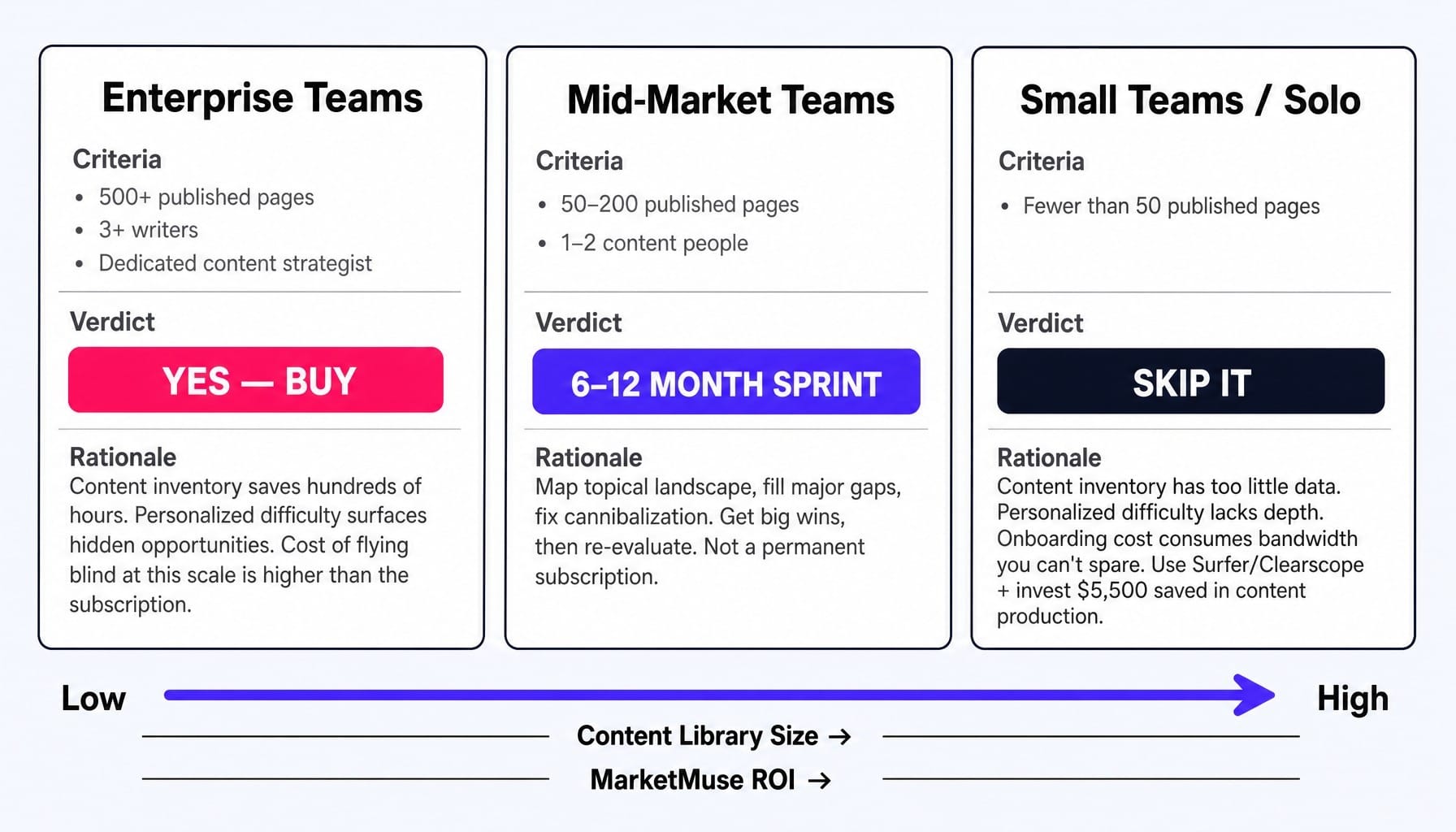
"Is MarketMuse worth it?" is the wrong question. The right question is, "Is MarketMuse worth it for my specific content operation?" Here are three clear profiles with verdicts.
Profile 1: Enterprise Content Teams
- Profile: 500+ published pages, 3+ writers, and a dedicated content strategist.
- Verdict: Yes. For this team, the premium pays for itself in strategic clarity. The content inventory intelligence will save hundreds of hours of manual audit work. The personalized difficulty scoring will surface opportunities the team would otherwise miss. The cost is high, but the cost of flying blind at this scale is higher.
Profile 2: Mid-Market Teams
- Profile: 50–200 published pages and 1–2 content people.
- Verdict: Consider a 6–12 month sprint, not a permanent subscription. Use MarketMuse to map your topical landscape, fill your major gaps, and fix critical cannibalization issues. Get your big wins. After that period, honestly evaluate whether the ongoing cost is justified by the now-incremental recommendations.
Profile 3: Small Teams or Solo Marketers
- Profile: Fewer than 50 published pages.
- Verdict: Skip it. The recommendation is this blunt for a reason. The content inventory features have too little data to be useful. The personalized difficulty scores lack the topical depth to be reliable. And most importantly, the hidden onboarding cost will consume bandwidth you simply cannot spare. Use Surfer SEO or Clearscope for page-level optimization and invest the $5,500 you save in actually producing more content.
MarketMuse vs. Clearscope vs. Surfer SEO vs. Frase: What Each Tool Actually Solves
These four tools are often lumped together, but they are not interchangeable alternatives. They solve different problems at different price points. Choosing the right one depends entirely on what your content operation's primary bottleneck is.
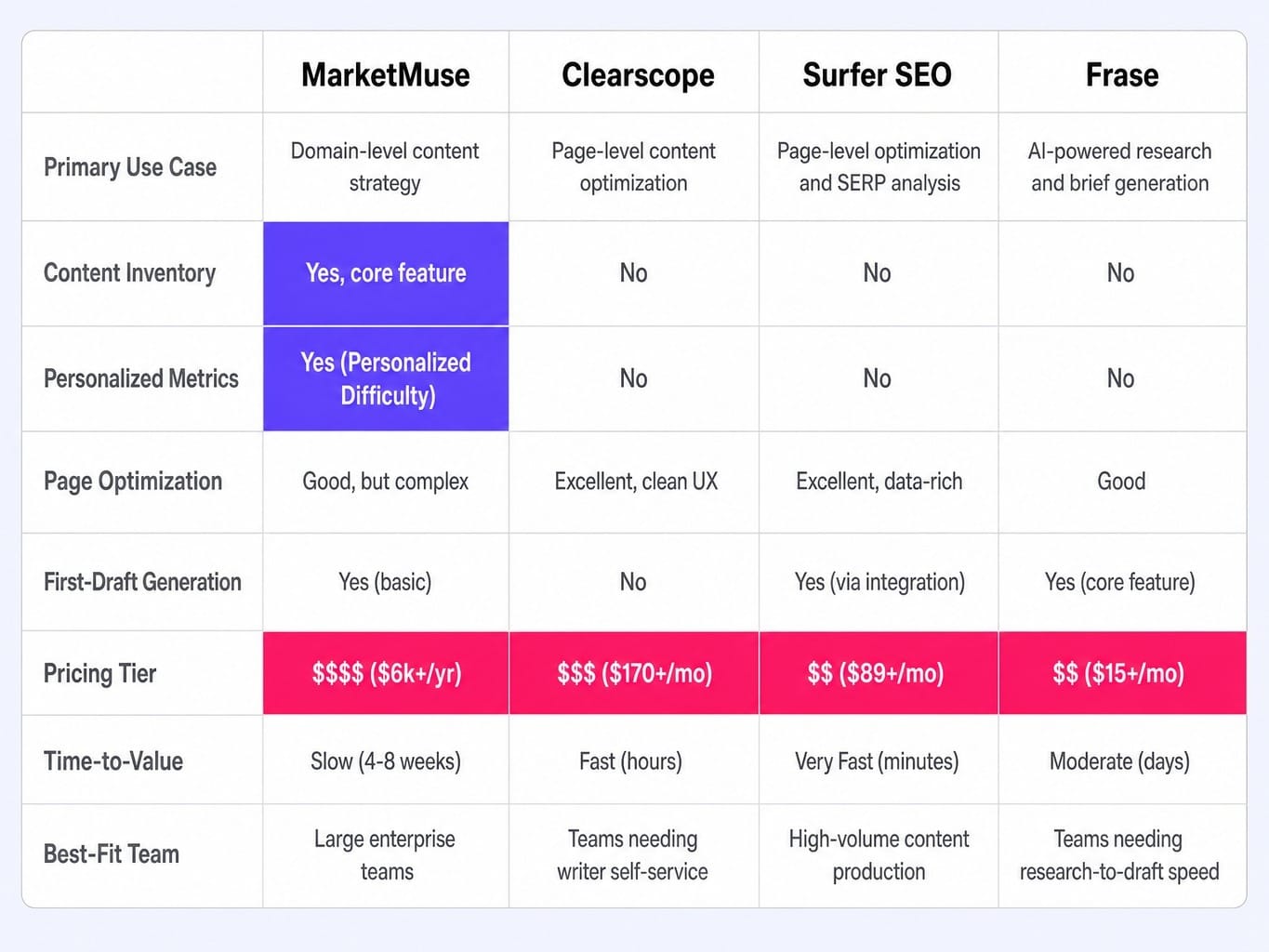
Here's the simple interpretation:
- If your problem is not knowing what to write next, you need MarketMuse.
- If your problem is optimizing what you're already writing, you need Clearscope or Surfer SEO.
- If your problem is the time it takes to research and draft, you need Frase.
For a deeper dive into how these page-level tools compare head-to-head, see our Surfer SEO vs MarketMuse comparison and our breakdown of Frase vs Clearscope.
Read more: Frase vs MarketMuse (2026): An Honest Comparison for Teams That Actually Ship Content
When the Real Problem Isn't Which Tool to Pick—It's Getting Changes Shipped
You've spent this entire article evaluating tools that help you figure out what to optimize. But you've likely recognized a pattern from your own experience: the bottleneck isn't identifying what needs to change, it's actually shipping those changes.
Content audits generate recommendations that die in spreadsheets. Optimization scores highlight content gaps that stay unfixed for weeks because the team is already at capacity. The gap between insight and implementation is the real cost center in marketing, far more than any tool subscription.
This is where the conversation shifts. Instead of adding another intelligence layer that surfaces more recommendations for an already-overloaded team, what if you had a system that identifies the single highest-impact change across your website, SEO, and content—and then executes it?
That's the difference between a tool and an engine. The value isn't in knowing your content score is 38 out of 45. It's in having that gap closed before your next editorial meeting. Spike AI operates downstream from content intelligence, turning diagnosis into deployment. It's the layer that closes the loop, ensuring that good strategy doesn't just get planned; it gets shipped. Every week.
See how Spike AI turns your content backlog into weekly shipped improvements
Is MarketMuse Worth the Investment in 2026?
MarketMuse is a strong, serious content intelligence platform. But its value in 2026 has concentrated. The premium is for its domain-level strategic planning—a feature that remains best-in-class. For page-level optimization, the moat has been breached; cheaper tools and powerful LLMs have closed the gap.
The decision is now clearer than ever. If you manage a large content library and need strategic direction to find your next wave of growth, MarketMuse earns its premium. It provides a map when you're lost in your own content jungle. For everyone else—smaller teams, those needing page-level polish—the ROI math no longer works. The market is splitting into tools that tell you what to do and systems that do the work. The teams that win will be those who stop accumulating recommendations and start shipping changes.
Frequently Asked Questions
How accurate is MarketMuse's content score compared to actual SERP performance?
Content scores correlate with topical comprehensiveness, not directly with rankings. A page scoring 45/50 can still underperform if it lacks backlinks or has poor page experience. Treat the score as a completeness indicator that you've covered the topic thoroughly, not a ranking predictor.
Does MarketMuse work well for non-English content optimization?
MarketMuse's topic modeling is strongest in English. While support for other languages exists, the models are often thinner, making suggestions and personalized scores less reliable. If non-English content is core to your strategy, test the tool on your specific language before committing.
Can I replicate MarketMuse's core workflow with cheaper tools and custom GPT prompts?
You can approximate page-level optimization using Surfer SEO plus ChatGPT for research. What you cannot easily replicate is MarketMuse's content inventory analysis and personalized difficulty score, which require crawling your entire domain. If those are the features you need, there's no cheap substitute.
What MarketMuse pricing tier makes sense for agencies managing multiple clients?
Agencies typically need the Premium or Enterprise tier. The Standard plan's limits on users (1) and queries (100/month) are consumed quickly across multiple clients. At $12,000+/year, the math only works if you're managing clients with substantial content libraries and can pass the cost through in your retainer.
How does MarketMuse handle content cannibalization detection across a large site?
The Connect application identifies pages competing for the same topic clusters and flags them as cannibalization risks. It's one of the tool's strongest features for sites with 200+ pages. However, it only identifies the problem; you still need the editorial judgment to decide whether to merge, redirect, or differentiate the pages.