Optimizely Review 2026: Who It's Actually Built For (And Who Should Skip It)

TL;DR
- Verdict: Optimizely is the best enterprise experimentation platform, but it's only worth the ~$36K+ annual cost if you have 250K+ monthly visitors and a dedicated experimentation team.
- Two Platforms in One: Marketing teams using the visual editor have a vastly different (and often more frustrating) experience than engineering teams using the powerful server-side SDKs and feature flags.
- Hidden Costs: The sticker price is just the start. MAU-based overages can spike your bill unpredictably, and implementation can add 15-30% to your first-year cost.
- Key Drawback: The platform assumes you have a mature experimentation culture. Without a hypothesis backlog and a testing cadence, it becomes a very expensive, unused gym membership.
- Better Alternatives for Most: Mid-market marketing teams get more value from VWO or AB Tasty. Engineering-led teams should evaluate Statsig or LaunchDarkly before committing to Optimizely's DXP ecosystem.
Here's a scenario we've seen play out a dozen times. A four-person B2B marketing team, under pressure to improve the pipeline, sits through an impressive Optimizely demo. They sign the $50,000 first-year contract. Six months later, they've run exactly two A/B tests. Both were declared inconclusive due to insufficient traffic. The platform is collecting digital dust, a monument to good intentions and a budget mismatch. The capability is undeniable; the team just wasn't ready for it.
This is the central tension of any honest Optimizely review. The platform is arguably the most powerful experimentation suite on the market. But capability without organizational readiness is an expensive shelf decoration.
This review evaluates Optimizely not just on what it can do, but on the specific conditions required for it to deliver real value. We'll cover the quick verdict, what the platform actually is in 2026, the two very different experiences it offers, the real pros and cons, the pricing reality, and exactly who should walk away. Because the question isn't just "Is Optimizely good?"—it's "Is Optimizely good for you?"
Quick Verdict: Is Optimizely Worth It?
Optimizely is the strongest enterprise experimentation platform available in 2026, but it is only worth the investment if your organization meets three conditions: 250,000+ monthly unique visitors, a dedicated experimentation team of at least three people, and an annual CRO budget exceeding $100,000.
While it holds a strong aggregate rating on G2 (4.2/5 from over 900 reviews), that score masks a deep divide: enterprise users with mature programs rate it highly, while many mid-market teams struggle to justify the cost.
- Worth it if you are an enterprise team running five or more concurrent experiments across web and product, requiring rigorous statistical validation and deep experiment governance features.
- Questionable if you are a mid-market team with 50K–250K monthly visitors who need solid A/B testing but don't require the full Digital Experience Platform (DXP) and its associated complexity.
- Not worth it if you are a lean team with under 50,000 monthly visitors, have no dedicated developer resources for experimentation, or only need to run basic landing page tests.
The rest of this review explains exactly why these thresholds exist.
What Optimizely Actually Is in 2026 (It's Not Just an A/B Testing Tool)
Optimizely is a composable Digital Experience Platform (DXP) that bundles web experimentation, feature experimentation, content management, personalization, commerce, and a customer data platform into a single ecosystem called Optimizely One. This is the first and most critical thing to understand.
Most people searching for an "Optimizely review" are evaluating it as an A/B testing tool. But Optimizely's pricing, contract structure, and sales motion are built around selling you the full DXP. This means you are often buying—and paying for—far more platforms than you need. The ecosystem includes seven distinct products:
- Web Experimentation
- Feature Experimentation
- Content Marketing Platform (CMP)
- Content Management System (CMS)
- Personalization
- Configured Commerce
- Optimizely Data Platform (ODP)
You can technically purchase these modules individually, but the platform's pricing heavily incentivizes bundling. The real power, and the justification for its enterprise cost, emerges from the cross-module integrations. For example, using the ODP to build audiences for personalized experiences in Web Experimentation. A team that only wants A/B testing is paying a DXP tax, inheriting the enterprise onboarding process, contract minimums, and support structure designed for full-suite customers. Evaluating it as a simple testing tool is a category error that leads to overspending.
Read more: SaaS Pricing Strategy That Compounds: Models, Value Metrics, and Governance for 2026
The Two Optimizelys: Marketing Teams vs. Product Engineering Teams
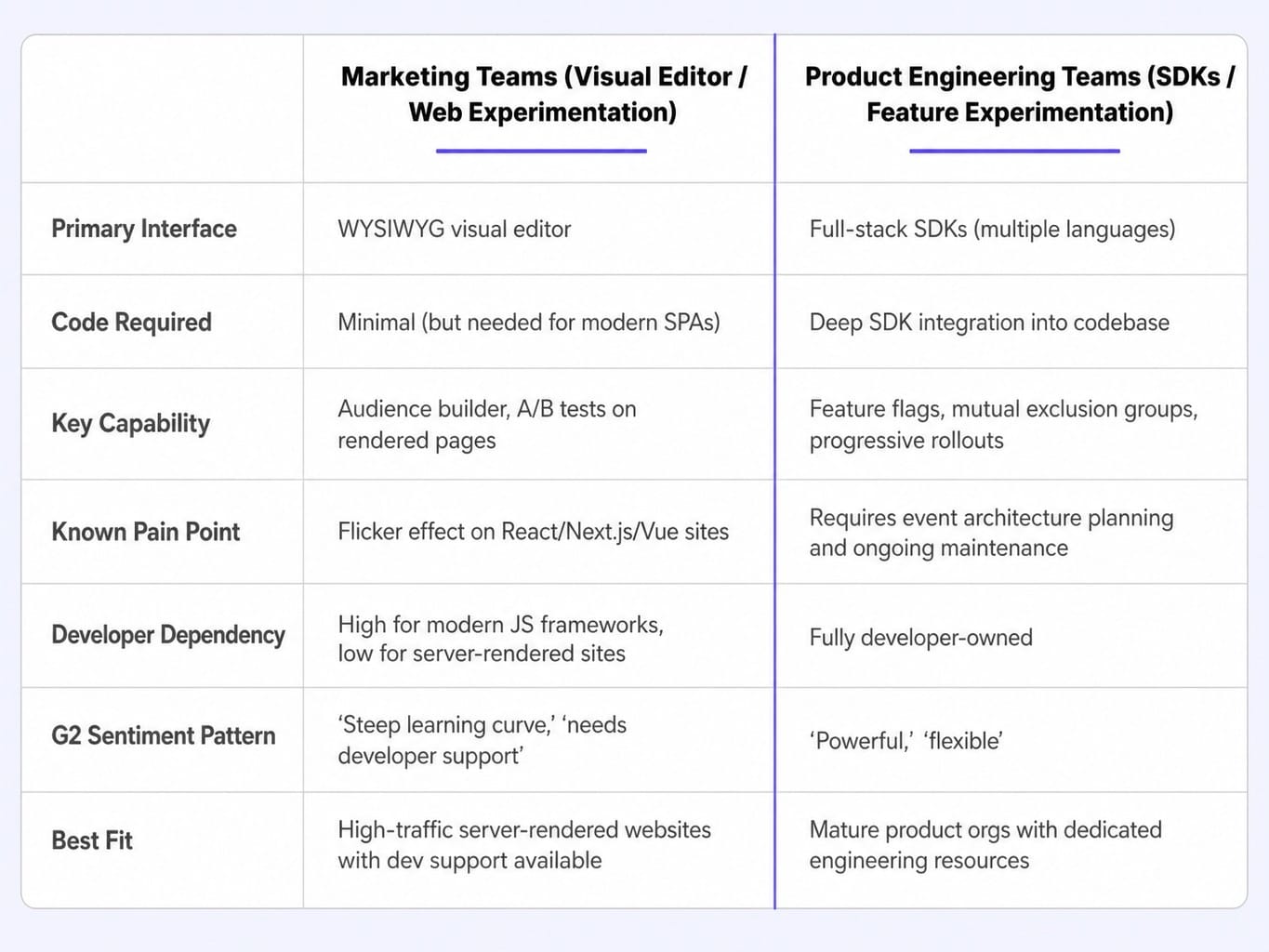
Optimizely serves two fundamentally different user bases on the same platform, and the experience quality diverges dramatically between them. This is why reviews are so polarized. A marketing team using the visual editor has a completely different—and often worse—experience than a product engineering team using the server-side SDKs.
The disagreements you see online about whether Optimizely is "easy to use" or "requires developers" stem from people evaluating different products that happen to share the same brand name. The marketing-facing tool has known limitations that frustrate technical marketers, while the developer-facing tool is praised for its robust architecture.
The critical takeaway for buyers is this: if you are a marketing team without dedicated engineering support, you are getting the weaker half of the platform at the same enterprise price point. A common complaint pattern on G2 confirms this: marketing users cite a "steep learning curve" and "needs developer support," while engineering users praise it as "powerful" and "flexible." Same platform, opposite experiences.
For Marketing Teams: Visual Editor Power and Its Limits
For marketing teams operating on traditional, server-rendered websites with high traffic, Optimizely's Web Experimentation product is genuinely powerful. The WYSIWYG visual editor, audience builder, and stats engine work well in that context. You can build and launch tests without writing code, and the results are trustworthy.
The problem starts the moment your site uses a modern JavaScript framework like React, Next.js, or Vue. The client-side visual editor becomes unreliable. You run into the dreaded "flicker effect," where the original page loads for a split second before the variation appears. You encounter DOM manipulation issues that break your test. The solution involves installing anti-flicker snippets that add page weight and often require developer help anyway. This isn't a bug; it's an architectural constraint of client-side testing. The sales demo might look seamless, but if your site is a modern single-page application (SPA), you will need engineering involvement.
For Product Engineering Teams: Full-Stack SDKs and Feature Flags
This is where Optimizely genuinely earns its enterprise reputation. The Feature Experimentation product is a developer-centric tool that competes directly with platforms like LaunchDarkly and Statsig. It offers:
- Full-stack SDKs for server-side experimentation in multiple languages.
- Feature flags with granular rollout management for progressive delivery.
- Mutual exclusion groups to prevent concurrent experiments from colliding and corrupting data.
- A flag delivery network that minimizes latency.
These are serious capabilities for mature product development organizations. But here's the catch: this is a developer tool. It requires careful event architecture planning, deep SDK integration into your codebase, and ongoing engineering maintenance. If your "experimentation team" is two marketers and a designer, Feature Experimentation is not for you. While its advantage is having both marketing and product testing under one roof, that only matters if you actually have the teams to use both.
What Optimizely Does Well: 5 Genuine Strengths
Optimizely's strengths are real, but they're specific. They matter most to teams with the scale and infrastructure to leverage them.
- A Superior Stats Engine. Optimizely's sequential testing model lets you analyze and call tests at any point without inflating false positive rates. This is a genuine statistical advantage over the fixed-horizon frequentist approach used by VWO and AB Tasty, where "peeking" at results is a statistical sin. For teams running 10+ tests at once, this means higher experiment velocity.
- Enterprise-Grade Experiment Governance. At scale, experiments can interfere with each other. Optimizely provides tools to prevent this, like mutual exclusion groups (to keep two tests from running for the same user) and detailed traffic allocation controls. It also includes a Sample Ratio Mismatch (SRM) check on every results page, a critical safeguard that simpler tools often lack.
- True Cross-Platform Experimentation. For companies with both a website and a mobile app, Optimizely provides a unified platform to run coordinated experiments across web, mobile (iOS/Android), and server-side environments. This helps solve the "experiment fragmentation" problem where different teams are testing in silos. This is a feature only large, multi-platform businesses can truly appreciate.
- Deep Personalization Capabilities. The audience builder segmentation logic is a significant strength. It allows you to move beyond basic demographic targeting (e.g., location, device) into rich behavioral and contextual signals, especially when integrated with the Optimizely Data Platform. This is for teams that have graduated from A/B testing to 1:1 personalization.
- Robust Ecosystem Integration. The platform offers reliable, native connections to essential tools in the modern data stack, including Google Analytics 4, Amplitude, and Segment. This allows for deeper post-experiment analysis, helping teams understand the downstream impact of a winning variation on long-term user behavior.
Where Optimizely Falls Short: 4 Real Drawbacks
Optimizely's drawbacks are not minor inconveniences; they are structural characteristics that can make or break its value for your team.
- Pricing Opacity and MAU-Based Cost Escalation. Optimizely's pricing is quote-based and starts at around $36,000 per year for a single product. The real issue is that it scales with Monthly Active Users (MAUs). A successful product launch or marketing campaign that doubles your traffic can trigger thousands in overage fees, even if that new traffic isn't part of your testing program. Teams on Reddit consistently report that the pricing scales much faster than the value they receive.
- Implementation Complexity and Time-to-First-Test. This is not a tool you can sign up for on Monday and run a test with on Tuesday. A realistic implementation timeline is 4-8 weeks for Web Experimentation and can stretch to 8-12 weeks for Feature Experimentation with SDK integration. We've seen teams that expected to be testing in a week spend their first six weeks just on event architecture planning and QA.
- The Experimentation Culture Prerequisite. The platform is a powerful engine, but it doesn't come with a driver or a map. It assumes you already have a mature experimentation program: a prioritized hypothesis backlog, a consistent testing cadence, and a process for analyzing and acting on results. Without this cultural foundation, it becomes the proverbial "gym membership you never use."
- Contract Lock-in and Poor Data Portability. Expect annual contracts with auto-renewal clauses. More importantly, getting your data out is difficult. While you can export results, historical experiment configurations and variation code are not easily portable. This creates significant vendor lock-in, as migrating to a new platform often means losing your institutional knowledge.
Who Should Not Buy Optimizely (The Disqualifying Conditions)
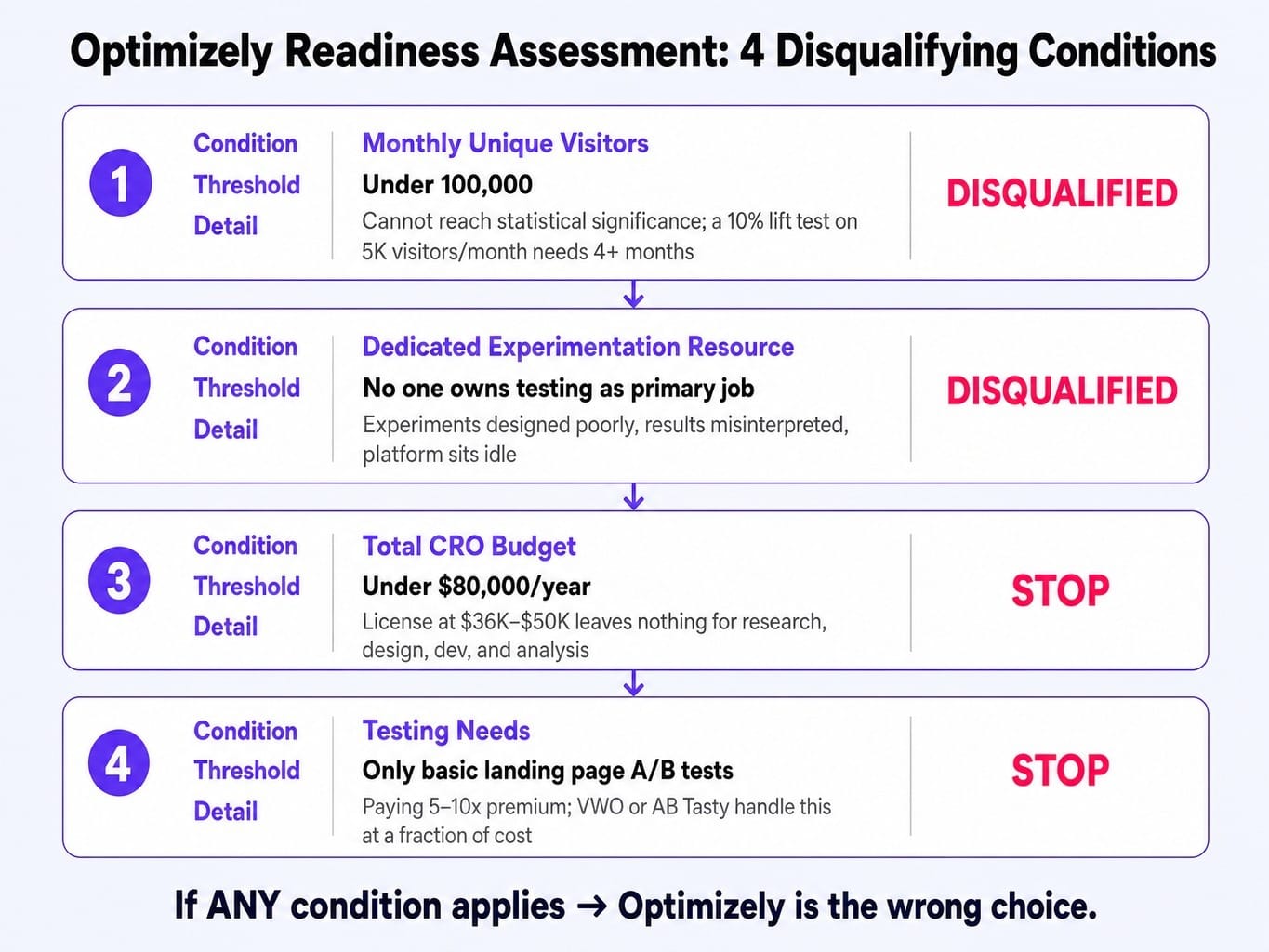
Optimizely is the wrong choice—not just suboptimal, but actively wasteful—under these specific conditions. If any of these describe your team, you should walk away.
- You Have Under 100,000 Monthly Unique Visitors. You simply cannot reach statistical significance on meaningful tests in a reasonable timeframe. A test to detect a 10% lift on a page with 5,000 monthly visitors needs over four months to conclude. At that velocity, the tool's cost is impossible to justify.
- You Have No Dedicated Experimentation Resource. If no one on your team owns the testing program as their primary job, experiments will be designed poorly, results will be misinterpreted, and the platform will sit idle. "We'll all chip in" is a recipe for failure.
- Your Total CRO Budget is Under $80,000. When the license for a single module costs $36K-$50K, you have almost nothing left for the research, design, development, and analysis that make experimentation actually work. The tool is not the program.
- You Only Need Basic Landing Page A/B Tests. If your primary goal is to test headlines and CTAs on marketing pages, you are paying a 5-10x premium for Optimizely. Tools like VWO, AB Tasty, or their peers handle this core use case for a fraction of the cost.
What If You Need CRO Results Without the Enterprise Platform Tax?
The analysis so far creates a clear tension. Optimizely delivers real value, but only for teams that have crossed a high threshold of traffic, budget, and headcount. Most B2B marketing teams—especially lean 1-to-5-person teams—fall below that line. They feel the pressure to improve conversion rates but can't justify an enterprise experimentation platform and the internal program it requires.
This is the exact execution gap Spike AI is built to close.
Spike AI isn't an Optimizely alternative; it addresses a different problem. For teams below Optimizely's readiness threshold, the bottleneck isn't the testing tool—it's the gap between knowing what to fix and actually shipping the fix. Instead of paying $50,000 a year for a platform that requires a team to operate, Spike AI acts as your execution engine.
Every week, Spike AI identifies the highest-impact move across your website, SEO, and ads—then deploys it. It's a system that delivers CRO outcomes directly, without requiring you to build an experimentation program, hire specialists, or integrate SDKs. The result is a continuous cadence of improvements that compound over time.
See how Spike AI ships weekly CRO improvements without the enterprise overhead
Optimizely vs. VWO vs. LaunchDarkly vs. Statsig: Which One Fits Your Team
The right experimentation platform depends on three variables: your traffic volume, your team composition, and whether you need marketing-side testing, product-side feature management, or both.
Here are the conditional verdicts:
- Choose Optimizely if you need both marketing experimentation and product feature management under one roof and have the budget and team to support its complexity.
- Choose VWO if you are a marketing team that wants a suite of SaaS marketing tools (testing, heatmaps, recordings) without the enterprise overhead. A 3-person marketing team with 80K monthly visitors will get more value from VWO at $15K/year than from Optimizely at $50K/year—because they'll actually use it.
- Choose Statsig or LaunchDarkly if your engineering team owns experimentation and you prioritize warehouse-native architecture or best-in-class feature flagging.
Conclusion: Misapplied, Not Overrated
Optimizely is not overrated; it's misapplied. The platform is genuinely best-in-class for enterprise-scale experimentation. Its statistical engine is superior, its governance features are necessary for large programs, and its DXP vision is coherent. But "best-in-class" is a meaningless label if your organization doesn't have the traffic, team, and budget to operate it at the level it demands.
The most important takeaway from this review is to turn the lens inward. Before you evaluate any experimentation platform, first evaluate your own experimentation readiness. Be brutally honest about your traffic volume, your potential testing velocity, and whether you have someone whose primary job it is to run the program. If those foundations aren't in place, no tool—no matter how powerful—will fix your conversion rates.
Read more: How to Structure a B2B SaaS Marketing Team That Actually Ships: A Stage-by-Stage Framework
Frequently Asked Questions
How does Optimizely's stats engine differ from traditional frequentist A/B testing?
Optimizely uses a sequential testing model that allows you to check results at any point without inflating false positive rates. This is unlike frequentist tests (used by VWO, Google Optimize), which require a predetermined sample size before you can look. This can speed up winning tests, but its "significance" is not directly comparable to a frequentist 95% confidence interval.
Can I buy just Optimizely Web Experimentation without the full DXP?
Yes, you can purchase modules individually. However, Optimizely's sales process and pricing incentivize bundling. A standalone Web Experimentation license starts around $36,000/year, and you'll still face the same enterprise sales cycle, implementation process, and annual contract structure as a full-platform buyer. The "platform tax" remains.
What happens to my experiment data if I cancel my Optimizely contract?
Optimizely offers limited data export. You can get results and event data, but historical experiment configurations, audience definitions, and variation code are not easily portable. Plan for a 60–90 day migration window before your contract ends and document your experiment setups externally, as many teams report losing institutional knowledge during a migration.
Does Optimizely offer AI-powered experiment recommendations in 2026?
Optimizely has introduced Opal, its AI assistant, for some content generation and optimization suggestions. However, as of 2026, it does not autonomously identify what to test, generate hypotheses from your data, or prioritize experiments by projected revenue impact. It is an AI layer on top of the existing workflow, not a replacement for experimentation strategy.
How long does a realistic Optimizely implementation take from contract signing to first test?
For Web Experimentation on a standard site, budget 2–4 weeks for snippet installation, QA, and training. For Feature Experimentation with SDK integration, plan for 6–12 weeks, depending on codebase complexity and engineering availability. Teams expecting to test within days of signing are consistently disappointed; budget at least one month of setup before your first meaningful experiment.