
Pipeline Marketing in 2026: Strategy, Metrics, and Why Most Teams Regress to Lead Gen
TLDR
- Pipeline marketing measures success by revenue contribution, not lead volume. The goal is to generate qualified pipeline that closes, not just MQLs that sit in a CRM.
- Focus on three core metrics: Pipeline Velocity (how fast deals move), Pipeline Coverage Ratio (if you have enough pipe to hit quota, targeting 3x-4x), and Marketing-Sourced Pipeline (your direct contribution to revenue).
- Pipeline decay—opportunities that stall in the funnel—silently kills forecasts. Actively monitor stage duration and recycle stale deals to maintain an accurate view of your pipeline health.
- Shifting from MQLs to pipeline reporting is a political challenge, not just a technical one. Run both reporting models in parallel for a quarter to manage the transition and prove the value of the new model.
- The primary failure point of pipeline marketing isn't the strategy; it's the operational cost of manually maintaining visibility and acting on insights. Sustainable pipeline marketing requires a system for continuous, prioritized action.
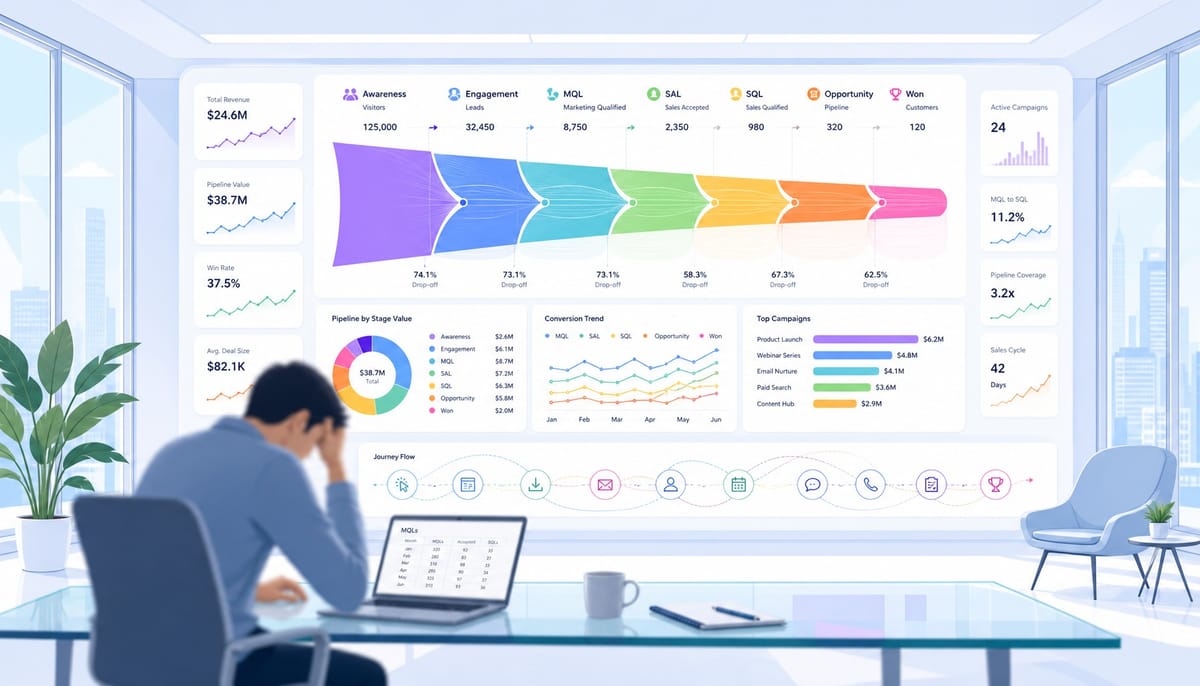
Your B2B SaaS marketing team did everything right. You read the articles, bought into the philosophy, and made the switch to pipeline marketing. The new dashboard was beautiful, tracking marketing-sourced pipeline and stage conversion rates. For six weeks, you ran the model, holding weekly pipeline reviews and feeling closer to revenue than ever before.
Then, reality hit. The attribution needed constant manual adjustment. The pipeline reviews became arguments over data hygiene. Nobody had the bandwidth to act on the insights the dashboard surfaced. Slowly, quietly, the weekly pipeline report was replaced by the old MQL slide. The team had regressed.
This isn't a hypothetical. It's the lived experience of most lean marketing teams. Pipeline marketing is the correct model for revenue-accountable growth, but it demands an operational cadence that most teams cannot sustain manually. The problem isn't strategic—everyone understands that pipeline is better than leads. The problem is that pipeline marketing requires continuous prioritization and action across every funnel stage, and that operational cost is what kills adoption.
This guide covers the framework, the metrics that actually matter, the failure modes that cause regression, and what it takes to make pipeline marketing stick.
What Is Pipeline Marketing?
Pipeline marketing is a revenue-focused B2B framework that measures marketing success by its contribution to qualified pipeline and closed revenue—not by lead volume, traffic, or MQL counts. It's not just "full-funnel tracking." It is an operational commitment to making every marketing decision based on its downstream impact on pipeline velocity and deal progression, which means marketing owns accountability for pipeline creation, not just lead handoff.
Unlike lead generation, which ends at form fills and MQL thresholds, pipeline marketing tracks whether those leads actually progress through sales stages and contribute to revenue. It reframes marketing's job from filling the top of the funnel to influencing its entire length.
Pipeline Marketing vs. Lead Generation: Why the Distinction Matters
B2B SaaS lead generation optimizes for volume at the top of the funnel—form fills, downloads, webinar registrations. Pipeline marketing optimizes for revenue contribution across every stage, from first touch to closed-won. When marketing teams report on MQLs but sales evaluates them on pipeline sourced, the two functions are measuring different things, and the misalignment is where growth stalls.
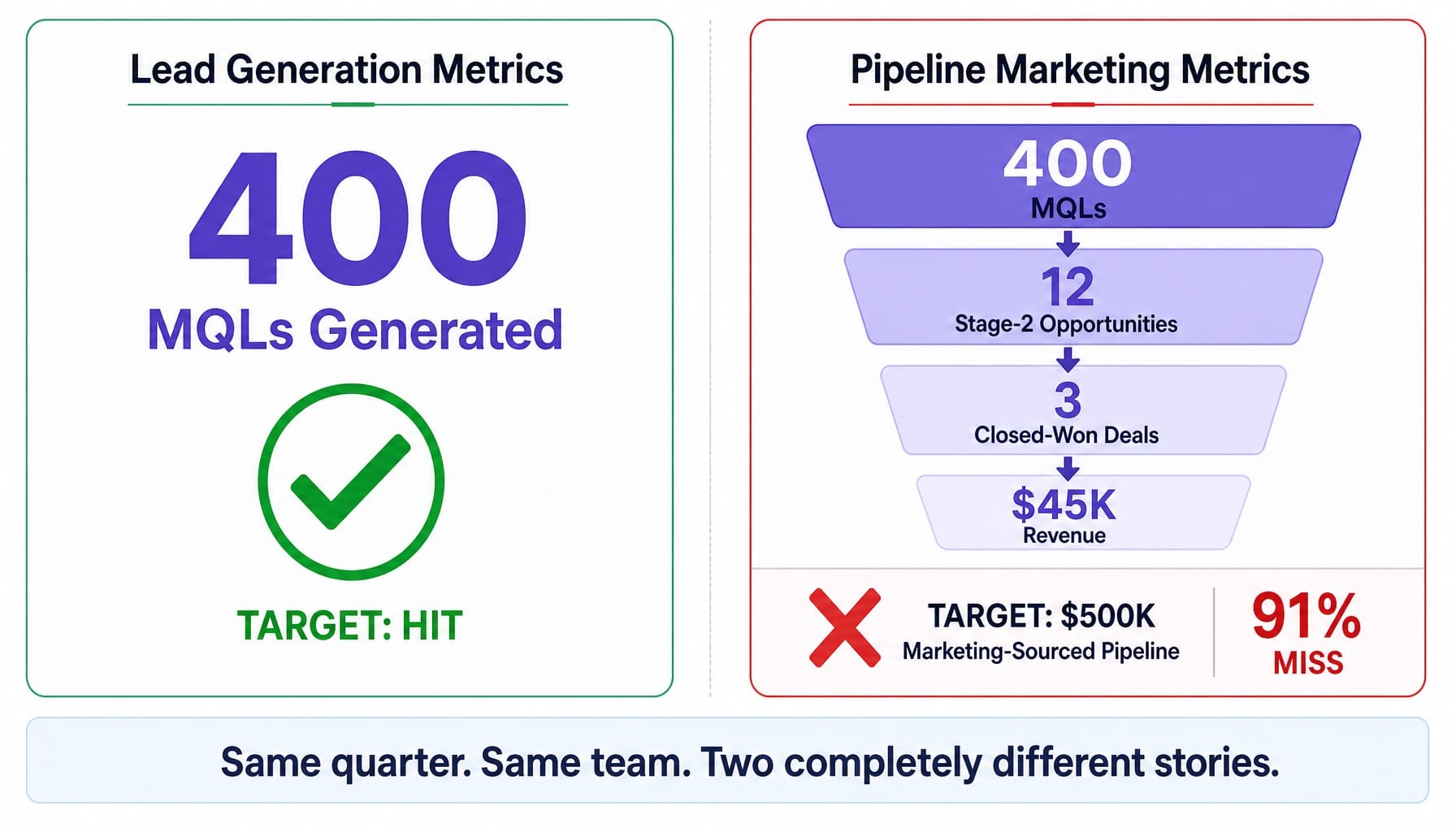
Consider this common scenario: a demand gen team celebrates generating 400 MQLs in a quarter. The team hit its number. But downstream, only 12 of those MQLs became stage-2 opportunities, and only three closed, contributing $45K in revenue against a $500K marketing-sourced pipeline target.
Under lead gen metrics, marketing succeeded. Under pipeline metrics, marketing delivered a 91% miss. This isn't a philosophical distinction; it changes what you optimize for daily. The average B2B website conversion rate still hovers around 2%, meaning the vast majority of "leads" never become pipeline. A pipeline marketing model forces you to ignore the 388 MQLs that went nowhere and triple down on whatever created the three deals that did. It shifts budget from what's popular to what's profitable, a decision the pipe-to-spend ratio makes brutally clear.
Read more: Data-Driven CRO Strategies: Identifying Marketing Opportunities for True Conversion Optimization
The 7 Stages of a Pipeline Marketing Framework
A healthy pipeline marketing framework maps every phase of the customer journey, ensuring marketing's influence and measurement extend beyond the initial handoff to sales. While every business is different, the core progression can be broken down into seven stages.
- Prospecting & Awareness: This is the work of identifying and reaching ideal customer profile (ICP) accounts through content, paid media, and outbound before they formally enter your funnel.
- Lead Qualification: This stage involves scoring and routing inbound signals to distinguish high-intent buyers from background noise, using a mix of behavioral data (e.g., pricing page visits) and firmographic criteria.
- Engagement & Nurturing: Here, multi-touch sequences move qualified leads toward a buying conversation. The goal is deal progression, not just "staying warm" with a monthly newsletter.
- Opportunity Creation: This is the critical handoff moment where a marketing-qualified opportunity (MQO) becomes a sales-accepted opportunity (SAO) with a defined deal value and timeline.
- Proposal & Negotiation: Marketing's role doesn't end at the handoff. Pipeline marketing tracks whether marketing-sourced deals convert at the same rate as sales-sourced deals, surfacing potential gaps in lead quality or sales enablement.
- Closing: This stage involves the attribution of closed-won revenue back to the originating marketing activities, ideally using multi-touch models that distribute credit across the entire buyer journey.
- Retention & Advocacy: The pipeline doesn't end when a deal is won. This final stage covers the post-sale pipeline: expansion revenue, cross-sells, referrals, and customer marketing as a source of new pipe.
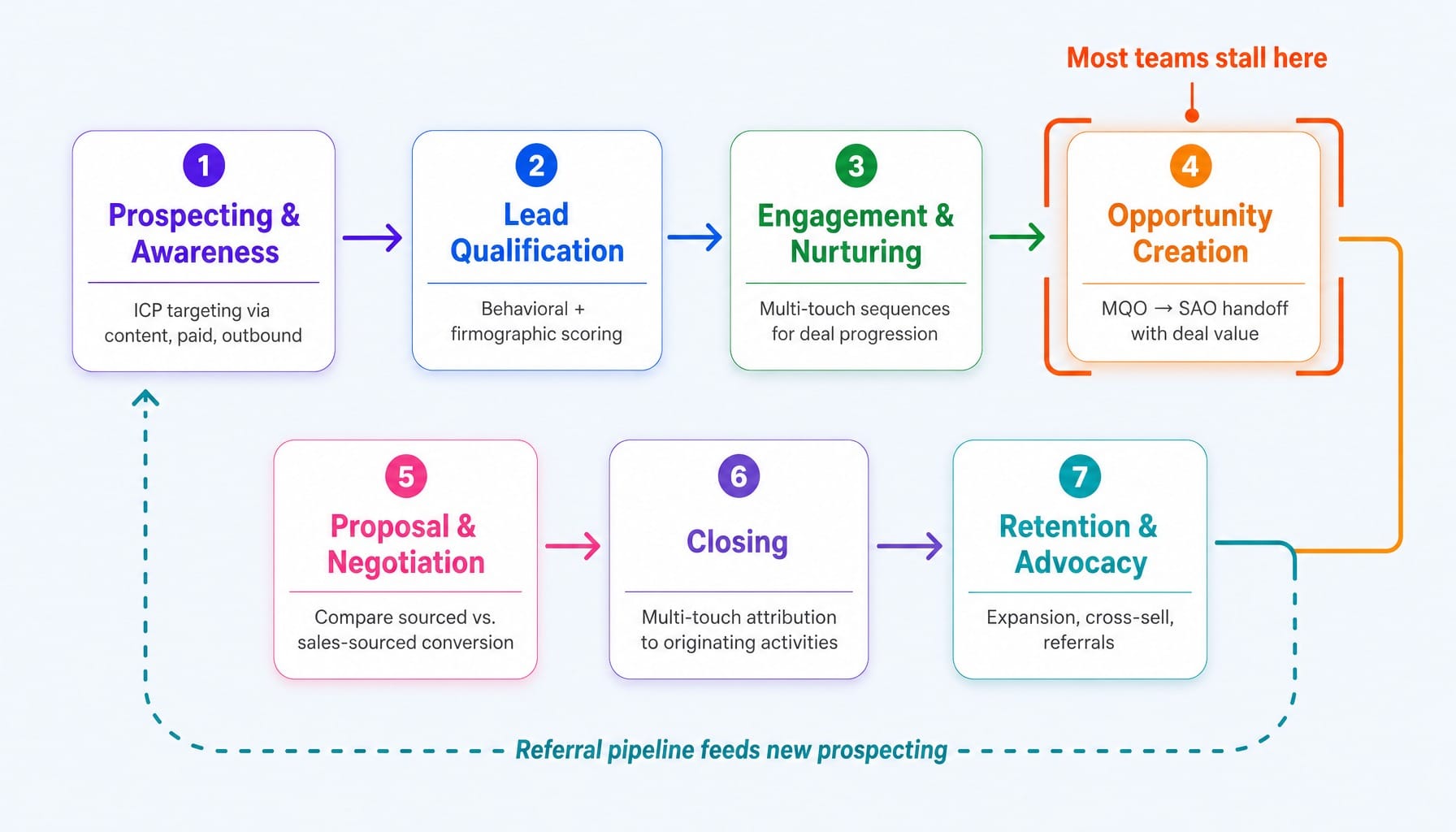
Most teams stall at stage 4. They are proficient at tracking leads and even opportunities, but they lose visibility into whether that marketing-sourced pipe actually closes at competitive rates and in a predictable timeframe. This is the gray area where pipeline decay begins.
Pipeline Marketing Metrics That Actually Drive Decisions
Most pipeline marketing implementations track too many metrics and act on none of them. The goal isn't to build a dashboard with twelve charts; it's to isolate the few indicators that signal whether the system is working. If you can only look at three numbers in your weekly pipeline review, these are the three.
Pipeline Velocity and Why It Beats Volume
Pipeline velocity measures the speed at which opportunities move through your funnel to become revenue. It's the single metric that captures whether your pipeline is actually moving or just accumulating.
The formula is:
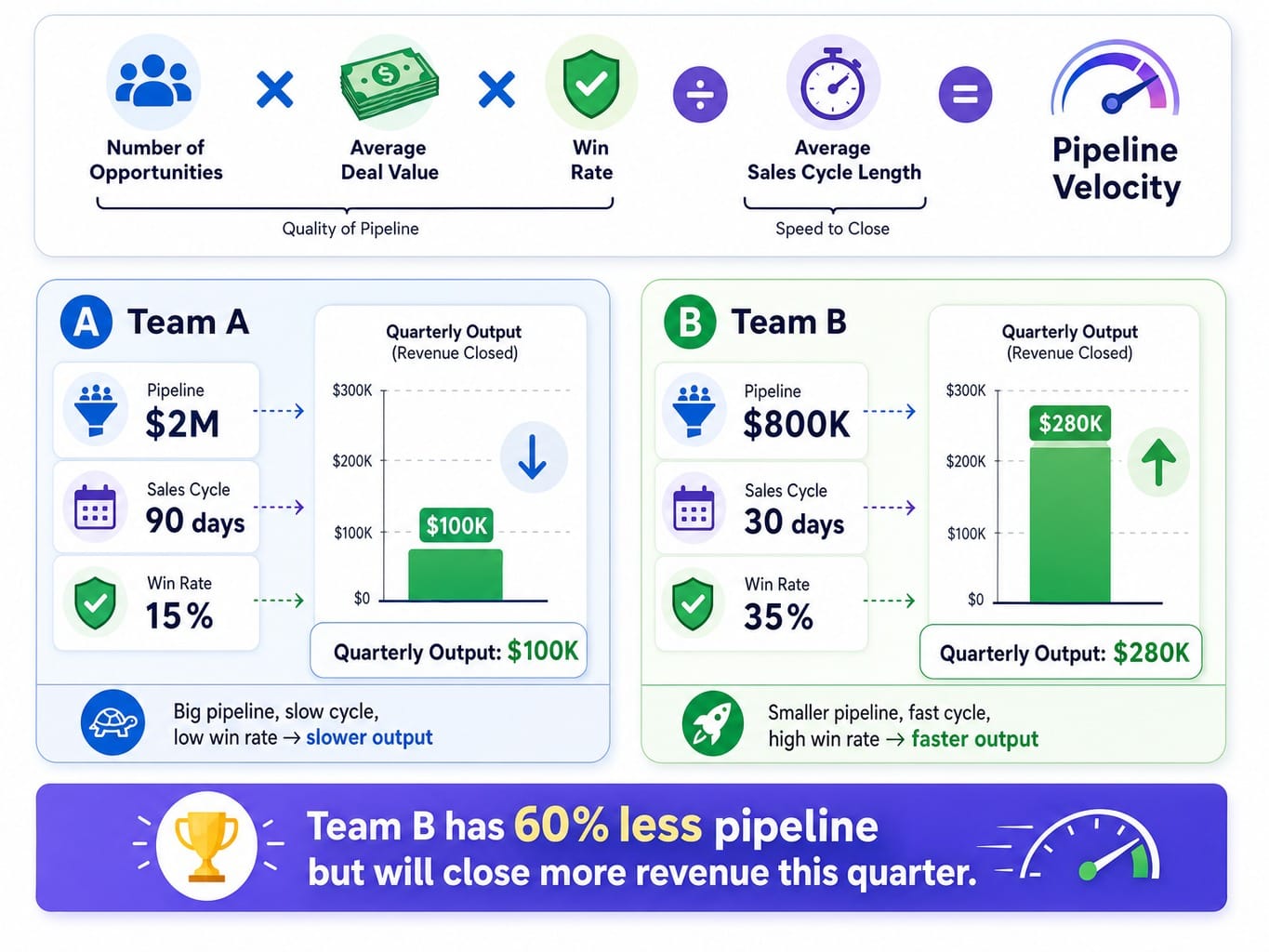
(Number of Opportunities × Average Deal Value × Win Rate) / Average Sales Cycle Length
Consider two teams. Team A has $2M in pipeline, but a 90-day sales cycle and a 15% win rate. Team B has only $800K in pipeline, but a 30-day cycle and a 35% win rate. Team B will close more revenue this quarter. A large pipeline with low velocity is a forecasting illusion, a vanity metric that masks deep-seated problems in deal progression. Tools like Clari and HockeyStack are designed to surface velocity, but even a simple spreadsheet can reveal whether your "big" pipeline is an asset or a liability.
Pipeline Coverage Ratio: The Metric That Prevents Quarterly Panic
Pipeline coverage ratio is your total qualified pipeline divided by your quota target. It's the most honest indicator of whether you can hit your number. For predictable revenue, most B2B organizations target 3x coverage for commit-level confidence and 4x for a best-case scenario.
This metric matters more than raw pipe gen. You can create $5M in new pipeline and still miss your quarterly target if 60% of it is early-stage and won't close in time. The calculation must be done on ACV-weighted pipe, not just a raw count of deals. A team that starts the quarter with 2x coverage and misses their number by 40% didn't have a sales problem; they had a math problem that was visible on day one.
Pipeline Decay: The Silent Killer of Forecast Accuracy
Imagine this: your VP of Marketing reports $3.2M in marketing-influenced pipeline at the start of Q3. The team is celebrating a healthy 3.2x coverage ratio. But by week eight, a closer look reveals that $1.1M of that pipeline has been sitting in stage 2 for over 60 days with zero activity—no calls logged, no emails opened, no next steps scheduled.
That $1.1M is a dead pipe. It's not real. The forecast says the team is at 3.2x coverage; the reality is 2.1x, and it's too late to generate enough new pipe to close the gap.
This is pipeline decay: opportunities that age past their expected stage duration without progressing, inflating pipeline numbers while contributing zero actual revenue probability. It's the silent killer of forecast accuracy, and it's caused by three things:
- Poor pipeline hygiene: No one is regularly scrubbing stale deals from the CRM.
- Misaligned handoffs: Marketing passes leads that sales never works, leaving them to rot.
- Lack of automated alerts: No system flags deals that have exceeded their expected time-in-stage.
A practical rule of thumb: any opportunity that exceeds 1.5x the average stage duration without a logged activity should be automatically flagged for review or recycled back to marketing. In organizations without regular pipeline scrubbing cadences, it's not uncommon for pipeline decay to account for 20-35% of the total reported pipeline. Tools like Salesforce Sales Cloud or Clari can help automate this detection, but the discipline must be cultural.
How to Shift from MQL Reporting to Pipeline-Based Reporting
The biggest obstacle to adopting pipeline marketing is not technical; it's political. Marketing teams that have built their credibility, headcount justifications, and bonus structures around MQL volume are hesitant to switch. Shifting to pipeline-based reporting means marketing's numbers will almost certainly look worse before they look better, because pipeline contribution is a harder, slower metric to move.
Acknowledging this is the first step. The transition isn't a dashboard swap; it's a two-quarter organizational change management project.
Here's the sequence that works:
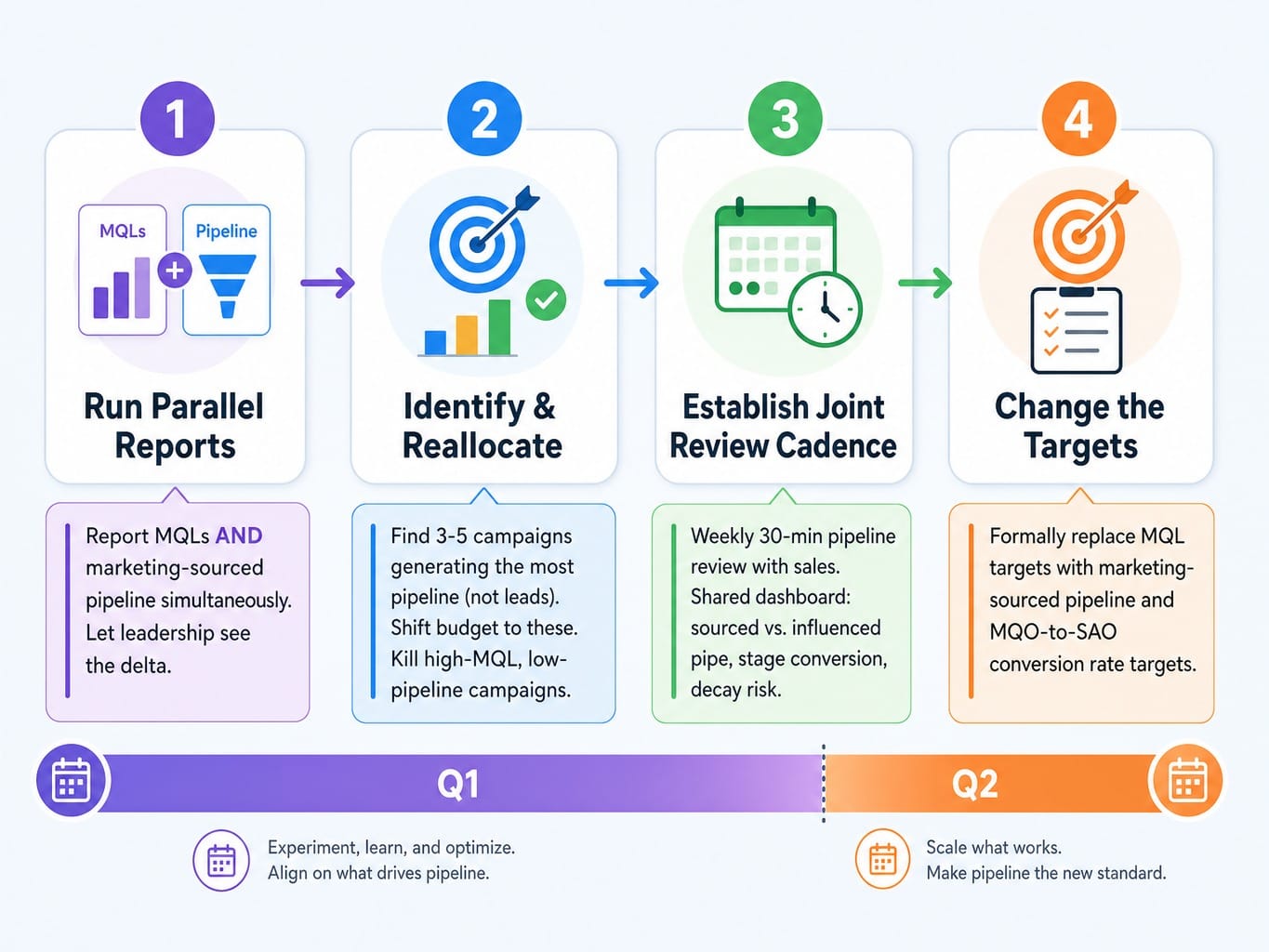
- Run parallel reports for one quarter. Continue to report on MQLs while you also report on marketing-sourced pipeline. This allows leadership to see the delta without marketing losing its existing narrative overnight.
- Identify and reallocate. Use the new pipeline data to find the 3-5 campaigns that generate the most pipeline, not the most leads. Shift budget toward these high-performers, even if it means killing a high-MQL campaign. This is your first proof point.
- Establish a shared review cadence. Institute a weekly 30-minute pipeline review with sales leadership where both teams look at the same dashboard—sourced vs. influenced pipe, stage conversion rates, and deals at risk of decay.
- Change the targets. In the second quarter, formally replace MQL targets with targets for marketing-sourced pipeline and MQO-to-SAO conversion rates.
A marketing leader who ran parallel reporting discovered their highest-MQL campaign (a gated eBook) had generated zero stage-2 pipeline, while their lowest-MQL campaign (a targeted webinar for 50 people) sourced 40% of the quarter's closed-won revenue. Without the pipeline data, they would have kept funding the failure and starved the winner. If you aren't willing to potentially look worse for one quarter to get to the truth, you aren't ready for pipeline marketing.
Aligning Sales and Marketing Around Pipeline Goals
Sales and marketing alignment in a pipeline marketing model requires three things: a shared definition of a qualified opportunity, a service-level agreement (SLA) on follow-up, and a joint pipeline review cadence. Without these, you have two teams using the same words to mean different things.
First, shared definitions are non-negotiable. Marketing and sales must agree on the exact criteria that turn a lead into an MQO, and an MQO into an SAO. If marketing counts a demo request as pipeline but sales only counts it after a 30-minute discovery call, your numbers will never reconcile.
Second, service-level agreements create accountability. A common SLA is that sales must engage with any marketing-sourced opportunity within four hours of its creation. This prevents high-intent leads from going cold and provides a clear mechanism for tracking sales follow-through.
Finally, joint reviews make alignment real. A weekly 30-minute meeting where both teams look at the same dashboard—using tools like HubSpot or an attribution platform like Dreamdata—transforms the relationship from adversarial to collaborative. When both teams are looking at stage conversion rates and pipeline decay together, the conversation shifts from "your leads are bad" to "how do we fix the conversion drop between stage 2 and 3?"
Read more: Stop Syncing Strategy and Execution: Platforms That Unify Marketing Goals With Task Management
Running a Pipeline Gap Analysis for Quarterly Planning
A pipeline gap analysis compares your current pipeline against your revenue target to identify how much new pipeline you need to create—and from which sources—to hit your number. It's the exercise that grounds your quarterly plan in reality.
Most teams do this once per quarter. The teams that consistently hit their numbers do it weekly. Here's the four-step process:
- Start with the revenue target. What is the board-level number you are on the hook for this quarter? Let's say it's $1M.
- Calculate total pipeline needed. Apply your historical win rate to the target. If your win rate is 25%, you need $4M in total qualified pipeline to hit a $1M target ($1M / 0.25 = $4M).
- Subtract existing qualified pipeline. Look at the ACV-weighted value of your current pipeline, not the raw, unweighted number.
- The delta is your pipeline gap. This is the amount of new pipeline that marketing and sales must collectively generate this quarter to have a shot at the target.
This top-down approach is more honest than bottom-up forecasting, which simply sums up what various campaigns hope to produce. It starts with what the business needs, not what marketing feels it can deliver. It forces a difficult but necessary conversation at the start of the quarter, when there's still time to act.
When Pipeline Marketing Demands More Bandwidth Than Your Team Has
The central tension of pipeline marketing is now clear. It's the right model, holding marketing accountable for revenue. But it requires a level of continuous analysis and action that exceeds the capacity of most lean teams. Monitoring pipeline decay, running weekly gap analyses, optimizing campaigns based on stage progression—this is a full-time job, and you already have one.
This is why so many teams quietly regress to counting MQLs. The operational cost of pipeline marketing is simply too high to sustain manually.
This is the exact execution gap Spike AI was built to close. Where other tools give you another dashboard to monitor, Spike AI provides the operational capacity to act. Every week, Spike AI identifies the highest-impact move across your website, SEO, and ads—the same cross-channel prioritization that pipeline marketing demands—and then executes it.
Instead of a marketing team trying to manually maintain pipeline visibility while also shipping campaigns, Spike AI closes the gap between "we know what needs to change" and "it is changed." Pipeline marketing gives you the model for revenue accountability. Spike AI gives you the shipping cadence to actually run it without burning out your team.
See how Spike AI turns pipeline insights into weekly shipped improvements — book a discovery call.
From Accountability to Action
Pipeline marketing is the only model that truly holds marketing accountable to revenue. But accountability without operational capacity is just a recipe for guilt. The teams that succeed with pipeline marketing aren't the ones with the most sophisticated dashboards; they are the ones that have closed the gap between identifying what needs to change and actually shipping that change, week after week.
If your team tried to implement pipeline marketing and quietly reverted to MQL reporting, the problem was never the framework. It was the shipping cadence. The manual effort required to sustain the model exceeded your team's bandwidth. Fix the cadence, and the framework works. The future of marketing isn't about finding more insights; it's about building the systems to act on the ones you already have.
Frequently Asked Questions
What is the 40-40-20 rule and how does it apply to pipeline marketing?
The 40-40-20 rule states that 40% of campaign success comes from audience targeting, 40% from the offer, and 20% from creative. In pipeline marketing, this reinforces that targeting the right accounts (ICP) and presenting the right value proposition matter far more than ad copy or design polish. This is why account-based marketing and ICP-driven pipeline strategies consistently outperform broad demand generation.
How do you measure marketing-sourced vs. marketing-influenced pipeline?
Marketing-sourced pipeline counts only opportunities where marketing generated the first touch that created the lead. Marketing-influenced pipeline includes any opportunity where marketing touched the account at any point before it closed. Most teams overcount influenced pipeline; using a W-shaped or time-decay attribution model helps weight touches by their actual impact rather than mere presence.
What pipeline coverage ratio should B2B companies target?
Target 3x coverage for commit-level forecasts and 4x for best-case scenarios. These ratios should be calculated on ACV-weighted pipeline, not raw deal count, to accurately reflect deal value. If your coverage is consistently below 3x at the start of a quarter, you have a pipeline generation problem that no amount of sales execution can fix.
How does account-based marketing fit into a pipeline marketing strategy?
ABM is a targeting and engagement layer within a pipeline marketing strategy, not a separate function. Pipeline marketing provides the measurement framework (pipeline sourced, velocity, coverage), while ABM provides the execution model for high-value accounts. The two work together when ABM campaigns are measured by their pipeline contribution, not just account engagement scores.
What is the difference between pipeline marketing and revenue marketing?
Pipeline marketing focuses on creating and accelerating qualified pipeline—the pre-revenue stage. Revenue marketing extends accountability through to closed-won revenue and post-sale expansion and retention. In practice, revenue marketing is pipeline marketing plus customer lifecycle metrics. Most teams should master pipeline marketing before attempting full revenue marketing accountability.
What tools do B2B teams use to track pipeline marketing performance in 2026?
The core stack includes a CRM (like Salesforce or HubSpot) for pipeline tracking, an attribution platform (like HockeyStack or Dreamdata) for multi-touch attribution, a revenue intelligence tool (like Clari or Gong) for deal visibility, and an intent data platform (like 6sense or Demandbase One). The gap most teams hit isn't tooling; it's the bandwidth to act on what the tools surface.