
Reduce Martech Stack Costs: 8 Proven Strategies for 2026 (With Estimated Savings)
TL;DR
- Your martech licenses are only a fraction of your real cost. The hidden "Stack Tax"—integration maintenance, context switching, and data reconciliation—is where the real waste lies.
- Start with the "First 48 Hours" plan: pull your renewal calendar, run a login audit to find zombie licenses, and identify tools that generate recommendations you never ship.
- Attack visible waste by eliminating duplicate functionality, downgrading plans to match actual feature usage, and renegotiating contracts 60-90 days before renewal.
- For deeper savings, consolidate overlapping tools (but watch for the "reverse consolidation trap") and automate the manual bridging workflows between your platforms.
- The most significant, long-term cost reduction comes from structural changes: replacing tools that only recommend with platforms that execute, and adopting a strict "one tool per function" governance discipline.
A marketing team spent Q4 auditing their martech stack. They canceled three unused tools, saving a respectable $28,000 in annual licenses, and declared victory. But by the end of Q1, their total martech-related costs had barely moved.
Why? The license fees they cut were less than 40% of what those tools were actually costing them. The integration maintenance, the manual data reconciliation, the context switching across seven different dashboards, the recommendations that nobody had bandwidth to implement—all that overhead remained.
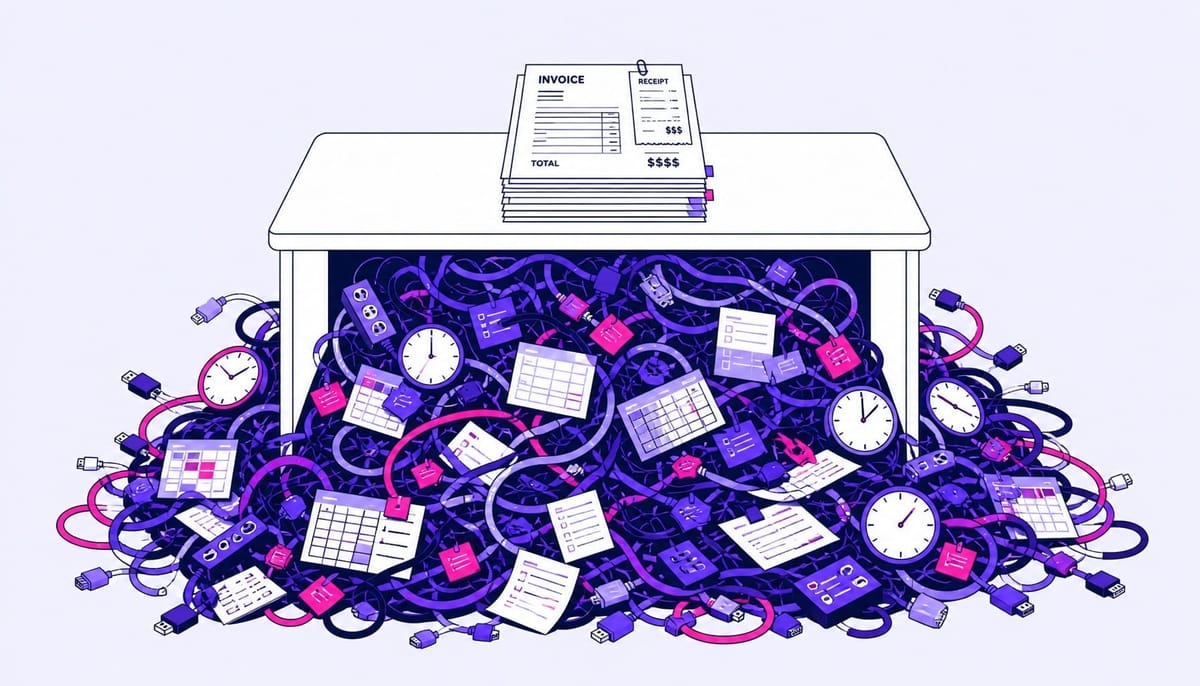
This is the reality of martech spend in 2026. You're paying a hidden tax on every tool in your stack. It's a multiplier that turns a $200,000 budget into a $500,000+ operational burden. In some enterprise environments, this multiplier can be extreme; for every dollar spent on tool licenses, organizations can spend up to 18x more on the people and processes required to operate those tools.
This guide provides eight concrete reduce martech stack costs strategies for 2026, ordered from actions you can take in the next 48 hours to structural changes that reshape your operating model. Each strategy attacks the real source of your spend: the Stack Tax.
The Stack Tax: Why License Fees Are Only a Third of Your Real Martech Cost
Most articles on how to reduce martech stack costs fail because they only address the line item on your P&L. They miss the far larger, invisible cost: the Stack Tax. This is the sum of all the operational overhead your tools generate, and it typically multiplies your license spend by 2-3x.
I once ran a martech audit where the annual license spend across 14 tools was roughly $280K. But when we mapped the hours spent on data reconciliation between their CDP, email platform, and analytics suite, the loaded labor cost of keeping those tools talking to each other exceeded $600K annually. The integration maintenance alone consumed one full-time engineer and 30% of a marketing ops manager's week. That's the Stack Tax in action.
It breaks down into four categories:
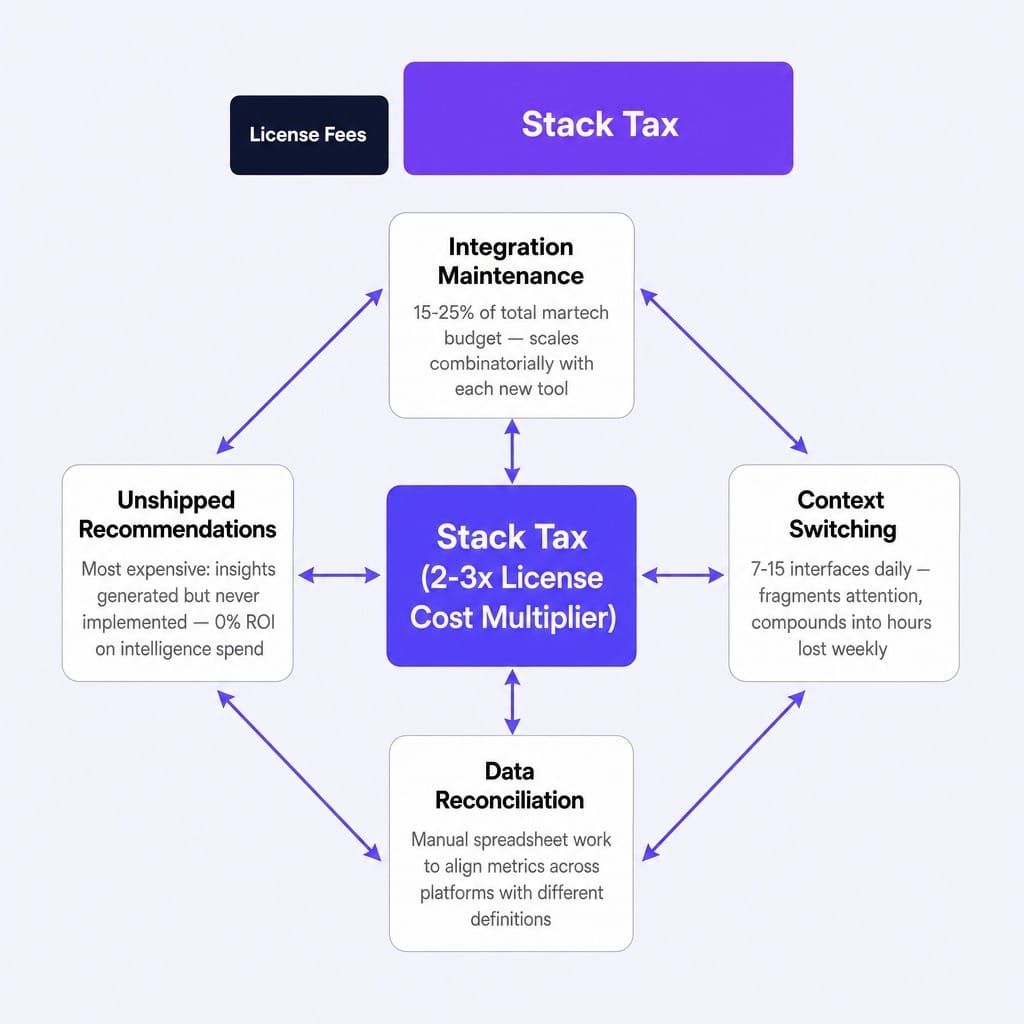
- Integration Maintenance: The engineering and ops hours spent building and fixing connections, managing API call overages, and dealing with broken data flows. It's not a linear cost; it scales combinatorially as each new tool creates potential dependencies with every existing tool. This "integration spaghetti" often consumes 15-25% of the total martech-related budget.
- Context Switching: The cognitive drain and lost productivity from marketers moving between 7 to 15 different interfaces daily. Each switch fragments attention and creates small delays that compound into hours of lost capacity every week.
- Data Reconciliation: The manual work of making numbers agree across platforms that define metrics differently. When your ad platform, analytics suite, and CRM all report different lead counts, someone has to spend hours in spreadsheets finding the truth.
- Unshipped Recommendations: The most expensive hidden cost. Your tools surface insights—SEO fixes, CRO opportunities, personalization ideas—that never get implemented because the team lacks bandwidth. You pay for the intelligence but get zero return, creating a backlog of missed growth.
The strategies that follow don't just cut license fees. They attack the Stack Tax.
The First 48 Hours: 3 Actions to Reduce Stack Costs Without Canceling Anything
Most cost-reduction guides require weeks of auditing. These three actions can be done in an afternoon and will surface immediate savings or prevent imminent cost leakage—without canceling a single subscription. As finance teams increasingly scrutinize every martech line item, proving you have a handle on this is no longer optional.
Action 1: Pull Your Renewal Calendar and Flag Auto-Renewals in the Next 90 Days
Most martech cost leakage happens silently through auto-renewals nobody reviewed.
The action is simple: open your finance system, contract management tool (like Zylo or Productiv), or even just a spreadsheet. Identify every martech contract renewing in the next 90 days. Put a hold on any that haven't been actively evaluated in the last six months. I've seen teams discover a high-value data enrichment contract auto-renewed at a 15% price increase three weeks prior simply because the renewal reminder fell through the cracks. This thirty-minute task prevents that.
Estimated Savings: Preventing one unnecessary auto-renewal of a mid-tier tool typically saves $5,000-$30,000.
Action 2: Run a Login Audit—Who Actually Used Each Tool in the Last 30 Days?
Zombie licenses—seats paid for but unused—are the lowest-hanging fruit in any stack. You can find them today.
Pull login data from your single sign-on (SSO) provider or each tool's admin panel. Identify every user who hasn't logged in within the last 30 days. For those users, immediately downgrade their seat to a free tier or remove them. It's common for a 40-person company to find 11 paid HubSpot seats where users log in less than once a month. At the Professional tier, that's over $6,600 a year in pure seat bloat.
Estimated Savings: $3,000-$15,000 annually for most mid-market teams.
Action 3: Identify Your Top 3 "Recommendation Generators" That Never Ship Anything
The most expensive tools aren't the ones with the highest license fees. They're the ones that generate recommendations your team never implements. This is the "unshipped recommendations" component of the Stack Tax.
List every tool that produces reports, dashboards, or optimization suggestions. Now, be honest: which ones have led to a shipped change in the last quarter? A team paying $24,000/year for an A/B testing platform that has run two tests in six months isn't getting ROI. It's not that the tool is bad; it's that the team lacks a system to execute. This surfaces the real question: do you need a better tool, or do you need a platform that unifies marketing goals with task execution?
Estimated Savings: Identifying and pausing even one tool in this category saves $8,000-$40,000/year.
Quick Wins: Cut Visible Waste in Your Current Stack (Weeks 1–4)
These strategies target the visible cost layer—the license fees and duplicate subscriptions on your P&L. They're easier to execute because they don't require changing how your team works, only what you pay for. But remember, this is only part of the equation. With 44% of marketing SaaS licenses being underutilized or unused, this is a necessary first step.
Eliminate Duplicate Functionality Across Tools
Most stacks contain 2-3 tools that do the same thing, often purchased by different teams at different times. This is shadow martech and SKU sprawl in action.
The fix is a feature overlap analysis. Map every tool to a primary function (e.g., email automation, social scheduling, web analytics). Identify where two or more tools serve the same core purpose. For example, a B2B SaaS company might find they're running Mixpanel for product analytics, Google Analytics 4 for marketing analytics, and have a legacy Amplitude contract still active. Three tools, overlapping work, and no clear owner. Sunsetting two of those can save $18,000-$35,000 a year.
Estimated Savings: $10,000-$50,000/year, depending on stack size.
Downgrade Plans to Match Actual Feature Usage
Teams routinely pay for enterprise tiers when they only use mid-tier features. You were sold on a capability, but your team's day-to-day workflow lives two tiers below. It's important to distinguish between a tool being 'unused' and 'underused.' An underused tool often has one critical workflow running through it that makes removal difficult, but a plan downgrade is almost always possible.
For your top 5 most expensive tools, compare your current plan's feature list against what your team has actually used in the last 90 days. A team on HubSpot Marketing Hub Enterprise ($3,600/month) might realize they don't use predictive lead scoring or multi-touch revenue attribution—the key features that differentiate it from the Professional tier ($800/month). Downgrading saves $33,600 a year on a single tool.
Estimated Savings: $15,000-$60,000/year across a typical mid-market stack.
Read more: SaaS Pricing Strategy Guide 2026: Value Metrics, Hybrid Pricing & AI | Spike AI
Renegotiate Annual Contracts Using Competitive Alternatives as Leverage
Vendors expect you to negotiate. Passive renewals are a gift. The best martech stack cost reduction strategies involve active negotiation.
The tactic: 60-90 days before renewal, research one credible alternative. You don't have to be serious about switching; you just need leverage. Schedule a call with your account manager and present a simple ask: match the competitor's pricing or add value at the current price. This leverages renewal timing asymmetry—vendors are most flexible at their fiscal quarter-end (often Q4) when they're trying to hit quota. A team can renegotiate their Salesforce contract by presenting HubSpot CRM pricing as an alternative, often securing a 15-25% discount. Using a service like Vendr can provide benchmarks on what other companies are paying.
Estimated Savings: 15-35% per contract, or $10,000-$80,000/year.
Medium-Effort Strategies: Consolidate and Automate (Months 1–3)
These strategies require cross-functional coordination and take 1-3 months to implement, but they attack the Stack Tax directly—reducing integration maintenance and data reconciliation costs. This is where martech stack rationalization moves from a procurement exercise to an architectural decision. This is also where most efforts stall, because they require changing workflows.
Consolidate Overlapping Tools But Watch for the Reverse Consolidation Trap
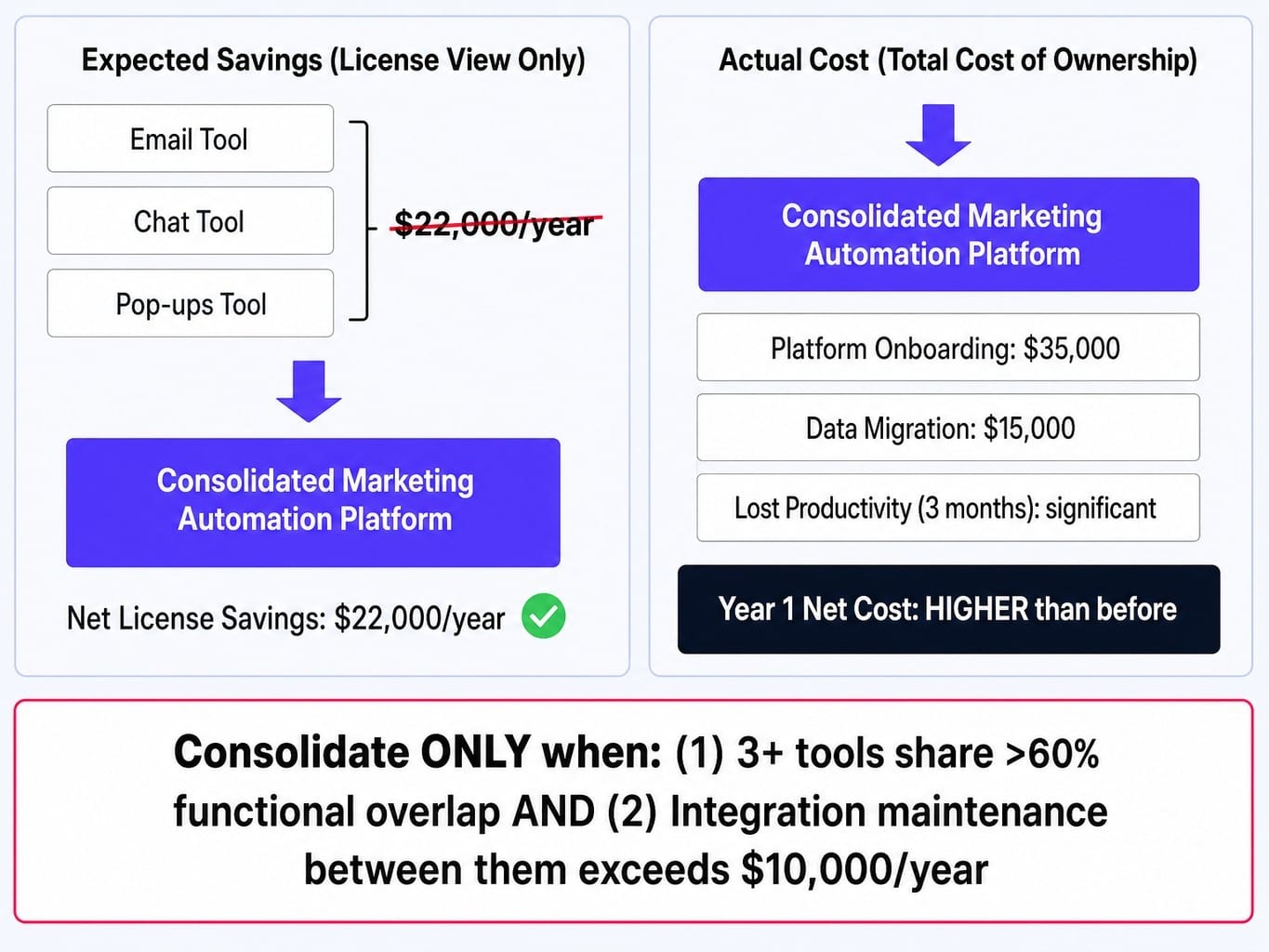
Tool consolidation is the most common advice, but it has a failure mode no one discusses: the reverse consolidation trap. This is when reducing your tool count actually increases your total cost of ownership because the new consolidated platform requires more customization, training, and integration work than the point solutions it replaced.
Consider a team that consolidates from three separate tools for email, chat, and pop-ups into a single marketing automation platform, expecting to save $22,000/year in licenses. They do. But they then spend $35,000 on platform onboarding, $15,000 on data migration, and lose three months of team productivity during the transition. The net cost in year one is higher.
Consolidation saves money only when the new platform genuinely replaces the functionality your team actually uses, and when migration costs are factored in. A good rule of thumb: consolidate when 3+ tools share over 60% functional overlap and the integration maintenance between them exceeds $10,000/year. Sometimes, a composable martech architecture using your data warehouse (with tools like Hightouch or Census) is a cheaper way to connect tools than replacing them.
Estimated Savings (when done right): $20,000-$100,000/year.
Automate Manual Bridging Workflows Between Tools
Before you consolidate tools, audit the manual work happening between them. The weekly CSV exports, the copy-paste data transfers, the "sync meetings" to reconcile numbers. This is human labor acting as a faulty, expensive API.
A RevOps manager spending 6 hours every week manually syncing lead scoring data between Salesforce and their marketing automation platform is a classic example. Replacing this with a Zapier or Make workflow costs $50/month and reclaims over 300 hours of high-value labor per year. Audit every manual data transfer. If a human is the integration layer, that's a prime workflow automation opportunity. For more complex needs, a platform like Workato can handle enterprise-grade logic.
Estimated Savings: $15,000-$50,000/year in recovered labor hours.
Read more: B2B RevOps in 2026: What to Measure, What to Build, and Where Most Teams Stall | Spike AI
Structural Changes: Reshape Your Martech Operating Model (Quarter 2+)
The strategies above reduce what you pay and how much overhead your tools create. These final two change the fundamental relationship between your team and your stack. They are the hardest to implement but deliver the largest sustained savings because they prevent stack debt from returning.
Replace Tools That Recommend With Platforms That Execute
The most expensive category of martech isn't the tools with the highest license fees. It's the tools that generate recommendations your team never implements. These tools create the illusion of optimization while actually inflating the Stack Tax. Every dashboard insight that doesn't become a shipped change is waste.
Picture a B2B SaaS team with an SEO audit tool ($12K/year), a CRO analytics platform ($18K/year), a heatmap tool ($6K/year), and a site speed monitor ($3K/year). Together, these generate 40+ recommendations per month. The team, constrained by resources, ships 3-4 changes per quarter. That's a 97% waste rate on the intelligence they're paying for.
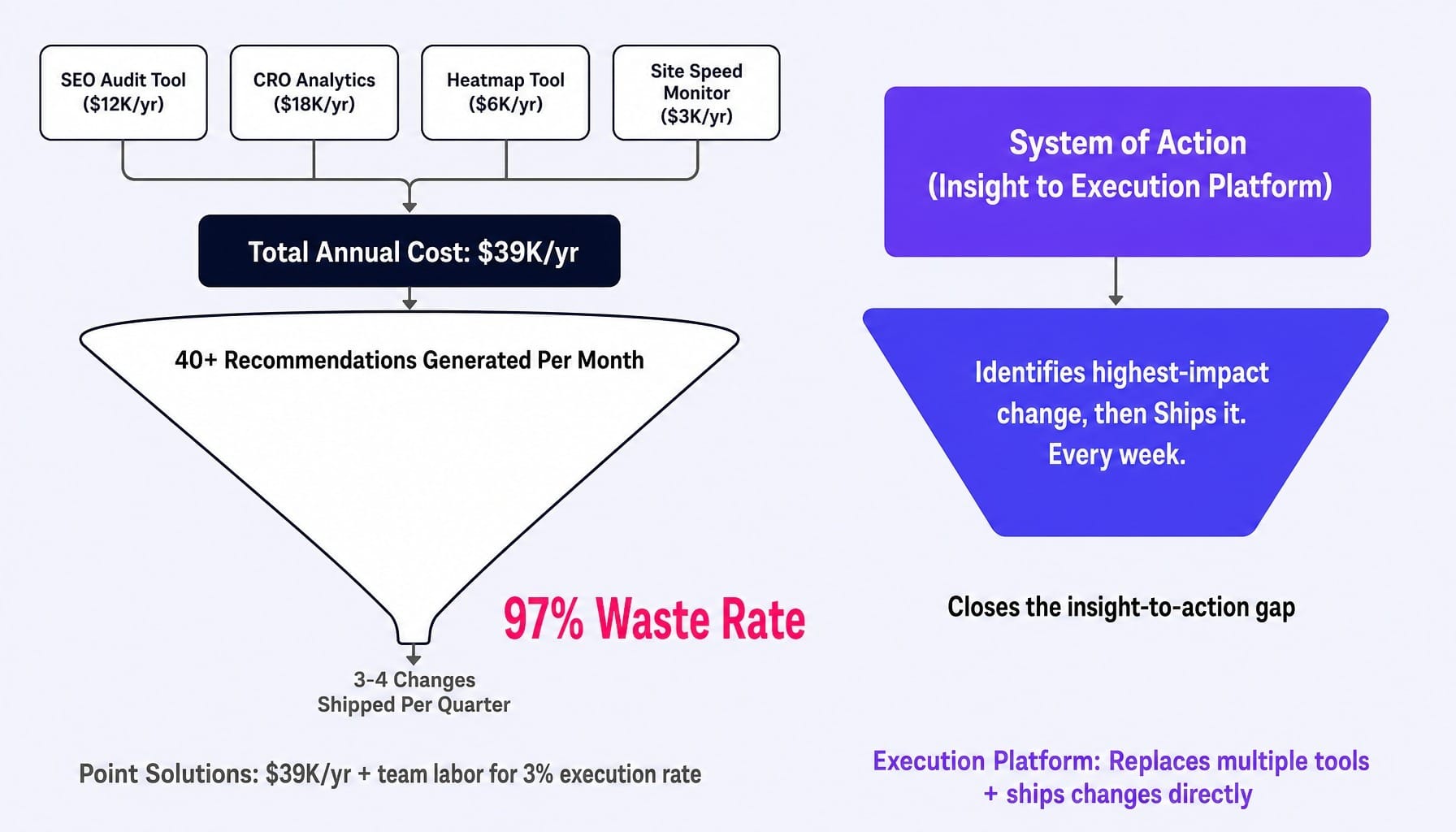
The structural fix isn't a better recommendation tool. It's a platform that closes the loop between identifying what needs to change and actually shipping it. This is the critical shift from "systems of insight" to "systems of action." The 18x multiplier is driven by the human cost of acting on tool outputs; the only way to structurally reduce that cost is to use a platform that acts on its own outputs. Teams pursuing data-driven CRO strategies often discover this gap between insight and execution is their biggest bottleneck.
Estimated Savings: $30,000-$80,000/year in direct tool costs, plus significant recovered team capacity.
Adopt a "One Tool Per Function" Governance Discipline
Cost reduction is temporary if you don't prevent martech sprawl from returning. The structural fix is a governance discipline: one tool per function, with no exceptions unless the request includes a deprecation plan for the tool it replaces. This is zero-based martech budgeting applied as an ongoing practice.
A VP of Marketing can implement a simple rule: any new tool request must include (1) which existing tool it replaces, (2) a sunset cadence for the old tool, and (3) a mandatory 90-day usage review. This discipline forces trade-offs and prevents the slow accumulation of point solution creep.
To support this, build a martech deprecation calendar—a shared document tracking every tool's renewal date, owner, and last usage review. This creates accountability and stops auto-renewal cost leakage before it happens. For teams building their SaaS marketing tools stack from scratch, embedding this governance from day one avoids the sprawl entirely.
Estimated Savings: Prevents $20,000-$60,000/year in future sprawl costs.
What If Your Stack Could Execute, Not Just Recommend?
The throughline of all eight strategies is a single tension: the most expensive part of your martech stack is the gap between what your tools recommend and what your team can actually ship. The Stack Tax is highest in the "unshipped recommendations" category.
This is why platforms like Spike AI represent a structural shift. It isn't another tool to add to your stack. It's a platform that replaces multiple point solutions—SEO audit tools, CRO analytics platforms, A/B testing tools—by collapsing the insight-to-action gap entirely.
Where those tools generate dashboards and recommendations that sit in a backlog, Spike AI identifies the highest-impact change across your website, SEO, and ads, then ships it. Every week. If the hidden cost of martech is driven by the people and processes required to act on tool outputs, the only real solution is a platform that acts on its own outputs. This isn't about adding to your stack; it's about replacing the most expensive, least productive layer of it.
See how Spike AI replaces your recommendation backlog with weekly shipped improvements
Your Martech Cost Is Not Your License Fee
The single most important takeaway is this: your martech cost is not your license fee. It's your license fee multiplied by the operational overhead each tool creates.
Canceling unused subscriptions is a necessary first step, but it's insufficient. Real savings come from attacking the Stack Tax: eliminating integration spaghetti, automating bridging workflows, and replacing tools that only generate recommendations with systems that ship changes.
Start with the First 48 Hours actions this week. Execute the quick wins over the next month. And begin planning the structural changes that prevent these costs from ever creeping back. The companies that will spend the least on martech in 2026 won't be the ones with the fewest tools. They'll be the ones with the least distance between insight and action.
Frequently Asked Questions
What is the average martech stack cost per employee in 2026?
Mid-market B2B companies typically spend $2,500-$5,000 per marketing employee per year on licenses alone. When you factor in the Stack Tax (integration work, administration, training), the true total cost of ownership per employee often rises to $6,000-$15,000. This varies significantly by industry, with companies reliant on enterprise platforms like Salesforce or Adobe skewing higher.
What is shadow martech and how does it inflate costs?
Shadow martech refers to tools purchased by individuals or departments on corporate cards, outside of centralized IT or marketing procurement. It inflates costs through redundant functionality (e.g., two teams buying separate survey tools), untracked auto-renewals that escape budget review, and significant security and compliance exposure. Tools like Zylo and Productiv can automatically detect shadow martech by scanning expense reports.
When is the best time to renegotiate martech vendor contracts?
Start the conversation 60-90 days before renewal, and aim for negotiations to conclude during the vendor's fiscal quarter-end (often October-December for many SaaS companies). Sales teams have quota pressure and are most willing to offer discounts or add-ons to close deals. Starting with less than 30 days to renewal removes your leverage, as the vendor knows switching costs make cancellation unlikely.
How do I build a business case for martech consolidation?
Focus on three numbers leadership cares about: (1) the current total cost of ownership (TCO) of the tools being replaced, including licenses and estimated admin hours; (2) the projected TCO of the consolidated platform, including all migration and training costs; and (3) the payback period. A business case that only shows license savings without accounting for one-time migration costs will quickly lose credibility.
Does zero-based martech budgeting actually work?
As a one-time rationalization exercise, it works well. As an ongoing annual process, it's often too bureaucratic. A more sustainable approach is adopting a "one tool per function" governance discipline combined with a martech deprecation calendar and quarterly usage reviews. This achieves similar outcomes by forcing trade-offs on an ongoing basis, without the administrative burden of a full zero-based evaluation every cycle.
How do I prevent martech sprawl from returning after a stack audit?
Audits reduce costs temporarily; governance prevents them permanently. The two most effective mechanisms are: (1) a shared martech deprecation calendar tracking every tool's owner and renewal date, and (2) a procurement rule requiring any new tool request to name which existing tool it replaces and include a sunset date. Without both, most teams return to their pre-audit tool count within 12-18 months.