SaaS ABM: Why Most Programs Fail at Contact Density (And How to Fix It)
TLDR
- Most SaaS ABM programs fail due to low "contact density"—targeting one contact in a buying committee of six or more. The fix is to shrink your account list and deepen your coverage.
- Treat ABM as a continuous execution system with a weekly shipping cadence, not a one-off campaign. The team that ships the most iterations against the best-mapped accounts wins.
- Product usage data is your best first-party intent signal. Use it to trigger ABM plays for high-value self-serve accounts, creating an ABM-PLG hybrid model.
- The highest-ROI ABM motion for SaaS is often expansion revenue. Run personalized plays against existing customers to increase seat penetration and drive net revenue retention above 120%.
- Your ABM tech stack should be built around function, not vendors. Start with contact enrichment and account-level attribution before investing in expensive intent data platforms.
Your B2B SaaS marketing team launches its first account-based marketing program. You build a target account list of 200 logos, buy the intent data, and spin up LinkedIn campaigns. SDRs send personalized emails to the one key contact they found at each company. Six months later, the results are in: the pipeline influenced by ABM is statistically indistinguishable from your old demand gen motion.
The strategy wasn't wrong. The tools weren't the problem. The failure was baked in from the start.
The problem was contact density. You had one thread into an account where a buying committee of six to ten people actually makes the decision.
Most SaaS ABM programs don't fail because of poor targeting or a bad tech stack. They fail because teams under-map the buying committee and then lack the execution bandwidth to personalize engagement across every contact that matters. This guide provides a playbook for building a SaaS ABM program that avoids this trap by treating ABM as a continuous shipping system, not a campaign you launch. We'll cover why it's distinct from demand gen, diagnose the contact density problem most teams ignore, and walk through a framework that actually generates pipeline—including advanced plays for PLG and expansion revenue.
What Is SaaS ABM?
SaaS ABM is a go-to-market strategy that concentrates marketing and sales resources on a defined set of high-value accounts rather than generating leads at scale. But it's not just "personalized marketing." For a SaaS company, adopting ABM is a revenue architecture decision that changes how pipeline is sourced, how sales and marketing share accountability, and how expansion revenue is generated post-sale.
SaaS businesses benefit disproportionately from this model for three structural reasons:
- Multi-Stakeholder Buying: Enterprise SaaS deals involve, on average, 6-10 decision-makers (Gartner). ABM is designed to orchestrate engagement across this entire buying committee.
- Recurring Revenue Models: The cost of acquiring the wrong customer isn't a one-time loss; it compounds over years in churn and support overhead. ABM focuses investment on accounts with the highest potential for long-term value.
- Expansion Potential: The "land and expand" model means account penetration is often more valuable than account volume. ABM provides the framework for turning a single departmental sale into an enterprise-wide contract.
SaaS ABM vs. Demand Generation: When to Use Which
ABM targets named accounts with personalized, multi-threaded engagement; demand generation targets a broad market with scalable content and campaigns. For SaaS companies with an average contract value (ACV) above $25K and sales cycles longer than 60 days, ABM typically delivers a higher return on investment.
This isn't a purely academic distinction. Choosing the wrong model for your business stage is a fast way to burn capital.
The choice isn't ABM or demand gen—most mature SaaS companies need both. ABM is for your top 50-200 strategic accounts where deal size justifies the heavy investment. Demand generation acts as "air cover" for the broader market, feeding your funnel with intent signals and nurturing future ABM targets.
The most common failure case here? A SaaS startup with a sub-$15K ACV and a small addressable market trying to run a 1:1 ABM program. They burn their entire budget on personalization that the deal economics simply can't support.
Why Most SaaS ABM Programs Fail Before Campaigns Even Launch
The two most common SaaS ABM failures happen before a single ad runs or email sends. Teams either build an Ideal Customer Profile (ICP) from firmographics alone, missing critical behavioral signals, or they identify the right accounts but only map one contact, leaving 80% of the buying committee untouched.
If your ABM program launched and the pipeline didn't move, the problem is almost certainly in one of these two places. It's a system design flaw, not a campaign execution error.
The ICP Problem: Building Target Lists from Firmographics Alone
Most struggling ABM programs start with an ICP built from filters like industry, employee count, and revenue. A team builds a 200-account list filtered by "B2B SaaS, 100-500 employees, North America" and then wonders why engagement is flat. This approach produces a list of companies that look right but have demonstrated zero buying intent.
The fix is signal layering. You must combine firmographics with other data types:
- Technographics: What tools do they use? Are they on a competitor's platform?
- First-Party Intent: Are they visiting your pricing page? Reading comparison content?
- Third-Party Intent: Are they researching your category on other sites? (Data from providers like Bombora or 6sense).
A useful rule of thumb: if more than 60% of your target account list has zero active intent signals, you don't have a target list. You have a wish list. Using tools like Clay to enrich firmographic lists with real-time intent data is no longer optional; it's the price of entry.
The Contact Density Problem: Why One Thread Per Account Kills Pipeline
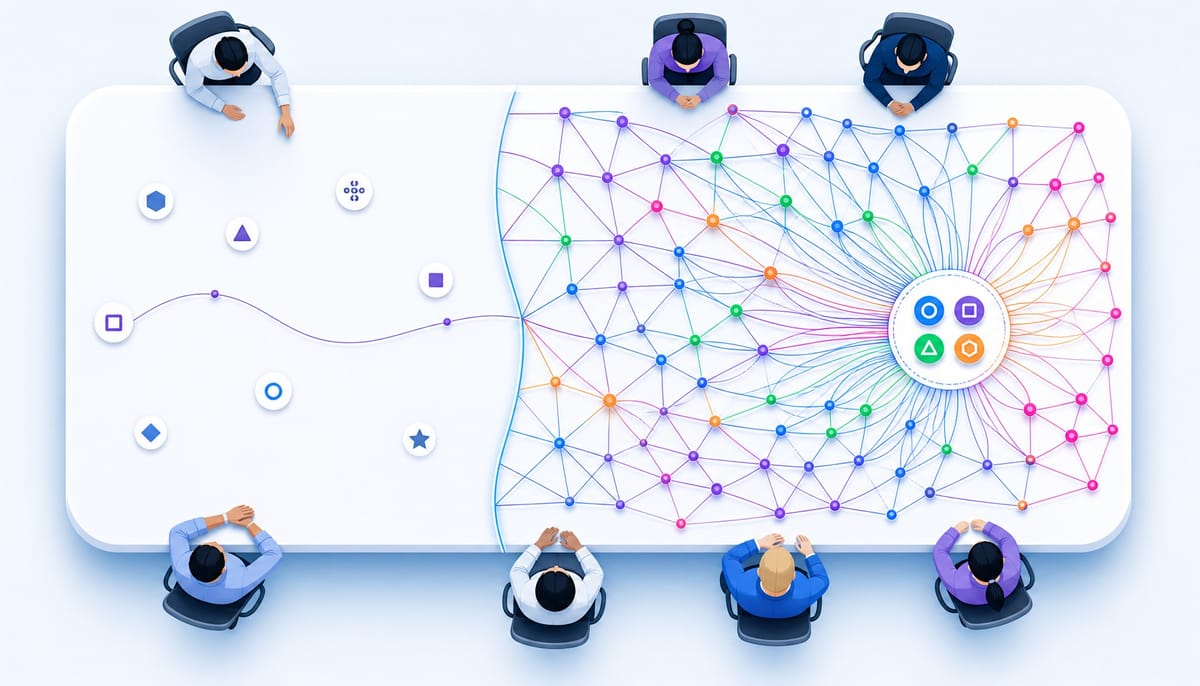
This is the signature failure of most SaaS ABM programs. Contact density ratio is the number of engaged contacts you have per target account, divided by the estimated size of the buying committee. Most programs operate with a ratio below 0.25, meaning they're reaching less than a quarter of the people who influence the deal.
Consider this scenario:
- Company A targets 150 accounts with 1 contact each. Total contacts: 150.
- Company B targets 50 accounts with 5 contacts each. Total contacts: 250.
Assuming a similar budget, Company B will generate multiples of the pipeline. Why? They achieve multi-threaded engagement. When their champion goes dark, the CFO or VP of Ops is already warm from seeing their ads and reading a relevant case study. In Company A's world, the deal dies with the single contact.
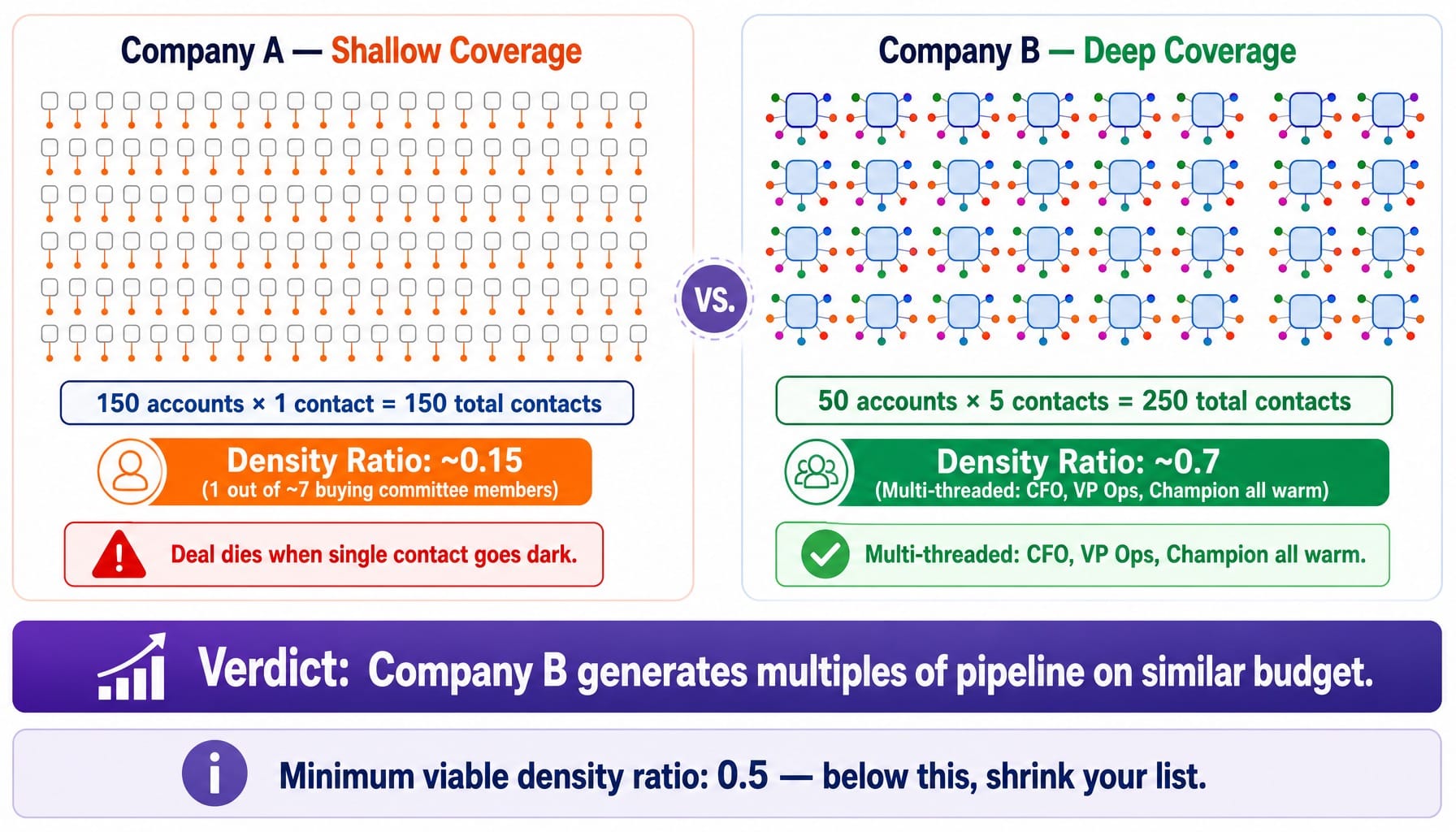
This is why mapping the full buying committee with tools like LinkedIn Campaign Manager or Common Room is non-negotiable. Before you scale your account list, audit your contact density. If your ratio is below 0.5, you don't have an ABM program—you have a glorified email list. Shrink your list and deepen your coverage.
How to Build a SaaS ABM Program That Actually Ships
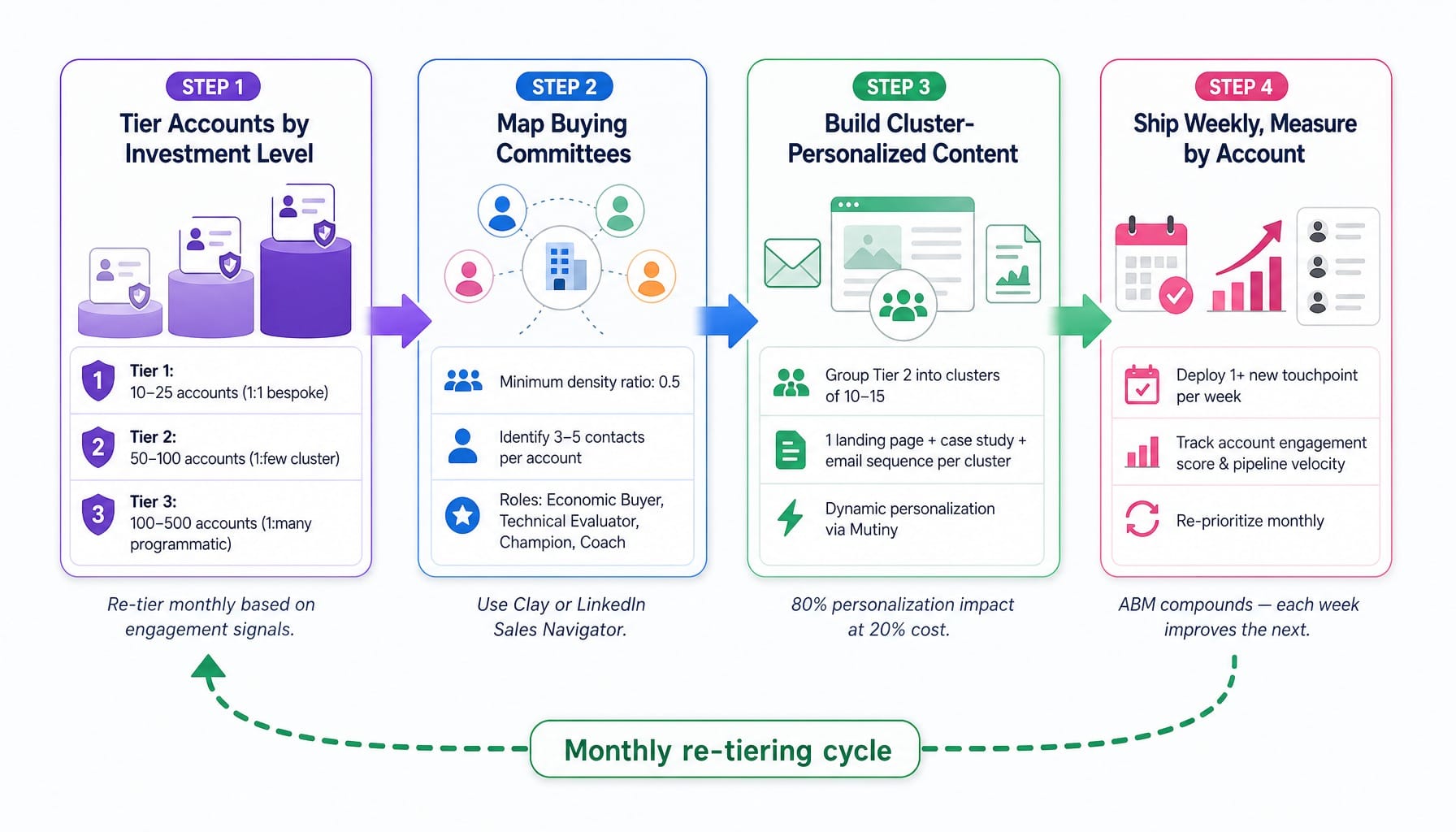
A SaaS ABM program that generates pipeline follows four sequential steps: tier your accounts by investment level, map buying committees to a minimum contact density, build personalized content by account cluster, and ship engagement weekly—not quarterly. The difference between teams that see ABM ROI and those that don't is cadence. Winners treat ABM like a product release cycle, with weekly iterations that compound over time.
Step 1: Tier Your Accounts by Investment Level
Action: Segment your target account list into three tiers based on deal size potential, intent signal strength, and strategic fit.
- Tier 1 (1:1): Your top 10-25 accounts. They get bespoke content, dedicated SDR attention, and high-touch plays like direct mail.
- Tier 2 (1:few): The next 50-100 accounts. They get cluster-personalized content by industry vertical or use case.
- Tier 3 (1:many): The next 100-500 accounts. They get programmatic ABM through targeted ads and scaled email sequences.
Outcome: Your marketing spend becomes proportional to revenue potential, preventing you from over-investing in smaller deals.
Failure Mode: Teams that put all their accounts in Tier 1 burn out within eight weeks. Bespoke personalization at scale is a myth for lean teams. Tiering must also be dynamic; re-tier accounts monthly based on their engagement signals.
Step 2: Map Buying Committees to a Minimum Contact Density of 0.5
Action: For every Tier 1 and Tier 2 account, your goal is to identify at least 3-5 contacts across the buying committee. This typically includes the economic buyer (CFO, VP), the technical evaluator (Head of Eng, IT), the end-user champion, and an internal coach. Use tools like Clay or LinkedIn Sales Navigator to build these contact heat maps.
Outcome: Your SDR-AE handoff includes a warm, multi-threaded account, not a single cold contact. The conversation starts with organizational momentum.
Failure Mode: Teams that skip this and rely on a single champion find that 40-60% of their "qualified" pipeline stalls when that one person changes roles, goes on leave, or loses internal sponsorship.
Step 3: Build Personalized Content by Account Cluster, Not by Account
Action: Group your Tier 2 accounts into clusters of 10-15 that share a common industry, pain point, or competitive displacement opportunity. Create one landing page, one case study, and one email sequence per cluster—not per account. Use a tool like Mutiny to dynamically personalize the landing page headline and hero copy with the visitor's account name or industry.
Outcome: You get 80% of the personalization impact at 20% of the production cost.
Failure Mode: Teams that attempt fully bespoke content for every account produce three perfect assets in month one, run out of bandwidth, and revert to generic messaging by month three. Personalization is a spectrum; cluster-level is the sweet spot for most SaaS teams.
Read more: B2B SaaS Content Marketing: The Shipping Problem Nobody Talks About (2026 Playbook)
Step 4: Ship Weekly, Measure by Account, Re-Prioritize Monthly
Action: Establish a weekly ABM shipping cadence. Every week, deploy at least one new touchpoint—an ad creative refresh, an email sequence update, a landing page variant. Measure success at the account level: track account engagement score, buying group coverage percentage, and pipeline velocity. Re-tier accounts monthly based on engagement—accounts surging with intent move up; accounts going dark move down or get paused.
Outcome: ABM becomes a compounding system where each week's data improves the next week's targeting.
Failure Mode: Teams that treat ABM as a "campaign" with a fixed start and end date never reach this compounding phase. They declare it "didn't work" after one quarter because they measured a marathon at mile two.
The ABM-PLG Hybrid: Running Account-Based Plays Inside a Product-Led Funnel
Product-led growth and ABM are not opposing strategies—SaaS companies can use product usage signals as first-party intent data to trigger account-based plays for their highest-value self-serve accounts. Most ABM programs ignore this completely, leaving their highest-fidelity intent signal on the table because the marketing and product teams don't share data.
Here's the model: a PLG company has thousands of free or trial users. Most will self-serve. But a subset—identifiable by usage patterns like number of seats, feature adoption, or integration activity—are actually enterprise buying committees evaluating the product from the bottom up. These accounts should be flagged and routed into an ABM motion.
Consider this scenario: a project management SaaS sees that a Fortune 500 company has 14 individual users on free plans across three departments. Product usage data shows they've hit the collaboration ceiling on the free tier. This is a Tier 1 ABM signal. The marketing team creates a personalized business case landing page for that company, the SDR reaches out to the VP of Operations (not the individual users), and the AE presents an enterprise consolidation proposal. Tools like Koala or Warmly are built to surface these product-qualified accounts and bridge the gap between product analytics and your ABM workflow.
ABM for SaaS Expansion Revenue: The Highest-ROI Play Nobody Runs
Most SaaS ABM programs focus exclusively on new logo acquisition, but the highest-ROI ABM motion for companies with a land-and-expand model is running account-based plays against existing customers.
The economics are undeniable. The ICP is already validated (they bought from you), the buying committee is partially mapped (you have a champion), and the expansion revenue has zero customer acquisition cost. It's pure margin.
Here's the play: identify existing accounts where product usage is high but seat penetration is low (e.g., the sales department loves your product, but marketing and success don't use it). Build a personalized expansion case—"Here's how your sales team is using our product and the results they're seeing"—and target the VP or C-suite sponsor who controls budget across departments.
Companies that run expansion ABM consistently report net revenue retention (NRR) above 120%. Those relying on organic expansion often hover around 105-110%. Teams that treat existing customers as "customer success's problem" are leaving the easiest pipeline on the table.
The SaaS ABM Tech Stack in 2026: What You Actually Need
A modern SaaS ABM tech stack requires five functional layers: intent data, contact enrichment, personalization, multi-channel delivery, and account-level attribution. But you don't need to buy it all at once.
The most common anti-pattern is buying all five layers before validating the ICP and contact density strategy. You build infrastructure for a program that doesn't have product-market fit. Start with enrichment and attribution. Add intent and personalization once you've proven the motion works on your first 25 accounts.
When ABM Execution Outpaces Your Team's Bandwidth
This playbook highlights a core tension: effective SaaS ABM requires a relentless weekly shipping cadence across personalized landing pages, ad variants, and multi-channel touchpoints. But for a lean marketing team of 1-5 people already carrying specialist expectations across SEO, CRO, and paid search, that cadence is unsustainable. The contact density problem only makes it worse—more contacts per account means more personalized assets to create, deploy, and optimize.
This is an execution bandwidth problem. The same team responsible for high-judgment ABM work like buying committee research and account strategy is also bogged down by the operational tasks of optimizing the website, A/B testing landing pages, and fixing technical SEO issues.
Spike AI closes this execution gap. It acts as the execution layer for your website, running a continuous weekly shipping cadence to optimize conversion paths, deploy new landing pages, and improve your site's performance—all without consuming your team's hours.
When your website optimization runs on a system, your team's bandwidth is freed for the high-impact ABM work that only humans can do. Spike AI doesn't replace your ABM program; it gives your team the bandwidth to actually run one.
See how Spike AI frees your team's bandwidth for high-impact ABM
Conclusion
SaaS ABM fails when teams treat it as a campaign instead of a system. They target too many accounts with too few contacts and lack the execution bandwidth to ship personalized touchpoints at a weekly cadence. The program stalls, and they conclude "ABM doesn't work."
The fix is structural, not tactical. Shrink your list to deepen your contact density. Tier your investment so it's proportional to deal size. And most importantly, build a weekly shipping cadence that allows your program to learn and compound. The SaaS companies winning with ABM in 2026 aren't the ones with the biggest budgets or the most sophisticated tech stacks. They are the ones that ship the most iterations per quarter against the fewest, best-mapped accounts.
Success isn't a function of account list size × campaign budget. It's a function of contact density × shipping cadence.
Read more: Pipeline Marketing in 2026: Strategy, Metrics, and Why Most Teams Regress to Lead Gen
Frequently Asked Questions
How many accounts should a SaaS company target with ABM?
Aim for 10-25 accounts for 1:1 ABM, 50-100 for 1:few, and 100-500 for 1:many programmatic plays. The real constraint isn't list size; it's your ability to maintain a contact density ratio above 0.5. A team covering 50 accounts deeply will always outperform a team spread thinly across 500.
What account engagement signals should trigger SDR outreach in a SaaS ABM workflow?
Look for a combination of signals: multiple contacts from one account visiting your pricing page within 7 days, a surge in third-party intent data for your category, a new executive hire in a relevant role, or product usage spikes (for PLG companies). A single signal is noise; two or more concurrent signals indicate genuine buying activity.
How do you measure ROI of account-based marketing in SaaS?
Measure at the account level, not the lead level. Track three key metrics: pipeline generated per target account (pipe-to-spend ratio), average deal velocity for ABM-influenced accounts versus non-ABM, and closed-won revenue attributed to ABM engagement. Use a tool like Salesforce Account Engagement or Demandbase, not lead-source reporting.
When should a SaaS startup invest in ABM vs. broad demand generation?
ABM makes economic sense when your ACV exceeds $20-25K, your sales cycle involves more than two stakeholders, and you can name at least 50 ideal customers. If your ACV is lower or your sales process is simple, demand generation will deliver better unit economics. Many startups try ABM prematurely and burn cash.
How do you personalize landing pages for ABM target accounts without a dedicated design team?
Use dynamic personalization tools like Mutiny that swap headlines, logos, and case studies based on the visitor's company. You don't need a unique page per account; create one template per industry or use case cluster and let the software handle the dynamic insertions. This provides 80% of the impact with one template.
What is the difference between MQA and MQL in a SaaS ABM context?
An MQL (Marketing Qualified Lead) is an individual person who hits a scoring threshold. An MQA (Marketing Qualified Account) is an entire account where multiple contacts have collectively demonstrated buying intent, measured by account engagement score and intent signal density. ABM programs should qualify accounts, not leads, because deals are won by committees.