SaaS Influencer Marketing: The 2026 Guide to Building a Creator Program That Compounds

TLDR
- Stop running one-off influencer campaigns that decay to zero. Build a compounding creator program by retaining 3-5 long-term ambassadors who produce content monthly.
- Follower count is a vanity metric for SaaS. Use tools like SparkToro and Modash to vet an influencer's audience for ICP alignment. If less than 30% of their engaged audience matches your ICP, walk away.
- Most influencer ROI is invisible to standard UTM tracking because it happens in dark social. Use a three-layer model: direct tracking, self-reported attribution on demo forms, and halo effect monitoring (branded search lift).
- The best compensation model for most B2B SaaS partnerships is a hybrid: a smaller flat fee to respect the creator's time, plus a 10-20% rev-share to align incentives with pipeline.
- Embed influencer content into your product experience. The best creator-led walkthroughs often make better onboarding assets than your own help docs because they're framed from the user's perspective.
SaaS influencer marketing uses trusted practitioners, educators, and niche thought leaders to translate complex software value into authentic content that builds trust where traditional advertising cannot. This encompasses everything from deep-dive product walkthroughs and workflow tutorials to technical reviews and step-by-step video guides.
Most B2B SaaS companies get this far. They run a one-off sponsorship, a single YouTube integration, or a few paid LinkedIn posts, and then wonder why it didn't move the pipeline. The failure isn't the channel; it's the architecture.
The companies generating real influence-assisted pipeline are doing something structurally different. They're embedding creators into the product experience itself—making influencer content part of onboarding, activation, and retention, not just awareness. They're running systems, not campaigns.
This guide provides the playbook for that system. We'll cover how to find and vet ICP-aligned creators, structure compensation models that actually work, measure ROI through the fog of dark social, and build a creator program that compounds quarter over quarter.
Why SaaS Companies Use Influencer Marketing
SaaS companies use influencer marketing because B2B buyers trust practitioners who use the tools far more than the brands that sell them. The latest Edelman Trust Barometer confirms that B2B decision-makers rank peer recommendations and expert content as significantly more credible than vendor-created marketing. For software, this trust gap is even wider.
Influencer marketing works differently for SaaS than for consumer products for three specific reasons:
- Product Complexity Demands Demonstration: A 30-second Instagram story can't explain why your CRM's pipeline automation is superior. A 12-minute YouTube walkthrough from a respected RevOps leader can. SaaS products are complex, and their value is revealed through demonstration, not just endorsement.
- The Buying Committee Lives in Dark Social: The average B2B purchase involves 6-10 stakeholders. Influencer content—a link to a great tutorial or a screenshot of a workflow—circulates through the Slack channels, email forwards, and LinkedIn DMs that your marketing team can't access. This dark funnel sourcing is where decisions are shaped.
- PLG Funnels Capture Immediate Intent: Most SaaS products have a free tier or trial. Unlike a physical product, an influencer can drive a viewer to a signup form that enters them directly into a product-led growth (PLG) funnel. The path from influence to activation can be nearly instantaneous.
This is why companies like Notion and Figma visibly accelerated their growth through creator-led content. They didn't just get endorsements; they got an army of educators showing the world how to use their product.
Types of SaaS Influencers Worth Partnering With
The most effective SaaS influencer partnerships come from five creator archetypes, each serving a different stage of the buyer journey. The key is to match the creator type to your campaign goal.
- Practitioner Creators: These are the operators who use tools like yours every day and share their workflows, frameworks, and tech stacks on platforms like LinkedIn and Twitter/X. They aren't professional "influencers"; they are credible professionals with influence. Their recommendations carry immense weight because they are rooted in daily use.
- Educational YouTubers: These are creators who produce in-depth tutorials, comparisons ("Tool A vs. Tool B"), and deep-dive reviews. They excel at showing, not just telling, and their content serves as an evergreen asset that can drive signups for months or years.
- Newsletter Operators: These are writers with highly engaged, niche subscriber lists on platforms like Substack and Beehiiv. A sponsorship in a newsletter read by 10,000 VPs of Engineering is often more valuable than a YouTube video with 100,000 generalist viewers.
- Podcast Hosts: These creators facilitate long-form conversations, often dedicating 30-60 minutes to exploring a product's value proposition with a founder or expert user. They are ideal for reaching senior decision-makers who consume content during commutes or workouts.
- Micro-Influencers (1,000-15,000 followers): For SaaS, these niche specialists are the engine of high-quality lead generation. Their audience trusts their recommendations as peer advice, not a paid celebrity endorsement. With engagement rates often 3-5x higher than macro-influencers, their content drives a higher engagement-to-signup ratio because the audience-product fit is so tight.
Why Most SaaS Influencer Campaigns Fail—And It's Not the Creator's Fault
Picture this: a B2B SaaS company pays a YouTube creator $5,000 for a sponsored integration. The video gets 40,000 views, 200 clicks, 12 trial signups, and zero paying customers. The marketing team concludes "influencer marketing doesn't work for us" and kills the channel.
The failure wasn't the creator or the content. It was the program architecture.
Most SaaS influencer programs fail because they treat influencer content as a top-of-funnel awareness play when it should be embedded across the entire product experience. They make three structural mistakes:
- The One-Off Campaign Mentality. A single sponsored post cannot build the trust required for a $15,000 ACV purchase. The content's impact decays within days, the relationship with the creator ends, and the marketing team has to start from scratch next quarter. There is no compounding.
- Awareness-Only Creator Briefs. The brief asks the creator to "mention our product." A better brief asks them to "walk through solving [specific ICP problem] using our product." The first generates awareness; the second generates demand by connecting the tool to a tangible business outcome.
- No PLG Integration. The influencer drives traffic to a generic homepage, where the user is left to figure things out. Instead, they should be driving traffic to a purpose-built landing page with a direct free-tier signup, an interactive demo, or the creator's own template. Without a clear activation path, the intent evaporates.
The problem isn't that influencer marketing is ineffective for SaaS. It's that most teams run it like a media buy instead of designing it as a growth system.
Read more: What Is B2B Demand Generation? Framework, Strategies, and the Execution Gap Most Teams Miss | Spike
How to Find and Vet Influencers for a Niche B2B SaaS Audience
Finding influencers for a B2B SaaS product is fundamentally different from consumer brands. Follower count is nearly irrelevant. What matters is whether the creator's audience is your Ideal Customer Profile (ICP). A creator with 8,000 followers who are all RevOps managers at mid-market companies is infinitely more valuable than a social media star with 200,000 followers who are mostly students.
Building Your ICP-Aligned Creator Shortlist
Your goal isn't to find the biggest creators; it's to find the right ones. This is a research process, not a guessing game.
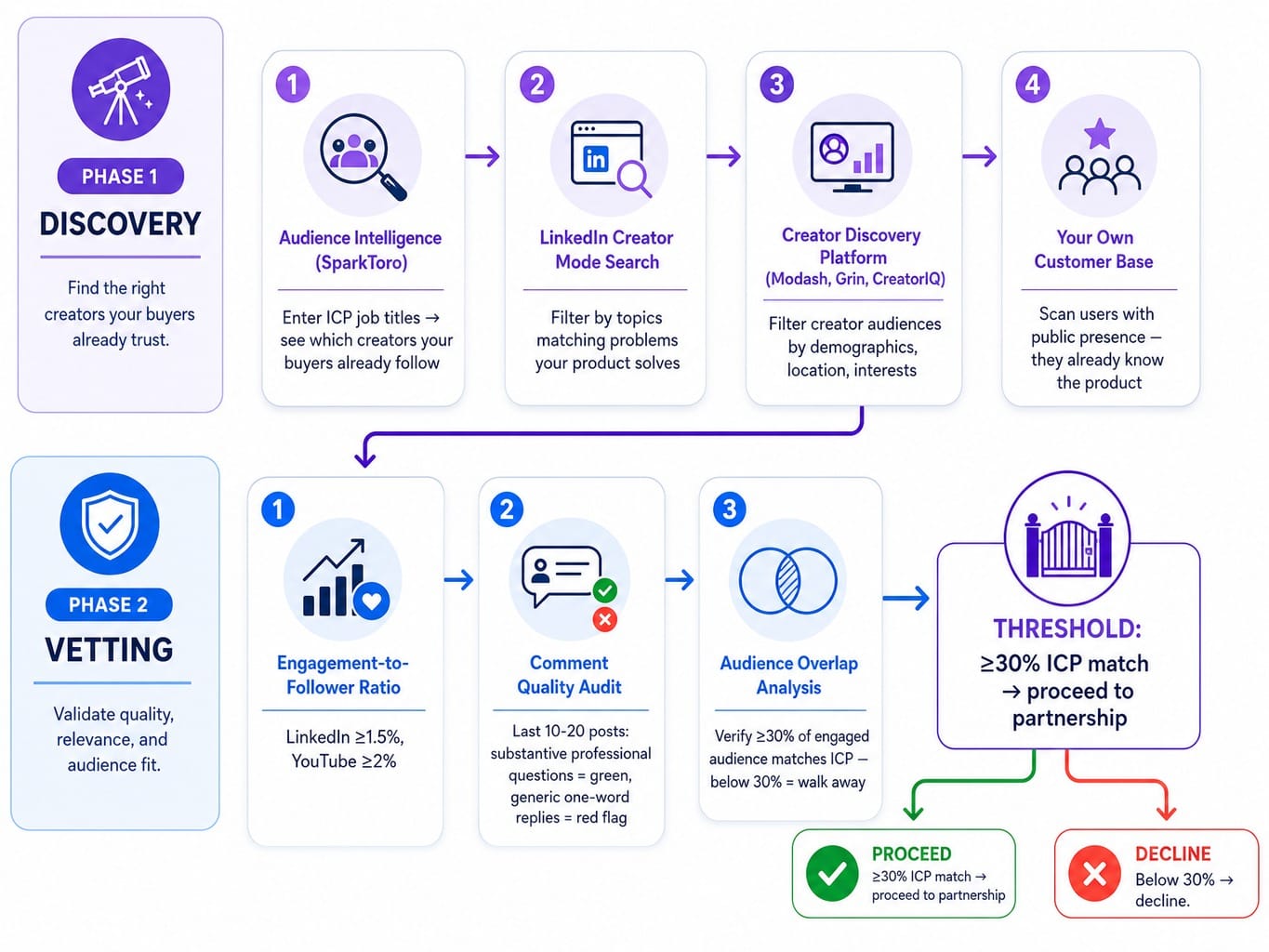
- Start with Audience Intelligence. Use a tool like SparkToro. Enter the job titles of your ICP (e.g., "Head of Growth," "CRO Specialist") or the domains of companies that use your product. SparkToro will show you which social accounts, podcasts, and YouTube channels that specific audience already follows and engages with. This is your seed list.
- Search LinkedIn Creator Mode. LinkedIn is the native home of the B2B practitioner. Search for creators in your niche and filter by the topics they post about. Look for individuals who consistently discuss the problems your product solves.
- Use a Creator Discovery Platform. Tools like Modash, Grin, or CreatorIQ allow you to search for creators by keywords and, more importantly, filter their audience by demographics like location, age, and interests. This helps you cross-reference creators you find on other platforms.
- Look at Your Own Customer Base. Your most powerful influencers might already be paying customers. Scan your user list for individuals with a public presence and reach out. They already understand the product's value, making them natural advocates.
Audience Authenticity Scoring: How to Vet Before You Sign
Once you have a shortlist, you must vet the quality of their audience. A large following means nothing if it's composed of bots or unengaged users.
- Check the Engagement-to-Follower Ratio. For a B2B creator on LinkedIn, a healthy engagement rate (likes + comments / followers) is typically 1.5% or higher. On YouTube, look for 2% or more. Anything significantly lower suggests a passive or inflated audience.
- Analyze Comment Quality. Scan the comments on their last 10-20 posts. Are they substantive questions from real professionals in your target industry? Or are they generic, one-word replies like "Great post!" and "Awesome!" from bots and engagement pods? The former is a strong positive signal; the latter is a major red flag.
- Run an Audience Overlap Analysis. This is the most critical step. Use SparkToro or the audience analysis features in Aspire or Modash to verify that the creator's audience demographics—job titles, company sizes, industries—actually match your ICP.
Here's the rule of thumb: if you can't verify that at least 30% of a creator's engaged audience matches your ICP, the partnership will underperform, no matter how good the content is.
SaaS Influencer Compensation: Flat Fee, Rev-Share, or Hybrid
The compensation model you choose shapes the entire creator relationship. Get it wrong, and you'll either overpay for awareness or under-incentivize performance, souring the partnership either way. Most successful SaaS programs use a hybrid model, but each has its place.
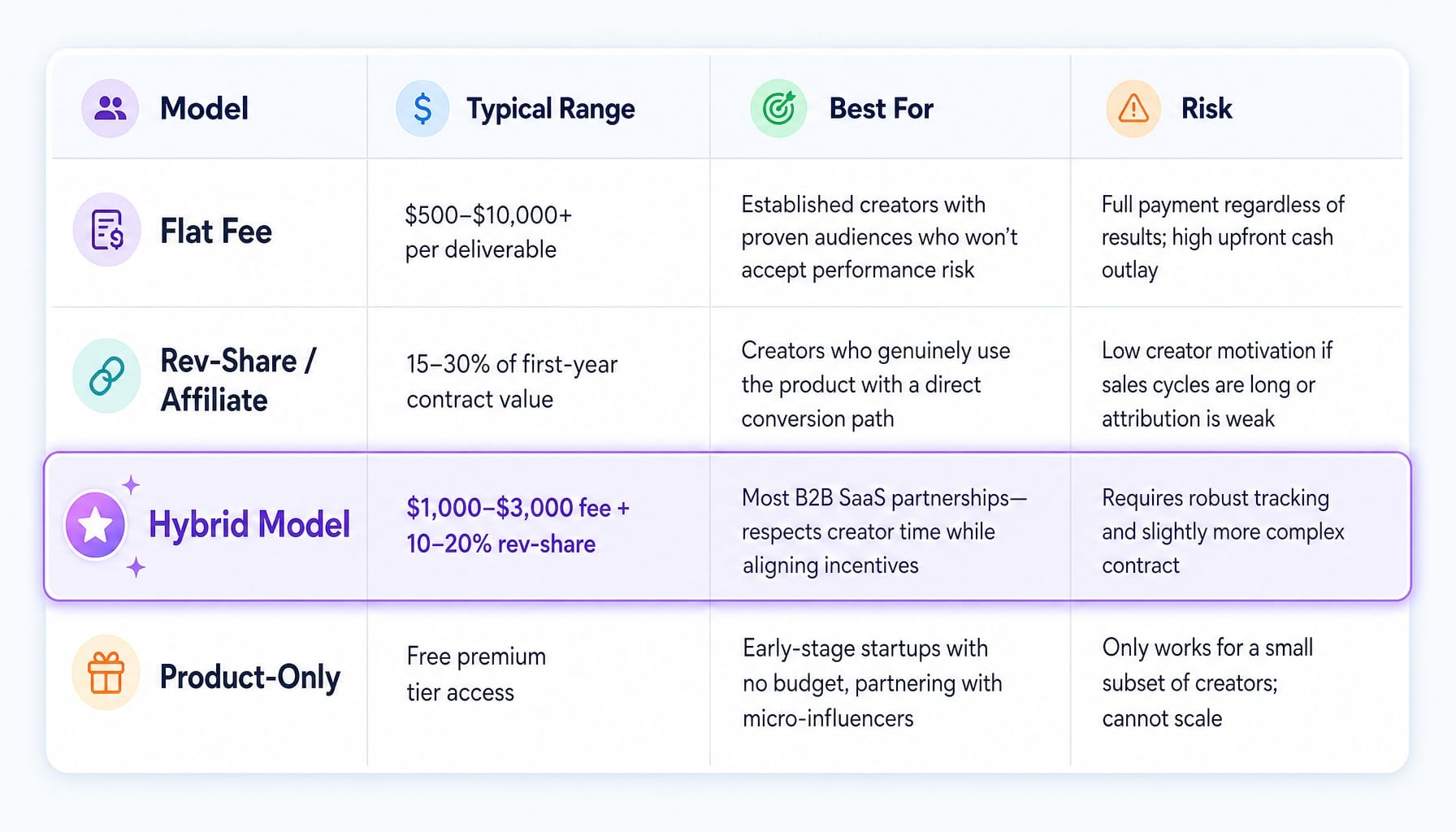
Regardless of the model, your contract must be explicit about deliverables, timelines, content approval workflows, and usage rights—especially if you plan to run whitelisted creator ads. For rev-share and hybrid models, use a platform like PartnerStack or impact.com to manage tracking and payouts transparently.
How to Measure SaaS Influencer ROI When Buyers Use Dark Social
Here's the uncomfortable truth: most of your SaaS influencer ROI is invisible to standard attribution models. The buyer journey runs through dark social—the Slack DMs, email forwards, and private group chats that no UTM parameter can track. It's estimated that 70-80% of B2B buying research happens in these channels.
This doesn't mean ROI is unmeasurable. It means you need a more sophisticated measurement stack.
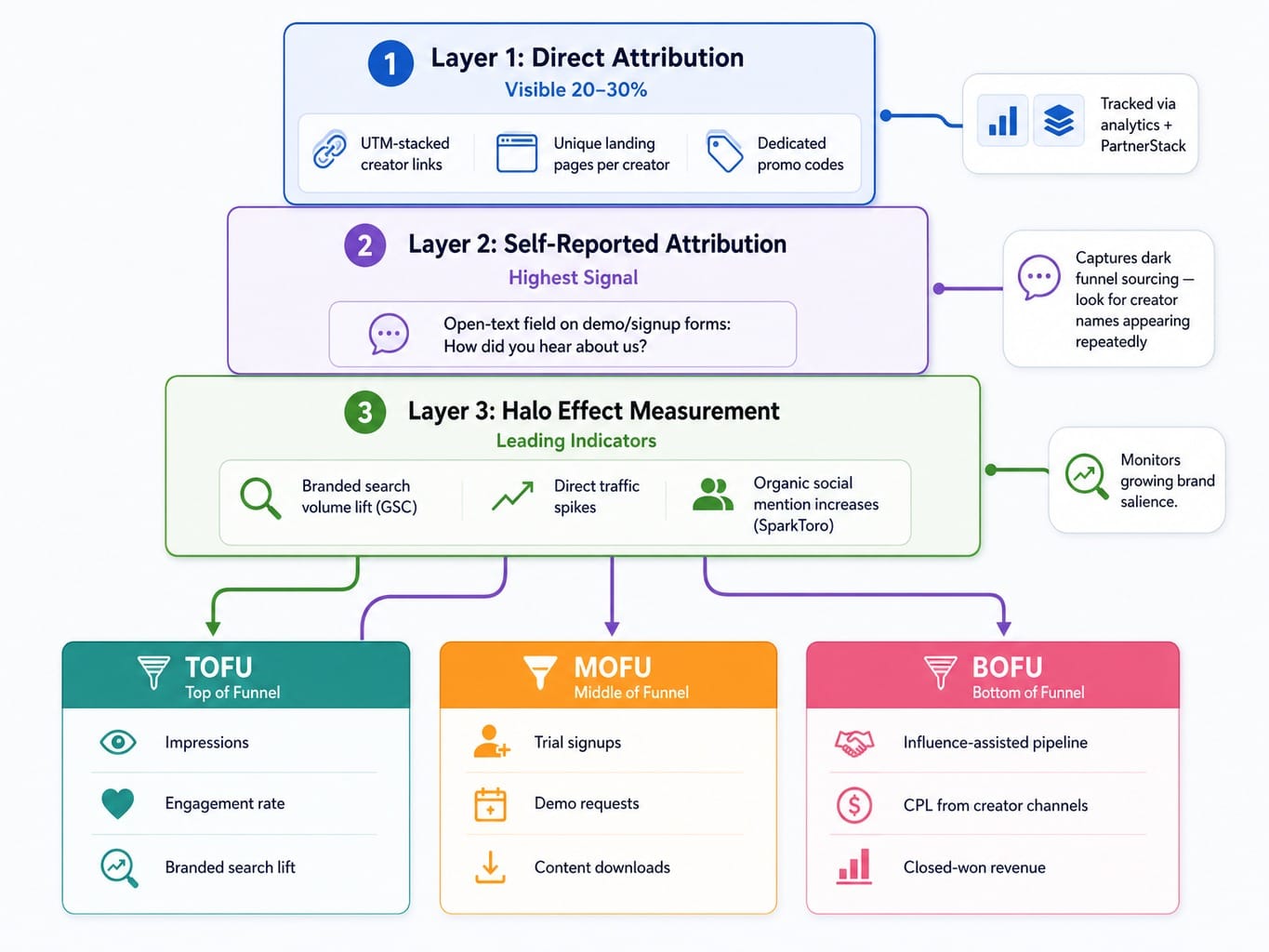
Use a three-layer attribution framework:
- Direct Attribution (The Visible 20-30%). This is the easy part. Use UTM-stacked creator links, unique landing pages per creator, and dedicated promo codes. Track signups and demo requests from these sources using your analytics and a platform like PartnerStack. This captures the portion of the influence-assisted pipeline that is directly trackable.
- Self-Reported Attribution (The Single Biggest Signal). Add a simple, open-text field to your demo request and signup forms that asks, "How did you hear about us?". This is the most underused and highest-signal tool for dark funnel sourcing. When you see a creator's name pop up 40 times, you know the campaign is working, even if UTMs only show 15 clicks.
- Halo Effect Measurement (The Leading Indicators). Monitor trends in your other marketing data during and after creator campaigns. Look for lifts in branded search volume (Google Search Console), spikes in direct traffic, and increases in organic social mentions (SparkToro). These are the leading indicators of growing brand salience.
Track KPIs by funnel stage:
- Top-of-Funnel (TOFU): Impressions, engagement rate, branded search lift.
- Mid-Funnel (MOFU): Trial signups, demo requests, content downloads.
- Bottom-of-Funnel (BOFU): Influence-assisted pipeline, CPL from creator channels, closed-won revenue.
If you are only measuring last-click attribution, you are likely seeing less than 20% of your influencer program's true impact and making budget decisions on dangerously incomplete data.
How to Build a Creator Program That Compounds Instead of Decays
Contrast two models. Company A runs four one-off influencer sponsorships per year. Each campaign generates a brief spike in traffic, but the content decay rate is high, and the impact drops to nearly zero within two weeks. Company B runs a continuous creator ambassador program. They retain six creators who produce monthly content, and each piece is systematically repurposed across paid, owned, and earned channels.
Company B's program compounds. Company A's program restarts from zero every quarter.
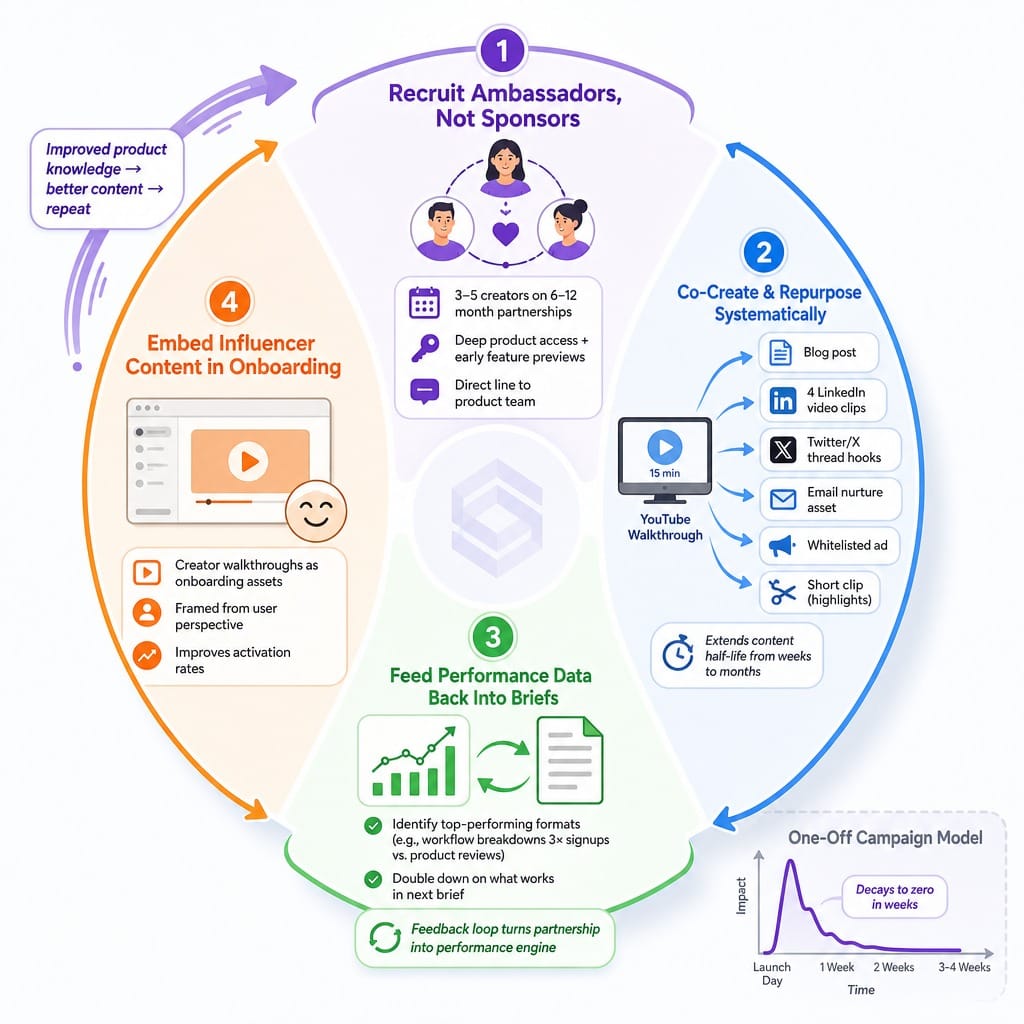
To build a program that compounds, implement the creator flywheel:
- Recruit Ambassadors, Not Sponsors. Onboard 3-5 creators for long-term (6-12 month) partnerships. Give them deep product access, early feature previews, and a direct line to your product team. Their content will improve as their product knowledge deepens.
- Co-Create and Repurpose Systematically. A single 15-minute YouTube walkthrough can become a full blog post, four LinkedIn video clips, a series of Twitter/X thread hooks, an asset in your email nurture sequence, and a high-performing whitelisted ad. This extends the content's half-life from weeks to months.
- Feed Performance Data Back into the Brief. The system gets smarter over time. If you see that a creator's "workflow breakdown" format drives three times more signups than their "product review" format, you double down on workflows in the next brief. This feedback loop is what turns a creative partnership into a performance engine.
- Use Influencer Content as Onboarding Material. The best creator walkthroughs often explain your product better than your own help docs because they frame it from the user's perspective. Embed this content directly into your user onboarding flow to improve activation rates.
The SaaS companies winning with influencer marketing aren't just running campaigns—they're running systems designed for compounding returns.
Read more: B2B SaaS Content Marketing: The Shipping Problem Nobody Talks About (2026 Playbook) | Spike AI
When the Bottleneck Isn't the Creator — It's Shipping What They Drive
You can build the most sophisticated, compounding creator program in your industry. You can find the perfect ICP-aligned creators, structure brilliant hybrid compensation models, and measure ROI through the dark funnel. Your creators can drive a steady stream of high-intent traffic to your website.
But if the landing pages, CTAs, and conversion paths that traffic hits are not continuously optimized, you are leaking the very pipeline your program worked so hard to build.
A compounding creator flywheel only works if the destination—your website—is also a compounding system. This is the execution gap that stalls most growth initiatives. The same logic of weekly iteration, data-fed prioritization, and continuous improvement that defines a successful creator program is exactly how your website should operate.
Spike AI is the execution layer that ensures the demand your influencer program generates actually converts. It continuously identifies the highest-impact website optimization—whether it's a headline change, a CTA redesign, or a new content section—and ships it weekly. Your creators drive the demand. Spike AI makes sure your website captures it.
See how Spike AI compounds your website conversions weekly
Conclusion
SaaS influencer marketing works when it stops being a campaign and starts being a system. It's a system where creators are embedded in the product experience, compensated for outcomes, measured through dark social attribution, and retained as long-term ambassadors whose content compounds across every channel.
The single most important shift is realizing the difference between SaaS companies that get ROI from this channel and those that don't is not budget or creator selection. It's whether they built a program designed to compound or one designed to decay.
The SaaS companies that will dominate their categories in 2026 are building the creator programs today that will still be generating pipeline in 2028. The ones running one-off sponsorships will still be wondering why influencer marketing doesn't work.
Frequently Asked Questions
What is the difference between influencer marketing and affiliate marketing for SaaS?
Influencer marketing typically pays for content creation and audience exposure—the creator produces a review or tutorial. Affiliate marketing pays purely for outcomes like signups via tracked links. Many successful SaaS programs blend both, offering creators a flat fee for content plus a rev-share commission on conversions.
How much should a SaaS startup budget for influencer marketing in 2026?
Early-stage SaaS companies ($1-5M ARR) often allocate $2,000-$10,000/month, focusing on 3-5 micro-influencer partnerships with hybrid compensation. Growth-stage companies ($5-30M ARR) may invest $10,000-$50,000/month across a larger portfolio of creators, including paid amplification of their content through whitelisted ads.
Can micro-influencers drive meaningful signups for a B2B SaaS tool?
Yes. Micro-influencers (1,000-15,000 followers) consistently outperform larger creators for B2B SaaS because their audiences are more niche, engaged, and aligned with a specific ICP. A creator whose 5,000 followers are all marketing ops professionals will generate more qualified signups than a general tech influencer with 100,000 followers.
What platforms are most effective for B2B SaaS influencer marketing in 2026?
LinkedIn dominates for B2B because the audience is already in a professional context and creator posts receive strong organic reach. YouTube is best for long-form product walkthroughs. Podcasts and niche newsletters (Substack, Beehiiv) are highly effective for reaching senior decision-makers with long-form, high-trust content.
How do you repurpose influencer content across paid and owned channels for SaaS?
First, negotiate broad usage rights in the contract. Then, run the original video as a whitelisted ad—it will outperform brand-created ads. Extract key quotes for email nurtures, embed walkthroughs in your onboarding flow, and clip long-form videos into dozens of assets for LinkedIn and YouTube Shorts.