SaaS Link Building in 2026: 7 Strategies That Build Links as a System

TLDR
- Stop running link building as a campaign. The highest-performing SaaS teams build systems where the product, content, and partnerships earn links continuously.
- Focus on creating "linkable assets" like free tools, proprietary data studies, and genuinely useful comparison pages. These assets attract links passively for years.
- Leverage your integration ecosystem. Co-marketing with non-competing SaaS partners is one of the most underutilized, high-ROI link building channels.
- Evaluate link quality beyond Domain Rating (DR). A link's value depends on topical relevance, the site's real organic traffic, and editorial standards — not just a vanity score.
- Measure ROI by connecting referring domains to compounding MRR. A link that helps a high-intent page rank drives recurring revenue, not just one-time traffic.
The six-week link building sprint is a familiar ritual in SaaS. The team fires off 500 outreach emails, places a dozen guest posts, and watches the company's Domain Rating (DR) tick up by two points. Then the sprint ends. The team moves on to the next quarterly initiative, and link velocity plummets to zero. Three months later, competitors who never stopped building have quietly overtaken them.
This is the core failure mode of most SaaS link building. It operates as a campaign with a start and end date, delivering a temporary sugar high of activity instead of sustained authority growth.
The teams that sustainably win in organic search treat link acquisition as a system—something the product, content, and partnerships generate continuously, not something a person manually cranks every quarter. SaaS link building is the practice of earning high-quality backlinks from authoritative, niche-relevant websites to grow a software company's organic visibility, domain authority, and qualified pipeline. But its real power is only unlocked through consistency.
This playbook isn't another list of tactics. It's a guide to engineering a link building system. We'll cover seven strategies selected specifically because they compound over time, a framework for evaluating link quality that goes beyond vanity metrics, and an ROI model that connects referring domains directly to MRR.
What Is SaaS Link Building?
SaaS link building is the strategic process of earning backlinks from authoritative, industry-relevant websites to increase a software company's domain authority, organic rankings, referral traffic, and visibility in AI-generated answers. Each high-quality link acts as a vote of confidence, signaling to search engines that your content is a credible resource. This process is fundamental to SEO for any software business aiming to capture high-intent organic traffic.
The value of these links compounds across four key pillars:
- Domain Authority Transfer: Backlinks from trusted sites pass authority (often measured as Domain Rating or Domain Authority) to your site, improving your ability to rank for competitive keywords.
- Trust Signaling to Search Engines: A diverse profile of relevant links signals trustworthiness and expertise, which is a critical component of Google's quality evaluation systems.
- Qualified Referral Traffic: Links from niche blogs, review sites, and industry publications drive traffic from an audience that is already interested in your solution space.
- Citation Eligibility in AI Answers: As search evolves, AI overviews and LLMs increasingly pull information from well-cited, authoritative sources. A strong backlink profile increases the probability of your content being featured and referenced.
The value of these pillars only multiplies when link acquisition is continuous, not episodic.
Why SaaS Link Building Is Different from Every Other Vertical
SaaS link building differs from ecommerce or local link building because the product is intangible, the sales cycle is long, and the pages that drive revenue—pricing, comparison, and feature pages—are inherently hard to earn links to. Generic playbooks fail because they don't account for these structural differences.
Here are three realities that define the SaaS link building landscape:
- Product Pages vs. Blog Content: In ecommerce, product pages naturally attract links from reviews and gift guides. But a SaaS feature page is an abstract description of value; editors and journalists rarely link directly to it. This forces SaaS teams to build "bridge assets"—free tools, benchmark reports, or data studies that attract links and then pass that equity to "money pages" via a deliberate internal linking strategy.
- The Comparison Page Battlefield: A huge volume of SaaS-related searches are for "[competitor] alternatives" or "best [category] software." Ranking for these high-intent keywords requires significant backlink authority. However, these pages are commercially oriented, making it difficult to earn purely editorial links. Success here depends on creating the most comprehensive, trustworthy resource on the SERP, which in turn becomes a citable asset for other reviewers. According to Ahrefs data, top-ranking SaaS pages for competitive keywords often have over 100 referring domains, a threshold far higher than in many other verticals.
- Integration Ecosystems as Link Sources: SaaS products rarely exist in a vacuum. They live within ecosystems like the HubSpot App Marketplace, the Slack App Directory, or the Zapier integration network. Each integration partner represents a co-marketing and link building opportunity that ecommerce and local businesses simply do not have. This creates a unique channel for acquiring highly relevant, high-authority links.
For example, a project management SaaS trying to rank for "best project management software" knows no editor will link to their pricing page. So, they build a free "Project Timeline Calculator." This tool earns hundreds of links from blogs about productivity and project management, and that authority is then funneled to their core product and pricing pages.
7 SaaS Link Building Strategies That Compound Over Time
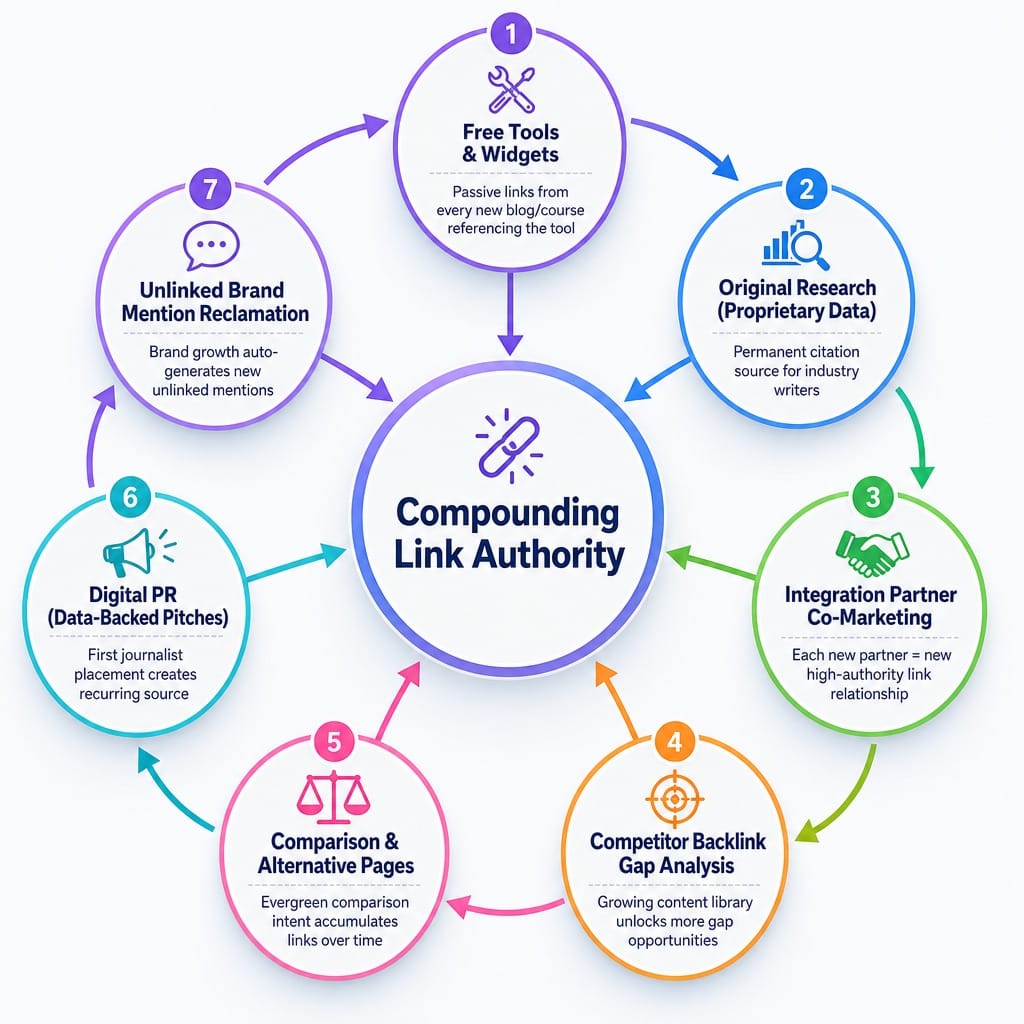
The following seven strategies were chosen because each one builds an asset or relationship that continues earning links long after the initial effort. They are designed as systems, not campaigns. They stop the cycle of manual outreach that produces nothing the moment you stop sending emails.
1. Free Tools and Embeddable Widgets as Permanent Link Magnets
A free, high-quality tool that solves a specific audience problem is the single highest-ROI link building investment a SaaS company can make. It earns links passively for years. The canonical example is HubSpot's Website Grader, which has earned tens of thousands of backlinks because bloggers, educators, and consultants reference it as a utility, not as marketing content.
The framework is simple: the tool must solve a problem adjacent to your core product, work without requiring a signup, and produce a shareable output (like a score, report, or visual).
- Compounding Mechanism: Every new blog post, course, or video about "how to check your website speed" or "free SEO audit tools" becomes a potential new link source without any outreach required. The asset's value grows as the topic's popularity grows.
- Choose this when: You have engineering resources to build and maintain a simple tool, and your product category has a quantifiable metric (e.g., ROI, speed, security score, readability).
- Skip this when: You cannot commit to maintaining the tool over time, or the problem your tool solves doesn't produce a shareable or citable output.
2. Original Research Using Proprietary Product Data
SaaS companies are sitting on mountains of proprietary usage data that no journalist, blogger, or competitor can replicate—and most never use it for link building. Anonymize and aggregate your data to publish a newsworthy finding. For example, a project management SaaS could analyze 10,000 projects and publish a report titled, "The Average Software Project Runs 2.3x Over Budget." This is a citable, linkable statistic that earns editorial backlinks from top-tier industry publications.
- Compounding Mechanism: The study becomes a permanent citation source. Every future article written on the topic of project management failure or budget overruns will reference and link back to your original research, often for years.
- Choose this when: You have a statistically significant and anonymizable dataset (ideally from 1,000+ users or data points) that can reveal a counterintuitive or surprising trend.
- Skip this when: Your dataset is too small to be credible or the insights are generic (e.g., "our users are productive").
3. Integration Partner Co-Marketing
Integration partnerships are the most underleveraged link building channel in B2B SaaS. When two non-competing products integrate, they can co-create content that earns links from both partner ecosystems. A CRM that integrates with an email marketing platform can co-publish a guide on "How to Automate Lead Nurturing with [CRM] + [Email Tool]." Both companies link to it, both audiences share it, and the integration page itself becomes a permanent linkable asset on app directories.
Outreach to a potential integration partner has a much higher response rate (15-25%) than cold link building outreach (3-5%).
- Compounding Mechanism: Each new integration partner adds another high-authority domain to your co-marketing flywheel. A portfolio of 10 integrations creates 10 distinct, warm link building relationships.
- Choose this when: You have at least three active, meaningful integrations with other SaaS products.
- Skip this when: Your "integrations" are just superficial Zapier connections with no deep, shared customer workflow.
4. Competitor Backlink Gap Analysis and Targeted Recapture
The fastest path to acquiring high-quality links is not discovering new sources, but systematically earning the links your top competitors already have. The workflow is straightforward: run a "link intersect" report in a tool like Ahrefs to find sites linking to two or more of your competitors but not to you. Then, qualify that list by topical relevance and DR. Finally, pitch those sites with a specific, compelling reason why your content or product is a better, more current, or more comprehensive resource.
Read more: Ahrefs vs Majestic: Which Backlink Tool Fits Your Actual Workflow (2026 Comparison)
- Compounding Mechanism: As your own content library and product feature set grow, more of these competitor link gap opportunities become pitchable. What was an irrelevant opportunity last quarter might be a perfect fit next quarter.
- Choose this when: You have at least three direct competitors with established backlink profiles to analyze.
- Skip this when: You are creating a new market category and have no direct competitors to reverse-engineer.
5. Comparison and Alternative Pages That Earn Links Naturally
Well-built "[Competitor] alternatives" and "[Tool A] vs. [Tool B]" pages are link magnets. They attract backlinks from review sites, affiliate bloggers, and journalists writing industry roundups—but only if they are genuinely useful and transparently honest. A self-serving puff piece will be ignored. A thorough comparison page that includes the pros and cons of your own product alongside competitors earns trust and, consequently, links. It becomes the most reliable single source for that specific comparison query.
- Compounding Mechanism: Comparison intent is evergreen. People search for these terms continuously, and the best, most honest comparison page on the SERP accumulates links and authority over time as other writers reference it as a definitive resource.
- Choose this when: You compete against well-known brands that generate significant "alternative" or "vs" search volume.
- Skip this when: Your category is too new or niche to have meaningful comparison search demand.
Read more: Ahrefs vs Semrush in 2026: Which SEO Tool Fits How Your Team Actually Works
6. Digital PR with Data-Backed Pitches
Digital PR for SaaS only works when the pitch contains a specific, newsworthy data point—not a product announcement. Most SaaS PR fails because the pitch is "we launched a feature" rather than "our data shows X surprising trend." Use platforms like Connectively (formerly HARO) or Qwoted, but lead with an exclusive insight from your proprietary data. Realistic outreach reply rates are low (3-5%), but a data-backed pitch can increase that to 15-20%.
This can feel like a campaign, but its effects compound. It's a bit of an exception to the rule, but a valuable one.
- Compounding Mechanism: The first placement with a journalist or publication is the hardest. Once you establish a relationship by providing valuable data, they will often come back to you for future quotes and insights, creating a recurring source of high-authority mentions and links.
- Choose this when: You have a genuinely contrarian industry take or proprietary data that can be framed as news.
- Skip this when: Your "news" is just a product update. Journalists are not interested in your roadmap.
7. Unlinked Brand Mention Reclamation
This is the highest-conversion, lowest-effort link building tactic available, but it only works for brands with existing market presence. The process is simple: use a tool like Ahrefs Content Explorer to find pages that mention your brand name without linking to you. Then, send a brief, polite email to the author or editor asking them to add the link. Conversion rates are often 30-50% because the writer has already demonstrated an affinity for your brand.
- Compounding Mechanism: As your brand awareness grows through all other marketing efforts, the volume of unlinked mentions increases automatically, creating a perpetual pipeline of easy link opportunities.
- Choose this when: Your brand is mentioned regularly in industry content, podcasts, or news.
- Skip this when: You are an early-stage startup with minimal brand recognition.
How to Evaluate Link Quality Beyond Domain Rating
Domain Rating (DR) alone is an unreliable proxy for link quality. A DR 45 niche SaaS blog with 5,000 monthly visitors in your category transfers more ranking power and qualified traffic than a DR 80 general news site with no topical relevance to your product. A high DR can be easily manipulated; real value cannot.
Build a link prospect qualification pipeline using this five-point rubric to evaluate every opportunity:
- Topical Relevance: Is the linking site's primary topic aligned with yours? Does their audience overlap with your Ideal Customer Profile? A high topical link relevance score is non-negotiable. A link from a marketing blog to a marketing automation tool is valuable; a link from a lifestyle blog is not.
- Real Organic Traffic: Check the site's estimated monthly organic traffic in Ahrefs or Semrush. A site with a DR above 60 but fewer than 500 monthly organic visitors is almost always a link farm or part of a private blog network (PBN). The traffic-to-DR ratio is the fastest disqualification signal.
- Editorial Standards: Open three recent articles on the site. Do they read like well-researched, expert content, or like thin, AI-generated filler? If the content quality is low, any link from that site is worthless, regardless of its metrics.
- Link Neighborhood: Use a backlink checker to inspect the site's other outbound links. If it links out to low-quality sites in casino, pharma, or payday loan niches, it's a toxic "link neighborhood." A link from such a site can harm your own profile.
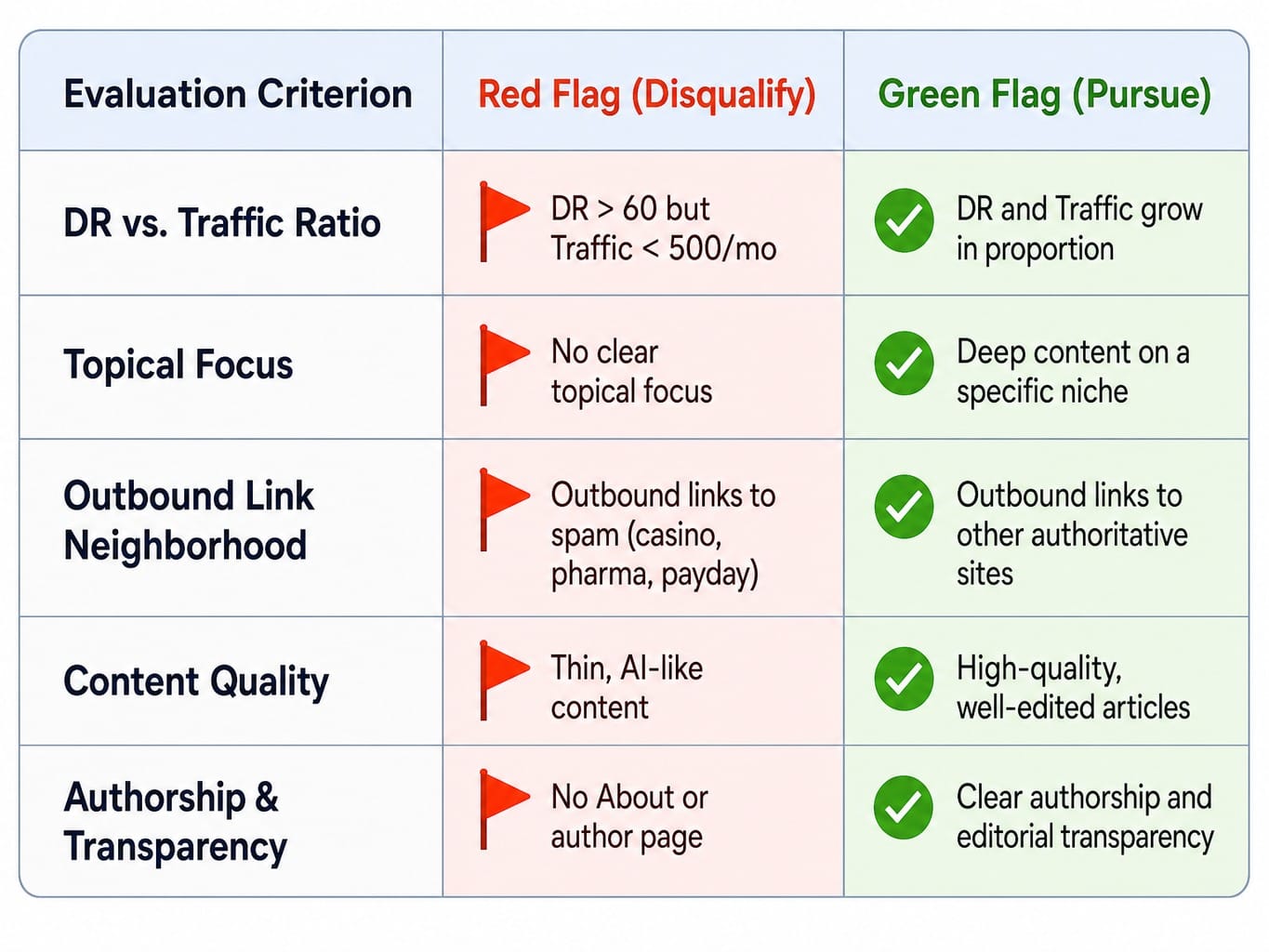
- Indexation Health: A link from a page that isn't indexed in Google passes zero value. Use Google Search Console's URL Inspection tool or a crawler like Screaming Frog to verify that the prospective linking page is indexed and crawlable.
Measuring SaaS Link Building ROI: From Referring Domains to MRR
Most SaaS teams measure link building ROI incorrectly. They track referring domain count and DR growth—vanity metrics that don't connect to revenue. The real ROI model for SaaS must account for compounding MRR.
A backlink that helps a high-intent page rank doesn't just drive one-time traffic; it drives trial signups that convert to monthly recurring revenue, which then compounds for the lifetime of that customer. Understanding data-driven CRO strategies is essential to maximizing the conversion side of this equation.
Consider this concrete example:
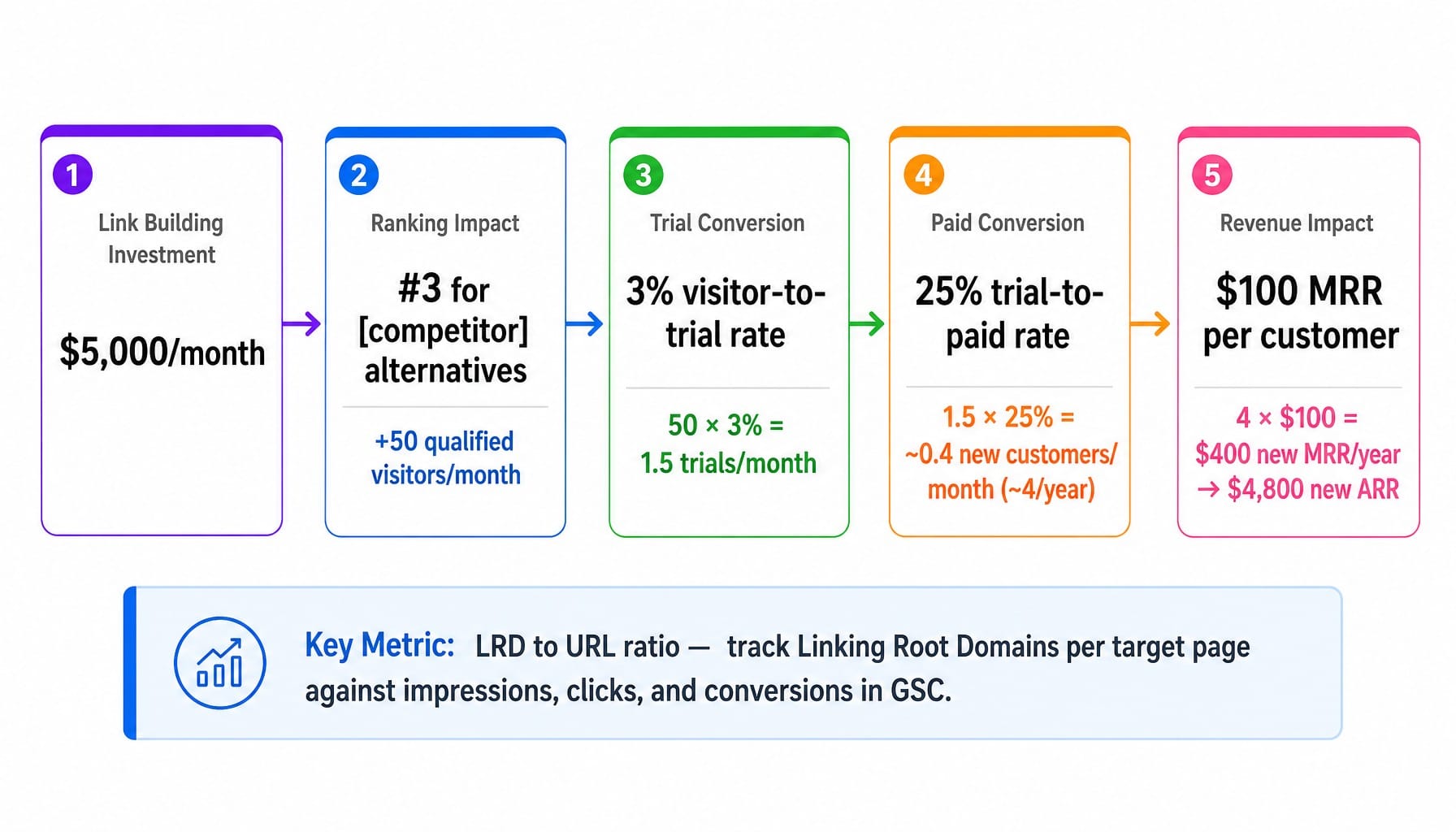
- A link building campaign costs $5,000/month.
- It helps a comparison page rank #3 for "[competitor] alternatives," driving 50 additional qualified visitors per month.
- That traffic converts to trials at 3%, and trials convert to paid customers at 25%.
- This yields ~0.4 new customers per month (50 0.03 0.25). Let's round up to 4 new customers per year for simplicity.
- At an average of $100 MRR per customer, that's $400 in new MRR added each year, which compounds to $4,800 in new ARR.
The link building cost is recovered within a few months, and the revenue continues to compound. The operational metric connecting effort to outcome is the LRD to URL ratio (Linking Root Domains to a specific URL). As you build links to a target page, monitor its impressions, clicks, and conversions in Google Search Console to tie your investment directly to pipeline impact.
When the System Needs to Run Without You
The argument is clear: SaaS link building only creates lasting value when it operates as a continuous system. But engineering that system requires constant evaluation of link quality, ongoing measurement of ROI, and tight coordination across content, product, and partnerships.
For lean marketing teams—where 1-3 people cover SEO, CRO, content, and paid ads—this is the core tension. You know what needs to be done. But when the quarter gets busy, link building is the first thing to get deprioritized. The compounding engine stalls. Teams that need to prioritize marketing channels with limited budget often find link building is the first casualty.
This is where the system needs to support the strategy. Spike AI acts as the execution layer that keeps the engine running. While you focus on building relationships and earning high-value links, Spike AI continuously identifies which pages need authority most, prioritizes where that link equity should flow via internal linking optimization, and ensures the content assets you create are perfectly optimized for both conversion and their link-earning potential.
You build the links. We make sure every link you earn actually moves revenue.
See which pages on your site would benefit most from link equity — book a free diagnosis call
From Campaign to System
SaaS link building is not a tactic to execute; it is a system to engineer. The teams that win in search are not the ones sending the most outreach emails. They are building free tools, publishing proprietary research, and co-marketing with integration partners—activities that compound without requiring constant manual effort.
Audit your current link building activity and ask one question: "If I stopped all outreach today, would my site still earn links next month?"
If the answer is no, you don't have a link building system. You have a campaign. And shifting from one to the other is the single highest-leverage change you can make to your SaaS SEO program.
Frequently Asked Questions
How many referring domains does a SaaS site need to compete on high-intent keywords?
There is no universal number; it depends entirely on the competitive density of your keyword. Run a link intersect report in Ahrefs for your target keyword's top 5 results and use the median referring domain count as your benchmark. For competitive SaaS categories like CRM, expect top-10 pages to have 150-500+ referring domains. For niche verticals, 30-80 may be sufficient.
Should SaaS companies buy links or focus only on organic link acquisition?
Buying links violates Google's spam policies and carries real penalty risk. The safer, more sustainable approach is investing that budget into creating linkable assets (like free tools or original research) that earn editorial links without the risk. Many companies pay for "niche edits" or sponsored posts, but if a link requires payment to exist, it should be considered a liability, not a long-term asset.
What outreach response rates should SaaS link builders expect in 2026?
Cold outreach reply rates for generic link requests have declined to 3-5% due to inbox saturation. However, warm outreach to integration partners or sites that already mention your brand can convert at 15-25%. The most effective teams focus on building relationships with a smaller set of high-relevance publishers who link repeatedly over time, rather than on high-volume cold outreach.
How do you build backlinks to SaaS product pages that are not blog content?
Product and feature pages rarely earn direct editorial links because they are commercial. The proven approach is to build "bridge assets"—free tools, comparison pages, or data reports—that attract links naturally. You then pass that authority to your product pages through a strategic internal linking architecture. Focus your external link building on the linkable assets and your internal linking on the money pages.
How do you prevent link decay on high-performing SaaS pages?
Link decay happens when linking pages are deleted or de-indexed. Set up monthly monitoring in a tool like Ahrefs or Linkody to detect lost backlinks. When a high-value link disappears, contact the site owner within 48 hours for the best chance of recovery. For pages with 50+ referring domains, expect to lose 5-10% of your links annually through this natural churn.
What anchor text strategy works best for SaaS homepage and feature page links?
Maintain a natural anchor text distribution to avoid penalties. A safe ratio is roughly 40-50% branded anchors (e.g., "Spike AI"), 20-30% naked URLs (e.g., "getspike.ai"), 15-20% generic anchors ("click here"), and only 5-10% exact-match keyword anchors. Over-optimizing exact-match anchors is a major red flag for search engines. Audit your current anchor ratio and compare it to stable, high-ranking competitors.