
The SaaS Marketing ROI Framework: How to Measure and Prove Your Contribution

TLDR
- Stop measuring campaign-level ROI. It's structurally misleading in SaaS. Instead, use cohort-based analysis to track revenue contribution over 6, 12, and 24-month windows.
- Your marketing ROI is a system of five interconnected metrics, not a single number. Focus on Blended CAC, Gross-Margin-Adjusted LTV, CAC Payback Period, Marketing Efficiency Ratio (MER), and Net Revenue Retention (NRR).
- Traditional attribution models are broken. Replace them with incrementality testing to measure a channel's true lift and self-reported attribution to understand the dark funnel.
- When reporting to your board, lead with cash flow metrics like CAC Payback Period and the overall Marketing Efficiency Ratio (MER), not theoretical LTV:CAC ratios or complex attribution models.
- The gap between measurement and action is where ROI stalls. Even perfect measurement is useless if your execution system can't ship improvements faster than the backlog grows.
You're in the boardroom. The slide shows a healthy 5:1 LTV:CAC ratio and a 40% quarter-over-quarter increase in marketing-sourced pipeline. You feel confident. Then the CFO leans forward and asks a simple question: "What would revenue look like next quarter if we cut marketing spend by 30%?" The room goes quiet. You have dashboards full of data, but you can't answer the one question that matters.
This is the moment marketing leaders realize they've been engaged in measurement theater. They've been tracking metrics that describe marketing's activity, not its incremental contribution to revenue.
The truth is, most SaaS marketing teams aren't failing at execution; they're failing at measurement. Real SaaS marketing ROI measurement requires three things most teams lack: the right metrics connected to financial outcomes, a calculation methodology that accounts for long sales cycles, and a way to isolate marketing's actual contribution from organic growth. This guide provides a system for all three, plus a framework for communicating ROI to leadership in a way that protects—and even increases—your budget.
Why Most SaaS Teams Miscalculate Marketing ROI
The root cause of poor ROI measurement isn't a lack of data. It's that teams measure at the wrong unit of analysis and the wrong time horizon. They calculate ROI at the campaign level (this webinar generated X leads) rather than at the cohort level (customers acquired in Q1 generated Y revenue over 18 months). This creates two specific distortions that make marketing's contribution seem both more immediate and less valuable than it actually is.
The Campaign-Level ROI Distortion
Campaign-level ROI is structurally misleading in SaaS because revenue is recognized over months or years, not at the point of sale. A demand gen manager reports a $50K campaign generated $200K in pipeline, claiming a 4x return. But pipeline isn't revenue. With an eight-month sales cycle and a 20% win rate, that $200K in pipeline might become $40K in actual revenue—nine months from now.
The calculation is a projection, not a measurement. It systematically overstates returns by ignoring win rates, sales cycle length, and churn. A more honest unit of analysis is the CAC payback period, which measures the time it takes to recoup acquisition costs. It forces you to connect spend to closed, recognized revenue, not just optimistic pipeline values.
Confusing Funnel Metrics With Financial Returns
Marketing Qualified Leads (MQLs), Sales Qualified Leads (SQLs), and even marketing-sourced pipeline are activity metrics, not ROI metrics. They describe marketing's throughput, not its financial return. A team can double MQL volume by loosening lead scoring criteria, but if the SQL conversion rate drops, the sales cycle lengthens, and the cost per opportunity climbs, net revenue contribution may stay flat or even decline. The system is producing more activity, but no more value.
This is a classic execution system failure. The workflow is optimized for a vanity metric (MQLs) at the expense of the financial outcome (profitable revenue). The bridge is to move from measuring marketing-sourced pipeline—a leading indicator—to measuring marketing-influenced revenue, which is a financial result.
Five Metrics That Actually Constitute SaaS Marketing ROI
SaaS marketing ROI isn't a single number. It's a system of five interconnected financial metrics that, together, tell you whether marketing is generating profitable growth or expensive activity. Optimizing any one in isolation creates false signals.
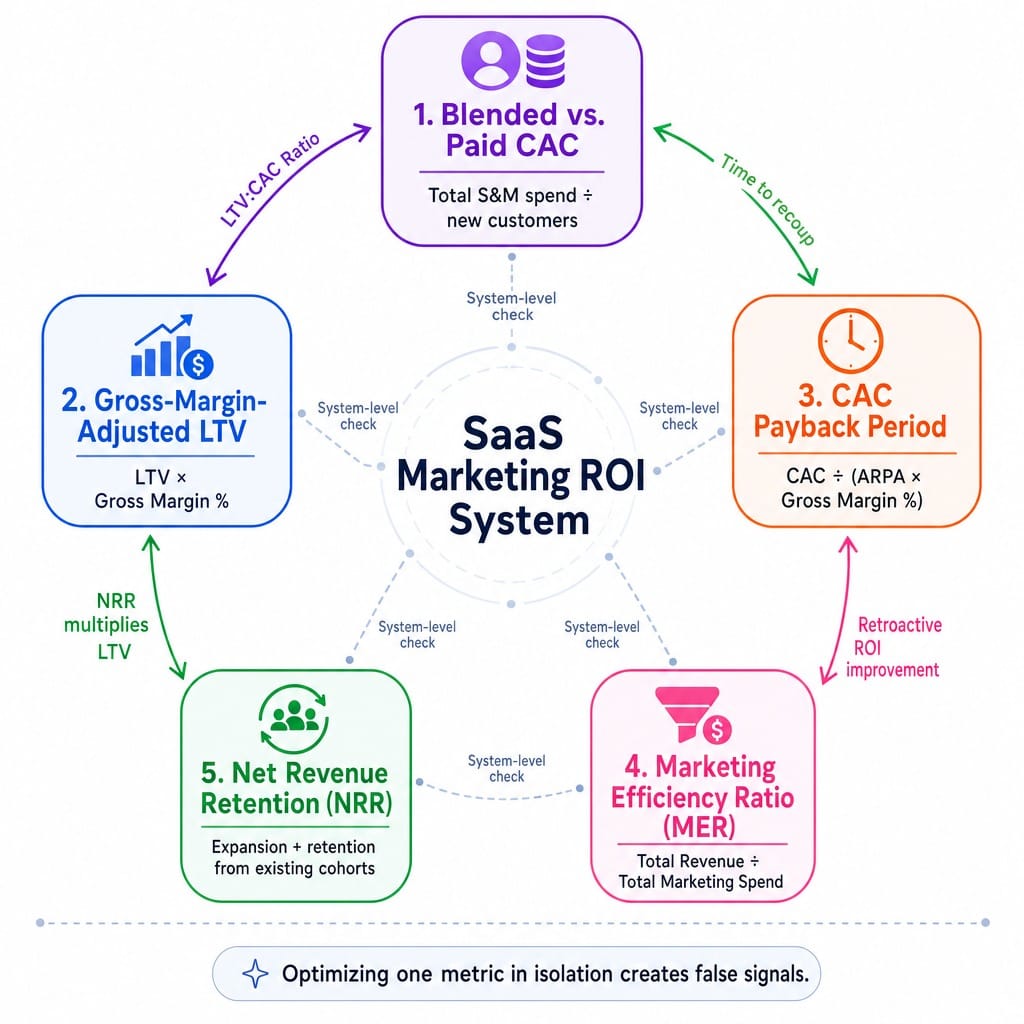
1.Blended vs. Paid CAC
What it is: Customer Acquisition Cost (CAC) is your total sales and marketing spend divided by the number of new customers acquired. Blended CAC includes all customers (including organic); Paid CAC includes only customers from paid channels.
Why it matters for ROI: Blending them masks channel inefficiency. A low blended CAC can hide an unsustainably high paid CAC. Separating them tells you if your paid channels are truly profitable or if they're being subsidized by organic growth.
2.Gross-Margin-Adjusted LTV
What it is: Lifetime Value (LTV) is the total revenue a customer generates. But raw LTV is a vanity metric. You must adjust for gross margin (LTV × Gross Margin %) to account for the cost of goods sold (COGS), like hosting and support.
Why it matters for ROI: A $50,000 LTV with a 60% gross margin is effectively a $30,000 LTV. This single adjustment can change a "healthy" 5:1 LTV:CAC ratio to a precarious 3:1, revealing your marketing is less profitable than you thought.
3.CAC Payback Period
What it is: The number of months it takes to earn back the cost of acquiring a customer. The formula is: CAC / (Average Revenue Per Account × Gross Margin %).
Why it matters for ROI: This is more operationally useful than LTV:CAC. It's a cash flow metric that tells your CFO when marketing spend becomes cash-flow positive. While a 3:1 LTV:CAC is a common benchmark, a CAC payback period under 18 months (for venture-backed SaaS) is the metric that gets budgets approved.
4.Marketing Efficiency Ratio (MER)
What it is: Total Revenue / Total Marketing Spend.
Why it matters for ROI: MER is replacing channel-level ROAS in SaaS boardrooms. Why? It sidesteps the impossible attribution debate entirely. It measures the overall productivity of the entire marketing system, accounting for cross-channel effects and dark funnel activity that attribution software can't see. It's the ultimate measure of correlation between spend and revenue.
5.Net Revenue Retention (NRR) Impact
What it is: NRR measures revenue from an existing customer cohort over time, including expansion and churn. An NRR over 100% means existing customers are generating more revenue.
Why it matters for ROI: NRR is a multiplier on marketing ROI. A cohort acquired 18 months ago by marketing might now be generating 40% more revenue through expansion, without any new acquisition cost. This means the true ROI of that initial marketing spend is still growing. Teams that ignore NRR systematically undervalue their past marketing investments.
How to Calculate SaaS Marketing ROI Across Long Sales Cycles
The fundamental problem with SaaS ROI calculation is the time delay. You spend in Q1, the deal closes in Q3, and the full LTV isn't knowable for three years. Any ROI calculation made in the same quarter as the spend is a forecast, not a measurement.
The standard ROI formula is: (Revenue from Marketing - Marketing Cost) / Marketing Cost. But this is where teams get it wrong.
Consider this scenario:
- Q1 Marketing Spend: $75,000
- Leads Generated: 30
- Customers Won (over 6 months): 12
- Average Contract Value (ACV): $8,000
- First-Year Revenue: 12 customers × $8,000 = $96,000
Using the standard formula on first-year revenue, your ROI is ($96,000 - $75,000) / $75,000 = 28%. It's positive, but not great.
But this is SaaS. Let's say your average customer lifespan is 3 years and your NRR is 115%. The true revenue from that cohort isn't $96,000; it's closer to $330,000 over three years. The cohort-level ROI is actually ($330,000 - $75,000) / $75,000 = 340%.
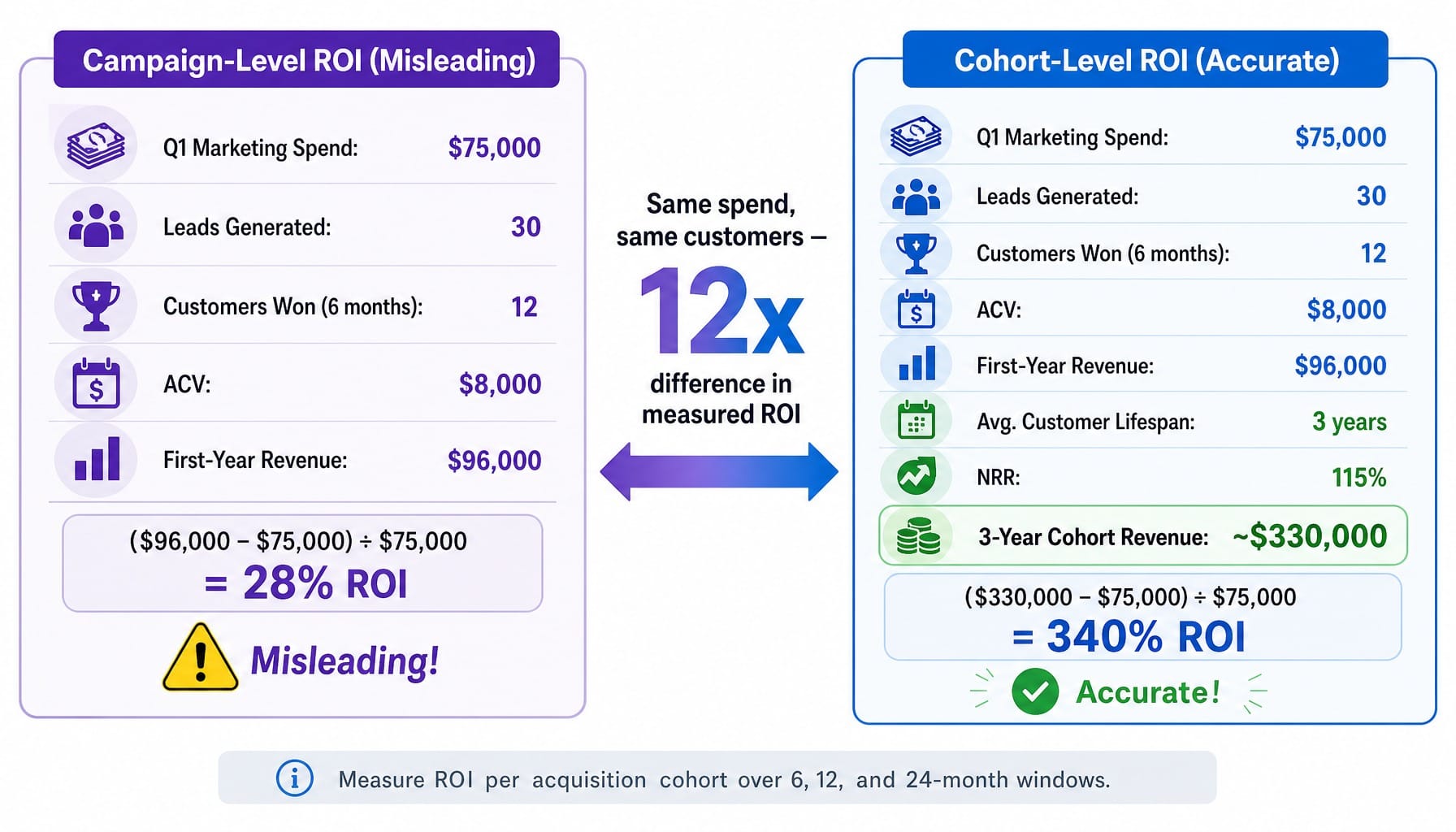
This reveals the only honest way to measure SaaS marketing ROI: cohort-based analysis. Instead of measuring ROI per campaign, you measure ROI per acquisition cohort (e.g., "customers acquired in Q1") over 6, 12, and 24-month windows. This approach, supported by tools like Dreamdata or HockeyStack, reveals which channels produce customers with the highest long-term value, not just the lowest upfront CAC. SaaS marketing ROI is a time-series measurement, not a point-in-time calculation.
Read more: Marketing Channel Prioritization for 2026: Where Your Budget Actually Compounds
Why Attribution Models Break in SaaS—and What to Use Instead
Attribution models—first-touch, last-touch, W-shaped—all share the same fatal assumption: that you can accurately trace a revenue outcome back to a set of marketing touchpoints.
In B2B SaaS, this assumption is broken. Buyers interact with dozens of touchpoints over months, and many are invisible to attribution software. This is the dark funnel: podcast mentions, Slack community recommendations, LinkedIn lurking, and peer conversations.
Imagine a buyer who:
- Hears about you on a podcast.
- Reads three blog posts over two months.
- Sees a LinkedIn ad they don't click.
- Asks a peer in a private Slack group for their opinion.
- Types your brand name into Google and books a demo.
First-touch credits the podcast (which your CRM can't see). Last-touch credits direct search. Multi-touch credits the blog posts and the ad impression. None of them capture the peer recommendation that actually drove the decision. Every model tells a different, incomplete story.
Stop trying to perfect a broken system. Use these two methods instead:
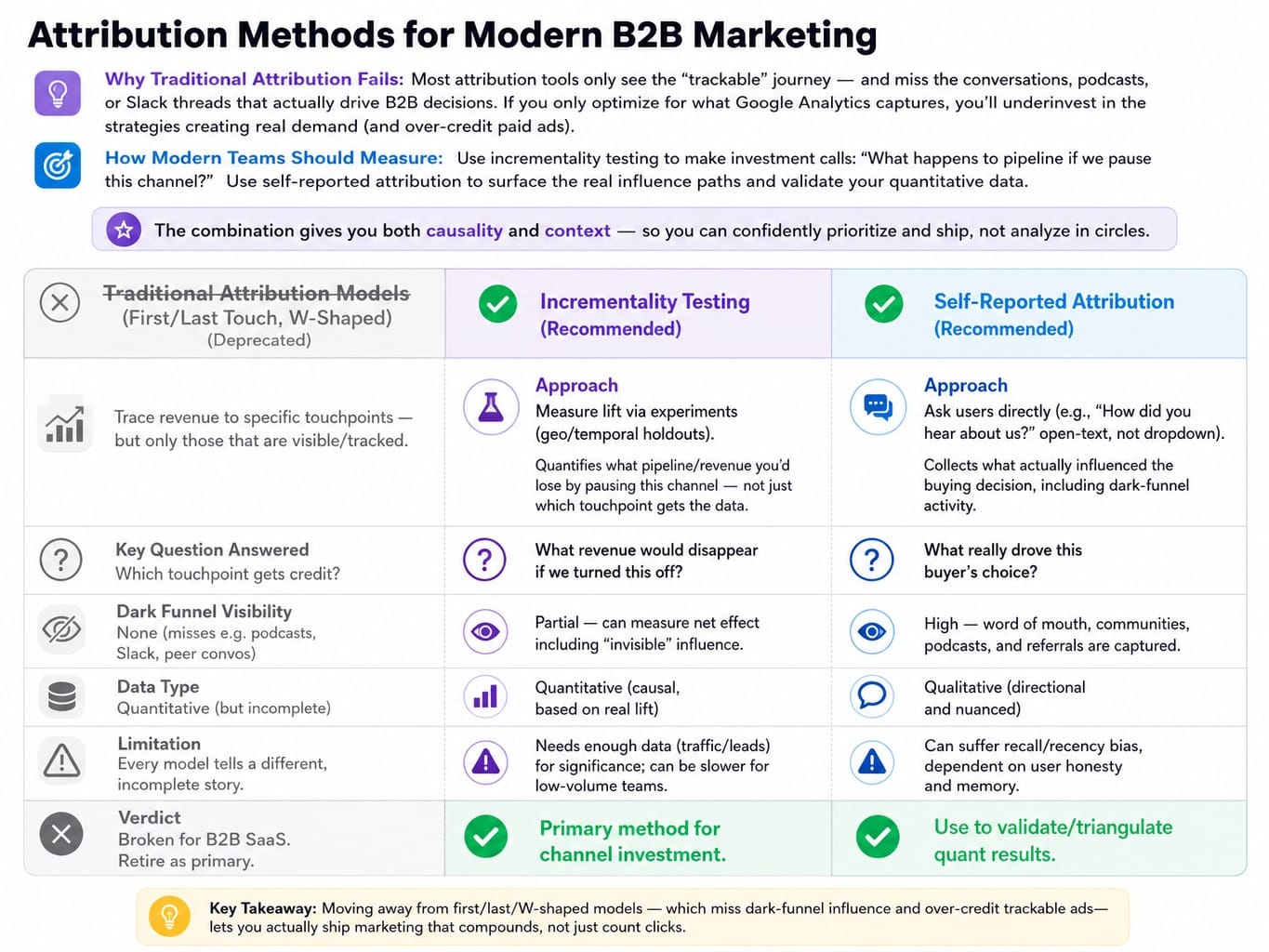
- Incrementality Testing: Instead of tracing individual conversions, measure the lift of a channel. Run geographic or temporal holdout experiments. For example, turn off branded search ads in five states for a month and measure the change in demo requests from that region compared to a control group. This answers, "What revenue would we lose if we turned this off?"—a far more valuable question than "Which touchpoint gets the credit?"
- Self-Reported Attribution: Add a simple, open-text field to your demo and signup forms: "How did you hear about us?" Treat the answers as a crucial qualitative signal to triangulate against your flawed quantitative data. Tools like Factors.ai are built around this principle, combining signal-based attribution with user-reported data to paint a more complete picture.
How to Prove Marketing ROI to Your CFO or Board
The final breakdown in the ROI system is often communication. Marketing teams present ROI using marketing language (MQLs, pipeline velocity, attribution models) when leadership thinks in financial language (payback period, gross margin, burn multiple). This mismatch causes boards to distrust marketing claims, even when the data is sound.
To bridge this gap, change your reporting language.
- Lead with CAC Payback Period, Not LTV:CAC. Payback period is a cash flow metric that CFOs immediately understand. It answers, "When do we get our money back?" LTV:CAC is a long-term projection they will instinctively challenge. Frame marketing as an investment that becomes cash-flow positive in X months.
- Present Cohort-Level ROI Over Time. Show a slide with cohort payback curves. Display the 90-day, 180-day, and 12-month ROI for customers acquired in each of the last four quarters. This visually demonstrates that marketing is a compounding investment, not a series of one-off bets.
- Use Marketing Efficiency Ratio (MER) as Your Headline Metric. Total Revenue / Total Marketing Spend. This simple ratio sidesteps the entire attribution debate. It gives leadership a single, high-level number to track quarter-over-quarter, showing the direct correlation between total spend and total revenue. You can support it with leading indicators like pipe-to-spend ratio, but MER is the ultimate financial proof.
One VP of Marketing we know switched from presenting a 47-slide attribution deck to a single slide showing the MER trend line and cohort payback curves. They got their budget approved in 15 minutes.
When ROI Stalls Because Execution Can't Keep Up With Measurement
You've done it. You've implemented cohort analysis, you're tracking MER, and you're reporting CAC payback to the board. You can now measure ROI with precision. But a new, more frustrating problem emerges: the numbers aren't moving.
You know your SEO content is underperforming. You know a key landing page has a 1.2% conversion rate. You know paid CAC is climbing. The measurement system is working perfectly, but the execution system is stalled. The time between identifying a problem and shipping a fix—through backlogs, planning, and approvals—stretches into weeks or months.
This is the execution gap, and it's where most marketing ROI initiatives die. Even with a solid marketing prioritization framework, the bottleneck shifts from knowing what to do to actually doing it fast enough.
Spike AI is the execution engine designed to close that gap. We turn your backlog of insights into a weekly release cadence. Every week, Spike AI identifies the single highest-impact move across your website, SEO content, or ads—and then executes it. Instead of one big optimization push per quarter, you get one meaningful improvement shipped every week. Each release compounds on the last, bending the ROI curve upward.
Where other tools give you another dashboard, Spike AI deploys the fix. It's the missing execution layer that connects your measurement system to financial results.
See how Spike AI turns your marketing backlog into weekly ROI gains — book a discovery call.
Your ROI Is a System, Not a Number
The single most important shift is this: SaaS marketing ROI is not a number you calculate once per quarter. It is a system you operate continuously.
Most teams miscalculate ROI because they measure at the wrong unit of analysis (campaigns instead of cohorts), the wrong time horizon (quarters instead of years), and through the wrong lens (attribution instead of incrementality).
The teams that win budget and drive growth are those that treat measurement and execution as a single, closed loop. They identify leverage in the system and apply resources to it, week after week. The next time you're asked, "What's marketing's ROI?", the answer shouldn't be a single number. It should be a trend line, showing how each week's disciplined execution compounds into revenue.
Frequently Asked Questions
How long should you wait before measuring ROI on a new SaaS marketing channel?
The minimum measurement window should be 1.5x your average sales cycle. If your cycle is four months, wait at least six months before drawing conclusions. Measuring earlier captures only the fastest-converting leads, which systematically overstates the channel's true ROI and ignores its contribution to longer, more complex deals.
What is the difference between marketing-sourced and marketing-influenced pipeline?
Marketing-sourced is pipeline where marketing created the first contact (e.g., a lead from a webinar). Marketing-influenced is pipeline where marketing touched the buyer at any point, even if sales created the contact. Most B2B SaaS companies should track both, but influenced pipeline is typically 2-4x larger and better reflects marketing's total revenue contribution.
How do you measure the ROI of content marketing specifically in SaaS?
Track which content assets appear in the journey of closed-won deals using a revenue attribution tool, not just traffic or leads. The formula is (Revenue from deals that touched content - Content cost) / Content cost. Be aware that content's ROI typically takes 6-12 months to materialize, making cohort analysis essential for honest measurement.
What marketing ROI benchmarks should seed-stage SaaS startups target?
Focus on CAC payback period (target under 18 months) and burn multiple (Net New ARR / Net Burn, target above 1.0x). At the seed stage, LTV data is too immature to calculate a meaningful LTV:CAC ratio. Payback period and burn efficiency are more honest indicators of whether your marketing spend is building a sustainable business.
How does net revenue retention change the way you calculate marketing ROI?
NRR over 100% means customers generate more revenue over time through expansion, increasing their effective LTV without new acquisition costs. This means marketing ROI improves retroactively. A cohort with a 150% ROI at 12 months may show a 300% ROI at 24 months if NRR is 120%. Ignoring NRR systematically undervalues your marketing.
What is the best attribution model for SaaS companies with both freemium and sales-led motions?
No single attribution model works for a hybrid motion. The buyer journeys are fundamentally different. The best practice is to run separate models for each motion (e.g., product analytics for PLG, CRM-based multi-touch for sales-led) and use Marketing Efficiency Ratio (MER) as the unified, top-level metric that captures total marketing efficiency across both.