
SaaS Marketing Tools in 2026: How to Build a Stack That Ships, Not Just Reports

TLDR
- Most SaaS marketing stacks fail because they are assembled by channel (SEO, email, etc.) instead of by execution layer (Identify, Prioritize, Ship, Measure).
- The biggest gap in most stacks isn't in identifying problems, but in prioritizing and shipping fixes without engineering dependencies.
- Your go-to-market motion dictates your stack. A tool that's essential for a Product-Led Growth (PLG) company can be useless for a sales-led one.
- Audit your stack for tool bloat by mapping every tool to an execution layer, checking integration depth, and running a "last login" report. Redundancy becomes obvious.
- The best SaaS marketing tools for 2026 aren't the ones with the most features—they're the ones that reduce your team's time-to-ship.
Your list of SaaS marketing tools probably looks familiar. There's a 3-person marketing team, 14 subscriptions—analytics, an SEO auditor, heatmaps, an email platform, A/B testing software, a CRM, an attribution tool—and a shared feeling of dread. Despite all this capability, the team ships fewer than five meaningful website or campaign changes a quarter.
The tools all work. The dashboards are full of data. The backlog of "should-fix" items grows every single week.
The problem isn't the quality of the tools. It's that the stack was built backwards, assembled around marketing channels because that's how vendors categorize themselves. The real constraint on growth isn't a lack of insight; it's the latency between finding a problem and shipping a solution.
The best SaaS marketing stacks in 2026 are organized by execution layer: Identify, Prioritize, Ship, and Measure. This guide maps 12 essential tools to that framework, shows you how to avoid tool bloat, and explains why your GTM motion changes everything.
What Are SaaS Marketing Tools?
SaaS marketing tools are software platforms that help subscription-based businesses acquire, convert, and retain customers across SEO, email, CRM, analytics, and conversion optimization. Unlike tools for e-commerce or media, a SaaS stack must solve for a unique lifecycle with distinct challenges.
These platforms are not just for generating traffic; they are integral to:
- Acquisition: Attracting and capturing the right prospective users.
- Conversion: Turning free trial users into paid customers.
- Retention: Reducing churn and increasing customer lifetime value.
- Analytics: Measuring product activation, user engagement, and expansion revenue.
Ultimately, the category a tool belongs to matters less than where it sits in the execution pipeline—the system that turns strategy into shipped work.
Why Most SaaS Marketing Stacks Underperform Despite Having the Right Tools
A growth marketer at a Series B SaaS company runs an Ahrefs audit on Monday, finding 23 technical SEO issues and 8 content gaps. On Wednesday, Hotjar reveals three high-exit pages in the pricing flow. By Friday, their email platform flags declining open rates on the onboarding sequence.
All three tools did their job perfectly. And nothing changed.
The marketer added every finding to a backlog that now contains 47 items, no clear prioritization model, and no immediate execution path. This isn't a hypothetical; it's the weekly reality for most lean marketing teams. We know this because the average B2B website conversion rate remains stuck around 2-3%, even as martech spending soars. More data hasn't led to better results.
The root cause is structural. Stacks are assembled by channel—one tool for SEO, one for email, one for analytics—because that's how vendors market themselves. But the actual constraint isn't "do we have an SEO tool?" It's "can we move from insight to a shipped change in under a week?"
This reveals the four-layer execution pipeline that marketing actually runs on:
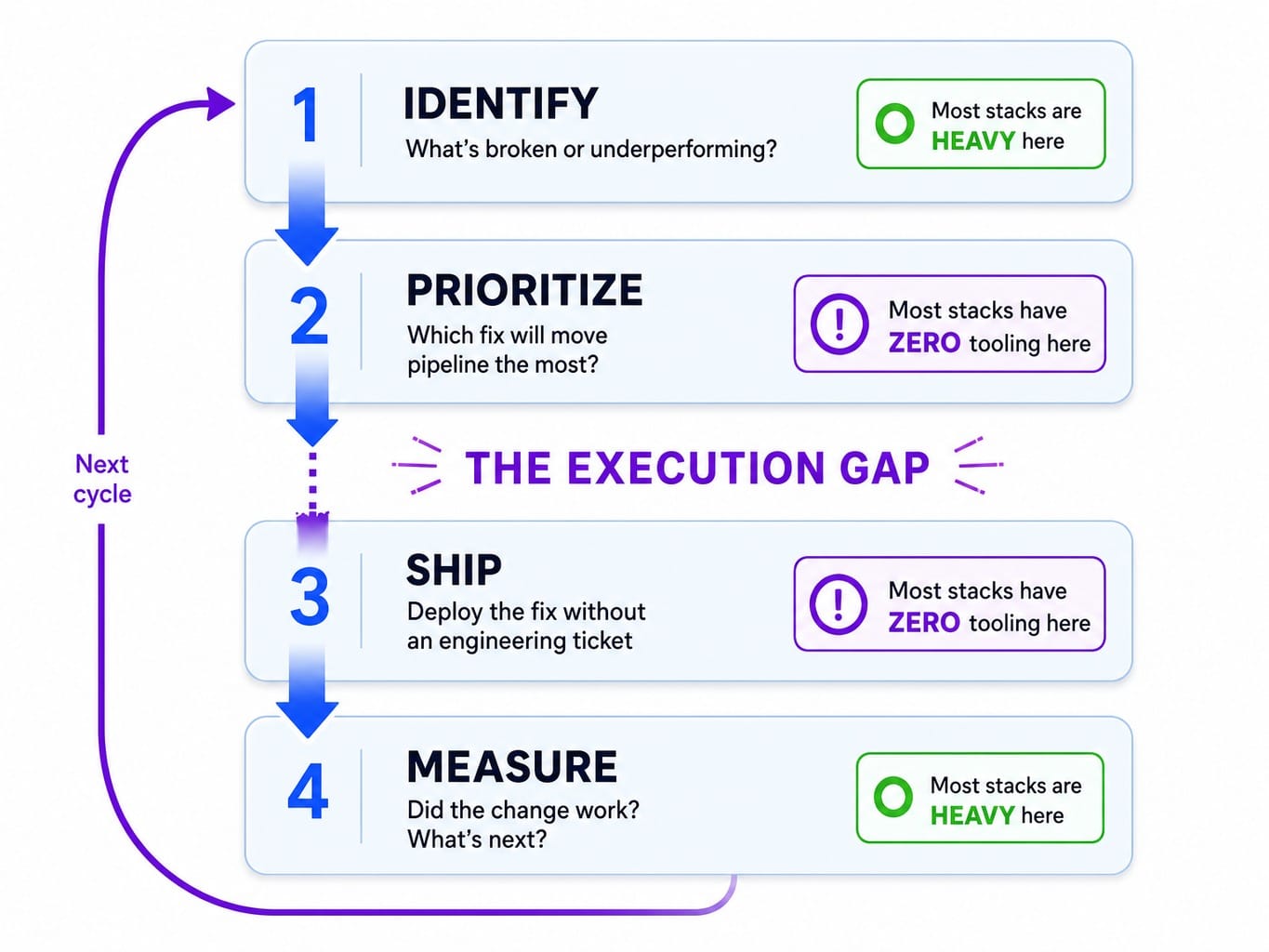
- Identify: What's broken or underperforming?
- Prioritize: Of all the broken things, which one will move pipeline the most if fixed?
- Ship: How do we deploy the fix without filing an engineering ticket?
- Measure: Did the change work, and what should we tackle next?
Most stacks are heavy on Identify and Measure but have zero tooling for Prioritize and Ship. That's the execution gap.
12 SaaS Marketing Tools Organized by Execution Layer
Instead of organizing by channel, this stack maps 12 essential B2B marketing tools to the four stages of execution. This reveals where your own process has gaps and which investments will actually increase your team's throughput.
Layer 1: Identify — Tools That Surface What's Broken
Identification tools are the starting point. They surface performance gaps across SEO, user behavior, and pipeline data, telling you what's underperforming and where. But remember, their job is to generate a list of problems, not to fix them.
Ahrefs: A complete SEO platform for identifying keyword opportunities, technical issues, and content gaps
Choose this when: Organic search is a primary growth channel and you need keyword-level data to prioritize content and technical fixes. It's the industry standard for a reason.
SaaS Use Case: Find "vs" and "alternative" keywords your competitors rank for but you don't, revealing bottom-of-funnel content gaps.
Integration: Connects with Google Search Console to overlay your site's performance data on Ahrefs' competitive insights.
Read more: SaaS Keyword Research: A Revenue-First Framework for 2026 | Spike AI
Hotjar: A behavior analytics tool that shows you how users interact with your site through heatmaps, session recordings, and feedback widgets
Choose this over FullStory when: You need to quickly diagnose UX friction on key landing pages, not conduct deep, session-level debugging across your entire application.
SaaS Use Case: Place a heatmap on your pricing page to see which features users hover over most and which parts they ignore completely.
Integration: Integrates with Google Analytics to let you filter recordings by traffic source.
Mixpanel: An event-based product analytics platform for understanding user activation, feature adoption, and retention
Choose this over Amplitude when: Your team is under 50 people and you need a faster setup with less configuration overhead to get immediate insights into your product-led growth motion.
SaaS Use Case: Build a funnel report to track where free trial users drop off during your activation flow, identifying the highest-impact onboarding fix.
Integration: Works with Segment to receive a clean stream of user event data from your app and website.
Layer 2: Prioritize — Tools That Rank What Matters Most
Most marketing stacks skip this layer entirely. They surface 30 issues and leave the marketer to guess which one will impact the MQL-to-SQL conversion rate. Prioritization tools replace guesswork with data, ranking opportunities based on revenue potential and buyer intent.
6sense: An intent data and account-based marketing (ABM) platform that uncovers which accounts are actively researching your solution
Choose this when: You're running an ABM strategy and need to prioritize accounts showing real-time buying signals (the "dark funnel") over those with a high static lead score.
SaaS Use Case: Create an audience of accounts visiting competitor pricing pages or high-intent review sites, then target them with personalized ads and sales outreach.
Integration: Native integrations with Salesforce and HubSpot push account-level intent data directly into your CRM.
Clearbit by HubSpot: A data enrichment platform that appends firmographic and technographic data to your inbound leads
Choose this when: You are already on HubSpot and need to instantly enrich inbound leads to score and route them correctly before a sales rep ever sees them.
SaaS Use Case: Use waterfall enrichment on a new trial signup to determine company size and industry, then trigger a personalized onboarding sequence tailored to that segment.
Integration: As a HubSpot product, its integration is seamless, making it the default choice for teams in that ecosystem.
HubSpot Marketing Hub: A comprehensive marketing automation platform with built-in lead scoring and attribution reporting
Choose this as your prioritization layer when: You need to tie MQL scoring directly to pipeline and revenue data within a single system. The native CRM connection eliminates the attribution gap that standalone tools often create.
SaaS Use Case: Build a lead scoring model that increases a contact's score when they visit the pricing page, watch a demo video, and fit your ICP based on enriched data.
Integration: Acts as the central hub, integrating with hundreds of other tools to become the system of record for customer data.
Layer 3: Ship — Tools That Deploy Changes Without Engineering Tickets
This layer is where most marketing backlogs go to die. Identification tools are abundant. Shipping tools—platforms that let marketers deploy website changes, landing pages, and personalization without filing an engineering ticket—are scarce, yet they determine your team's true velocity.
Mutiny: A no-code website personalization platform for B2B
Choose this when: You need to serve different headlines, social proof, and CTAs to different audience segments on your existing website without touching the codebase.
SaaS Use Case: Identify visitors from a target enterprise account (via reverse IP lookup) and dynamically replace your standard customer logos with logos from their industry.
Integration: Integrates with Clearbit and 6sense to power personalization based on firmographic and intent data.
Webflow: A visual-first CMS and website builder that empowers marketing teams to design, build, and launch pages independently
Choose this when: Your marketing team is constantly bottlenecked by engineering for simple landing page updates, blog posts, or new campaign pages.
SaaS Use Case: Create a new landing page for a webinar in under an hour, A/B test the headline, and update the content post-event without a single developer ticket.
Integration: Connects to Zapier, allowing you to automatically send form submission data to HubSpot, Salesforce, or a Google Sheet.
Zapier: A workflow automation tool that connects thousands of apps, allowing you to trigger actions across your stack without writing code
Choose this when: You need to connect two or more tools that don't have a native integration. It's the glue for a composable marketing stack.
SaaS Use Case: Build a multi-step "Zap" that triggers when a user signs up for a trial: enrich the lead with Clearbit, create a contact in HubSpot, and send a notification to the sales team in Slack.
Integration: Zapier is the integration layer, connecting everything from Ahrefs to Zoom.
Layer 4: Measure — Tools That Close the Loop
Measurement is not a retrospective exercise; it's the input for the next execution cycle. Identification tells you what's broken before you act. Measurement tells you if what you shipped actually worked and what to prioritize next.
Segment: A customer data platform (CDP) that collects, cleans, and controls your customer data
Choose this when: Your customer data is fragmented across five or more tools, leading to inconsistent analytics and broken attribution.
SaaS Use Case: Implement Segment once on your website and in your product, then use it as a single, reliable event stream to feed data to Mixpanel, HubSpot, and Google Ads simultaneously.
Integration: Acts as a data switchboard, with pre-built integrations to over 400 marketing and analytics tools.
Dreamdata: A B2B revenue attribution platform designed to track the long, complex journey of a SaaS buyer
Choose this when: You need to attribute pipeline and revenue to specific marketing touches across a multi-month sales cycle. Standard analytics like GA4 cannot do this because they are session-based, not account-based.
SaaS Use Case: Discover that a series of blog posts influenced three key stakeholders at a target account over six months before they finally requested a demo.
Integration: Pulls data from your CRM (HubSpot, Salesforce), ad platforms (LinkedIn, Google), and customer success tools to build a unified account journey.
Databox: A business analytics platform for building and sharing reports from multiple sources in one centralized dashboard
Choose this when: Your team needs a single view of performance across HubSpot, Google Ads, GA4, and Ahrefs without building and maintaining custom dashboards.
SaaS Use Case: Create a weekly marketing dashboard that shows CPL blended vs. isolated, MQLs by source, and ARR impact per channel, automatically delivered to your team's Slack channel.
Integration: Features native integrations with over 70 of the most popular marketing tools.
PLG vs. Sales-Led: Why the Same Tools Fail in Different Go-to-Market Motions
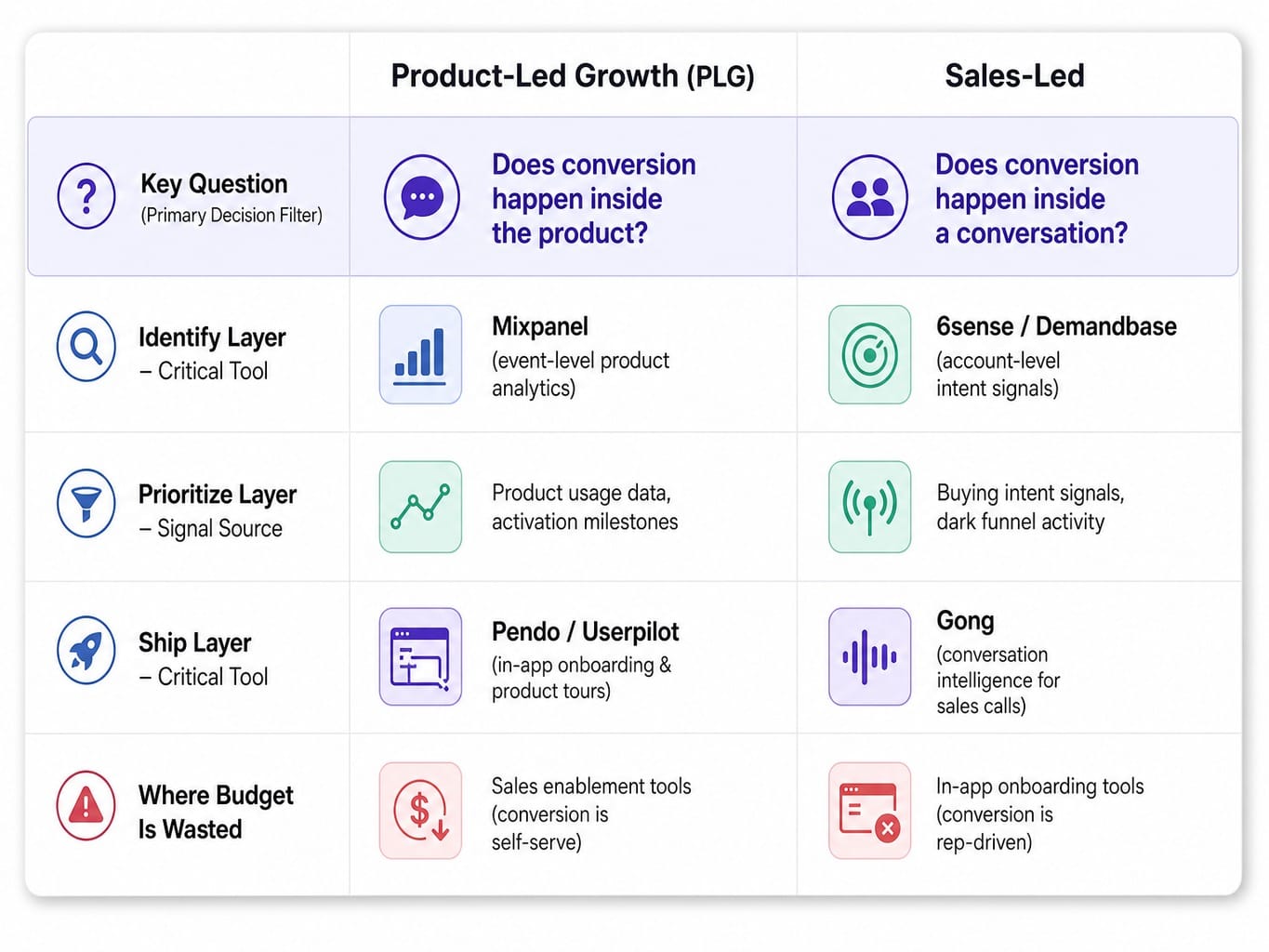
A tool that is essential in a Product-Led Growth (PLG) motion can be irrelevant—or actively harmful—in a sales-led one, and vice versa. Building an effective stack requires knowing which GTM motion you're running.
Consider two contrasts. In a PLG company like Notion, a tool like Pendo or Userpilot (for in-app onboarding and product tours) is a core part of the Ship layer. The product is the sales funnel; if users don't activate during their trial, no amount of email nurturing will save the deal. For a traditional sales-led company, that same budget is far better spent on Gong (conversation intelligence), because the critical conversion happens inside a sales call, not inside the product.
Similarly, a PLG company lives and dies by event-level product analytics, making Mixpanel a non-negotiable part of its Identify layer. A sales-led company, however, cares more about account-level intent signals to prioritize outreach, making a tool like 6sense or Demandbase the more critical investment for its Prioritize layer.
Before adding any tool, ask this one question: Does our conversion happen inside the product or inside a conversation? That single filter eliminates half the tools on any recommendation list.
How to Audit Your Stack for Tool Bloat Without Losing Functionality
The average SaaS marketing team spends $5,000-$15,000/month on tools, and according to Gartner, utilizes only 33% of their martech stack's capabilities. Much of the rest is redundant functionality that no one has audited.
Tool bloat is a symptom of channel-based stack building. When you organize by execution layer, redundancy becomes obvious. Here is a 3-step audit you can run this week:
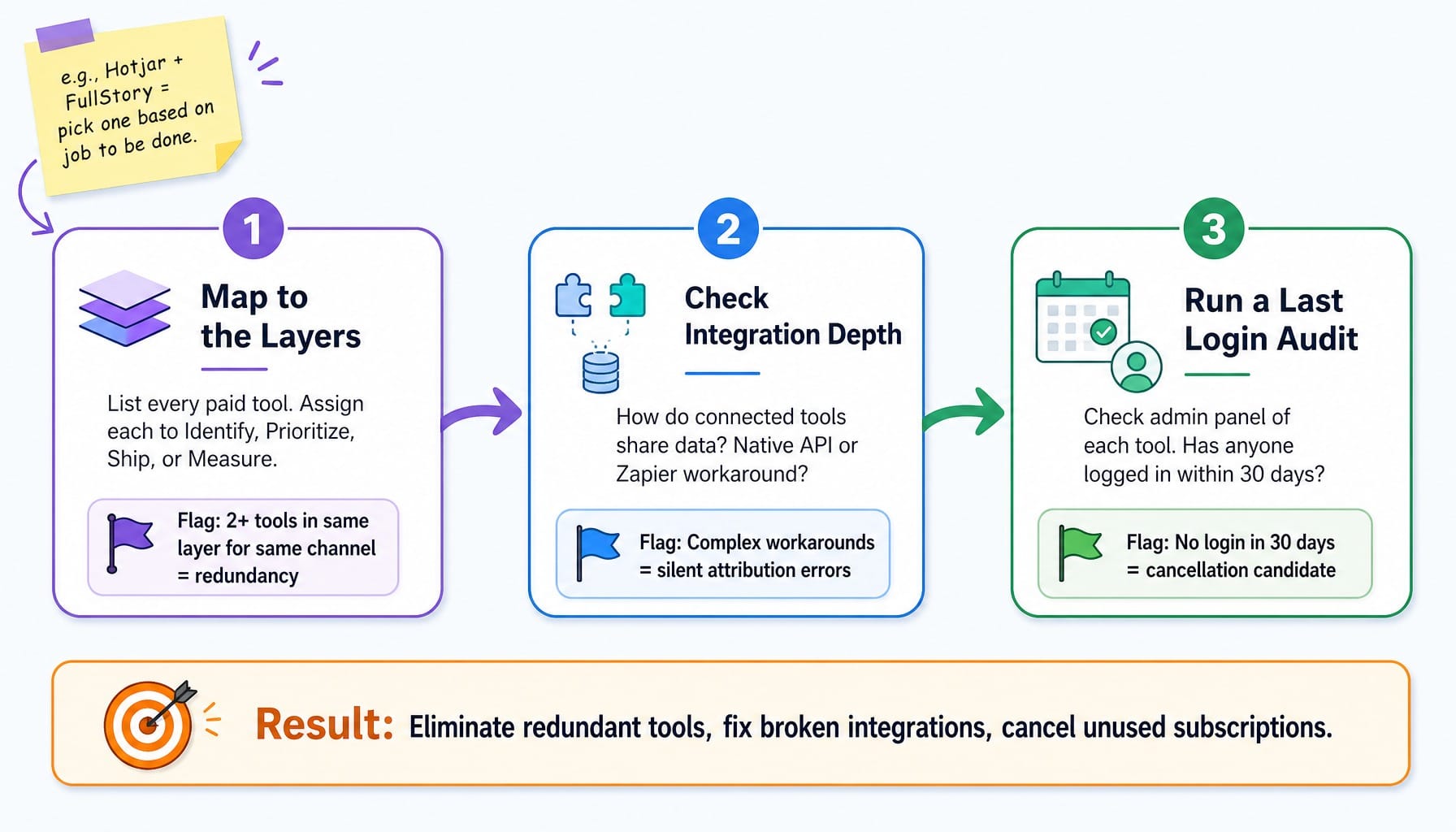
- Map to the Layers: Create a spreadsheet and map every single marketing tool you pay for to one of the four execution layers: Identify, Prioritize, Ship, or Measure. If two or more tools serve the same layer for the same channel, one is likely redundant.
- Check Integration Depth: For tools that are supposed to work together, how do they share data? If they require a complex Zapier workaround to stay in sync, the data lag is creating silent attribution errors and operational drag. A truly integrated stack has deep, native connections.
- Run a "Last Login" Audit: Check the admin panel of each tool. Any platform that no one on your marketing team has logged into in the last 30 days is a prime candidate for cancellation, regardless of its theoretical value.
For example, if you're paying for both Hotjar and FullStory, you likely only need one. Choose Hotjar if you primarily need quick heatmaps and surveys on marketing pages. Choose FullStory if your product team needs deep, session-level debugging for complex application flows. Be honest about the job to be done.
What If One Platform Covered Identify, Prioritize, and Ship?
This article has built a specific tension: most marketing stacks are strong on identification and measurement but have a structural hole in prioritization and shipping. Your real constraint isn't which SEO tool to use, but how to close the gap between what your tools surface and what actually gets deployed.
This is the execution gap Spike AI was built to close.
Spike AI is a marketing execution platform that collapses the Identify → Prioritize → Ship pipeline into a single, closed loop. It ingests signals from across your marketing footprint—SEO, CRO, and ads—to continuously identify the single highest-impact move for generating qualified leads. Then, it helps you execute it.
This isn't a replacement for your entire stack. It's the missing execution layer that makes your existing tools like Ahrefs, Hotjar, and HubSpot more productive. It's the system that turns dashboards full of insights into a rhythm of weekly shipped improvements. Each release feeds the next prioritization cycle, creating a compounding loop where your marketing gets measurably better every week, not every quarter.
See how Spike AI turns your marketing backlog into weekly shipped improvements →
Your Stack Isn't Broken, Your Architecture Is
The next time you evaluate a SaaS marketing tool, don't start by asking what features it has. Ask which execution layer it serves.
Most stacks are assembled by channel because that's how vendors sell. But the teams that compound growth are the ones who architect their stack to close the loop from insight to shipped change in days, not weeks. They obsess over reducing the time-to-value of a marketing idea.
Map your current stack to the four layers. If Prioritize and Ship are empty, that's not a tool problem. It's an architecture problem. Fix the architecture first.
Frequently Asked Questions
How much should a SaaS startup spend on marketing tools annually?
Seed-stage teams should budget $500-$1,500/month, focusing on one core tool per execution layer (e.g., Ahrefs, HubSpot free, Webflow, GA4). Series A and beyond typically spend $3,000-$10,000+/month as they add intent data, CDP, and personalization. The benchmark isn't a fixed percentage of revenue; it's whether every tool in the stack was actively used in the last 30 days.
What is the difference between demand generation tools and lead generation tools?
Lead generation tools capture known intent—forms, gated content, and chatbots that collect contact info. Demand generation tools create intent before capture—content distribution, paid media, community platforms, and brand awareness. Most SaaS teams over-invest in lead capture and under-invest in demand creation, which is why CPL rises as the pool of "already interested" buyers shrinks.
Are AI-powered marketing tools replacing traditional marketing automation platforms?
Not replacing, but layering on top. Platforms like HubSpot still manage core workflows, but AI-native tools add capabilities they lack, like real-time personalization (Mutiny) or predictive prioritization (6sense). The risk is adding AI tools that duplicate what your existing platform already does. Audit for functional overlap before you buy.
How do B2B SaaS companies track multi-touch attribution accurately?
Session-based analytics (GA4) can't track B2B buying journeys that span months and multiple stakeholders. Use an account-based attribution platform like Dreamdata or HockeyStack that stitches every anonymous visit, ad click, and sales interaction into a single account timeline. This requires connecting your CDP (like Segment) so every touchpoint feeds the same model.
What is the role of a customer data platform in a B2B SaaS marketing stack?
A CDP like Segment collects event data from your website, product, and tools into a single, clean stream, then routes it to every other platform (analytics, email, CRM). Without a CDP, each tool has its own partial view of the customer, which is why attribution breaks and personalization feels generic. It's the connective tissue that makes the rest of the stack trustworthy.
Which marketing tools help improve trial-to-paid conversion rates?
Three categories matter most: in-app onboarding tools (Userpilot, Pendo) that guide users to activation milestones; behavioral email platforms (Customer.io) that trigger messages based on product usage, not time delays; and product analytics (Mixpanel) that show exactly where trial users drop off. Optimizing the marketing site is easy; optimizing the in-product experience is what drives conversion.