SaaS Outbound Marketing: 7 Signal-First Strategies That Actually Convert in 2026
TLDR
- Most SaaS outbound fails because it's treated as a volume game. The winning model in 2026 is a signal-first intelligence game, replacing static lists with real-time buyer intent triggers.
- Aggressive, untargeted outbound creates "deliverability debt," damaging your domain reputation and making future campaigns less effective. Protecting your domain is a core strategy, not just a technical task.
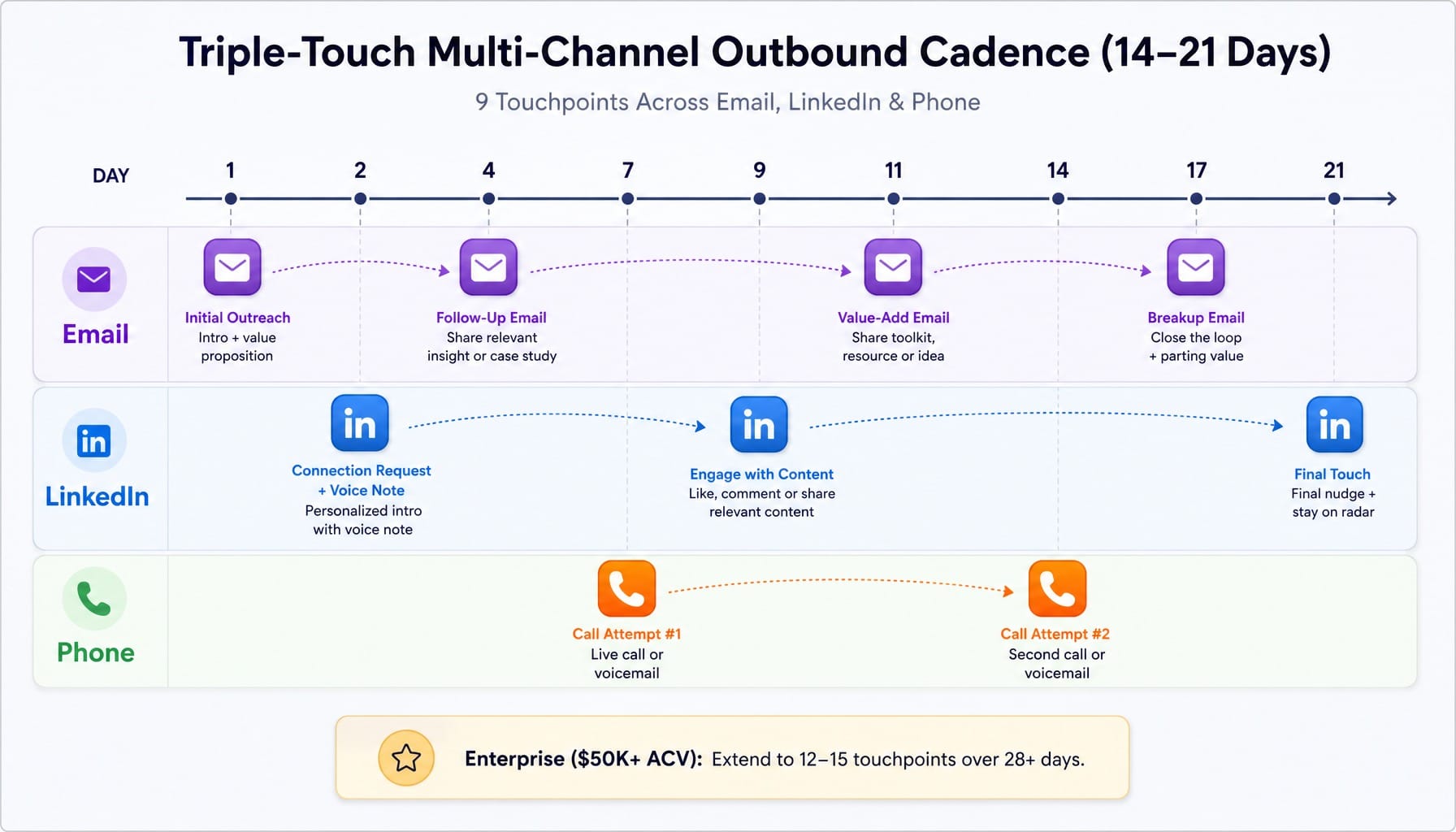
- The highest-performing outbound cadences are multi-channel, using a "triple-touch" approach (email, LinkedIn, phone) across 7-9 touchpoints over 14-21 days for mid-market deals.
- Even the best outbound sequence fails if the prospect clicks through to a generic website. The post-click experience is the most overlooked part of the outbound stack.
- Add outbound to your inbound model when you move upmarket (ACV >$25k), enter a new market with no brand awareness, or when inbound consistently covers less than 70% of your pipeline target.
Your team loads 5,000 contacts into Instantly. You write three email variants with spintax, launch a 5-step sequence, and then watch the results. The positive reply rate stalls at 0.4%. Your primary domain's sender reputation, which you weren't even tracking, drops from 95 to 72 in six weeks.
This isn't a hypothetical. It's the median outcome for SaaS teams running outbound as a volume play in 2026.
SaaS outbound marketing isn't broken, but the way most teams practice it is. They treat it as a numbers game when it is fundamentally an intelligence game. The companies generating real pipeline from outbound have replaced static, list-based campaigns with signal-routed sequences that respond to buyer behavior in near real-time.
This isn't about sending more emails; it's about sending the right email at the exact moment a prospect becomes receptive. This guide covers what signal-first outbound actually looks like, seven specific strategies with tool-level detail, and how to integrate outbound with inbound without cannibalizing either channel.
What Is SaaS Outbound Marketing?
SaaS outbound marketing is the practice of proactively initiating contact with targeted prospects who match your ideal customer profile but have not yet engaged with your brand. Unlike inbound, which waits for demand to express itself, outbound manufactures the first conversation. In 2026, however, the best outbound teams no longer manufacture conversations from static lists. They manufacture them from live signals: job changes, tech stack shifts, funding events, competitor churn indicators, and content engagement patterns.
This distinction is critical. Generic B2B outbound can still function in less saturated markets. But SaaS buyers are drowning in a flood of AI-generated cold emails. To earn attention, SaaS outbound must be an exercise in extreme relevance and perfect timing, not brute-force volume. This higher bar requires a different system, one designed for precision from the ground up. This article covers how to build it.
Why Most SaaS Outbound Marketing Fails in 2026
The default SaaS outbound playbook—buy a list, write a sequence, blast it—was viable in 2021. In 2026, it is structurally broken for three specific reasons.
First is the AI-SDR inbox flood. Every prospect in your ICP now receives 30-50 AI-generated cold emails per week. The result isn't just lower reply rates; it's active hostility toward cold outreach. When every company has access to the same AI writing tools, personalization at scale becomes indistinguishable from spam at scale. A {{first_name}} and {{company}} merge field no longer signals relevance; it signals automation.
Second is domain reputation as hidden debt. Aggressive sending volumes (200+ emails/day from a single secondary domain without proper warm-up pool management) accumulate what can only be called deliverability debt. A mid-market SaaS team can burn through four secondary domains in three months, watching their inbox placement rates drop below 60% as DKIM/DMARC/SPF alignment drifts. This isn't a temporary problem. The compounding effect means each damaged domain makes the next campaign harder to execute, eventually impacting the deliverability of your primary domain—including customer success and transactional emails.
Third is the failure of spray-and-pray economics. The math no longer works for most. If your positive reply rate is a typical 1.5% and your reply-to-meeting conversion is 30%, you need to contact 2,222 prospects to book 10 meetings. At a $15K CAC target, that math only works if your ACV is high enough to justify the burn. For most mid-market SaaS ($5K-$20K ACV), this model is a fast path to a negative ROI unless targeting precision is exceptionally high. Outbound failure today is systemic, not tactical. The fix is architectural, not cosmetic.
Signal-First Outbound: The Model That Replaces Static Lists
The highest-performing SaaS outbound teams in 2026 do not start with a list. They start with a signal.
Signal-first outbound is the practice of routing real-time buyer intent signals—job changes, technology adoption events, funding rounds, competitor churn indicators, content engagement spikes—directly into personalized outbound sequences, so that every email or LinkedIn message arrives at the moment of highest receptivity.
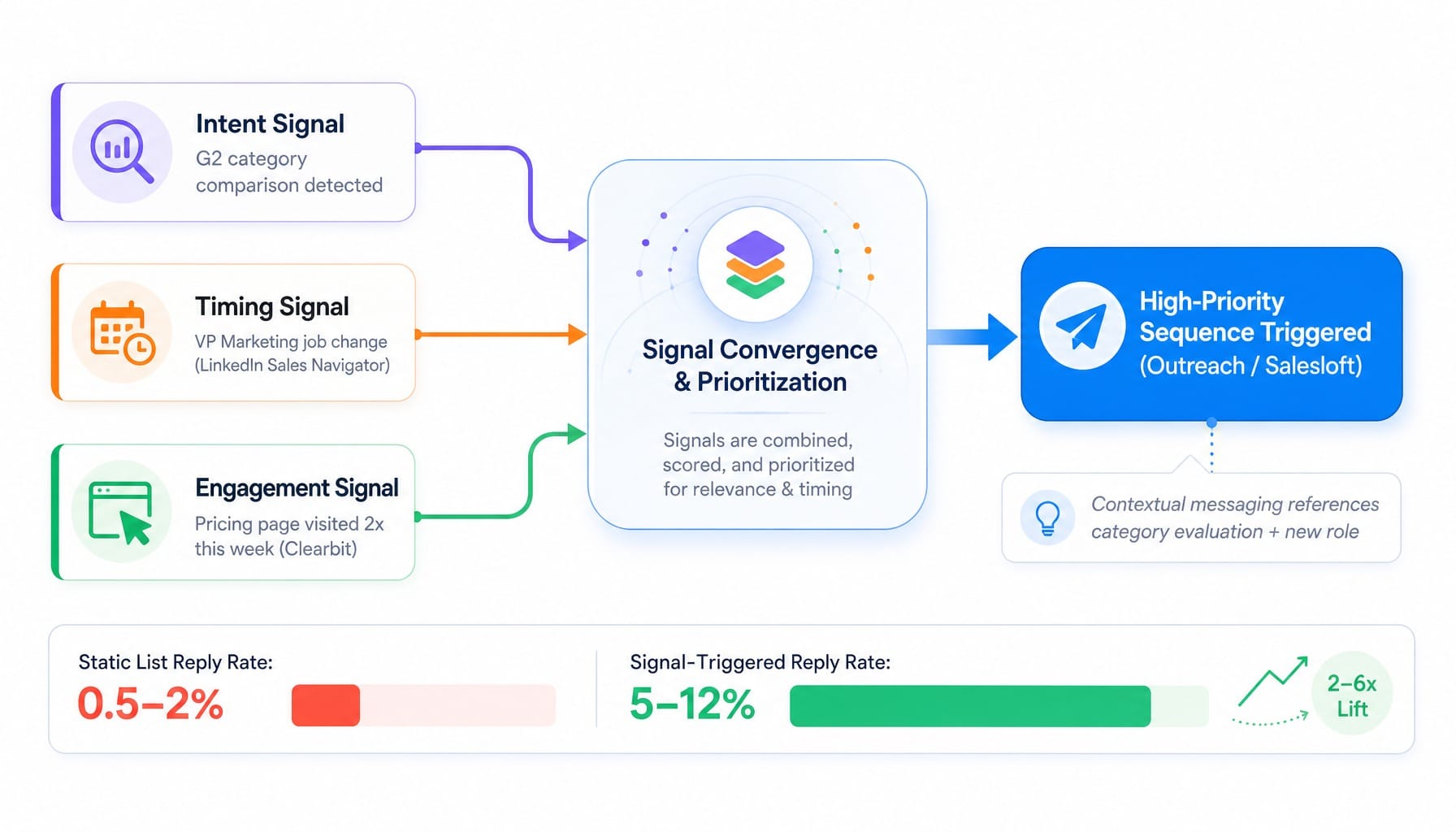
Consider this signal-to-sequence routing example:
- A prospect's company appears on G2 comparing your category (Intent Signal).
- Their VP of Marketing just changed jobs, per a LinkedIn Sales Navigator alert (Timing Signal).
- They visited your pricing page twice this week, revealed by a tool like Clearbit (Engagement Signal).
Instead of sitting in a static list, these three signals converge. A system triggers a specific, high-priority sequence in Outreach or Salesloft. The messaging references the category evaluation and the new role, not a generic value proposition. The result is a positive reply rate that jumps from the typical 0.5-2% for static lists to 5-12% for signal-triggered sequences.
This architectural shift changes the SDR's job from "find people to email" to "respond to signals the system surfaces." It's the sniper approach versus spray and pray, but systematized. Building it involves a modern stack:
- Signal Aggregation: Clay for waterfall enrichment and pulling signals from dozens of sources.
- Community & Product Signals: Common Room to identify engaged users in communities or product-led funnels.
- Contact & Company Data: Apollo.io or ZoomInfo for foundational data.
- Sending Infrastructure: Instantly or Smartlead for managing warm-up pools and scaled sending.
- Message Quality: Lavender for real-time email copy scoring.
This is more than a tactic; it's a fundamental re-architecture of the outbound function.
7 SaaS Outbound Marketing Strategies That Drive Pipeline in 2026
These seven strategies are ordered from foundational (do these first) to advanced (layer these on once the foundation is working). Each builds on the last, forming a complete system for signal-driven outbound.
1. ICP-Led Prospecting With Waterfall Enrichment
ICP segmentation is table stakes, but most teams stop at firmographics (company size, industry). The differentiator is waterfall enrichment. This involves using tools like Clay to layer firmographic, technographic, and intent data sequentially, so each prospect record is enriched from multiple sources before entering a sequence. You start with a broad list and progressively filter it down based on increasingly specific criteria. This also helps you achieve the ideal contact-to-account ratio of 3-5 contacts per target account, ensuring you can reach the full buying committee. For lookalike account discovery, tools like Ocean.io can expand your TAM with high-fit prospects.
2. Multi-Channel Outbound Cadences Beyond Email
Email-only outbound is the weakest configuration. A triple-touch cadence—email, a LinkedIn connection request with a voice note, and a well-placed phone call—outperforms email-only approaches by creating pattern recognition in the prospect's mind. For mid-market SaaS, 7-9 touchpoints over 14-21 days is the current sweet spot. Enterprise deals ($50k+ ACV) warrant longer sequences, often 12-15 touchpoints over 28+ days. Platforms like Salesloft and Outreach are built to orchestrate these complex, multi-channel sequences and prevent channels from colliding.
3. Cold Email Personalization That Survives the AI Inbox Flood
"Personalization at scale" is a broken concept. Inserting {{first_name}} and {{company}} into a template is now a clear signal of low-effort automation. The new bar is contextual personalization: referencing a specific signal (their recent blog post, a job listing they posted, a product launch) in the opening line, then connecting it to a relevant problem your product solves. This is about demonstrating you've done the work. Use tools like Lavender for real-time email quality scoring and run constant sequence A/B splits in your sending platform to test which subject lines and opening hooks generate the highest positive reply rate.
4. LinkedIn Outbound Prospecting With Content Hooks
The most effective LinkedIn outbound leads with value, not a pitch. The best hook is often original content—a short post, a data point, a framework—that the prospect would find genuinely useful. This is an example of outbound-inbound convergence: the outbound touch triggers inbound engagement. They visit your profile, read your content, and check your website, all without you having to ask for a meeting. LinkedIn Sales Navigator is essential for identifying active prospects, and tools like Gong can analyze call and email data to reveal which messaging patterns generate the most engagement.
5. Account-Based Marketing for Enterprise SaaS Deals
ABM is not a separate strategy from outbound; it is outbound applied at the buying committee level. Where standard outbound targets individuals, ABM targets accounts by systematically mapping the entire buying committee—typically 6-10 stakeholders in an enterprise SaaS deal. This is the critical step most teams skip. You then run coordinated, multi-threaded sequences across all of them. This approach is only cost-effective for deals with an ACV above $50,000; below that, the coordination overhead often exceeds the deal's value. ABM is how you penetrate high-value accounts, while ICP-led prospecting is how you find them.
6. Founder-Led Outbound Beyond the First 50 Customers
Founder-led outbound is the highest-converting channel for any early-stage SaaS, but most founders abandon it after the first 50 customers because it feels unscalable. This is a mistake. The solution is to systematize the founder's voice, not have the founder personally send every email. The founder writes the core messaging frameworks and records 2-3 short, authentic Loom-style videos. Then, SDRs execute sequences that reference the founder by name and link to that content. This preserves the authority signal of the founder's voice while distributing the execution workload, allowing the magic of founder-led selling to scale.
7. Domain Reputation Protection as an Outbound Strategy
Domain reputation is the most overlooked variable in SaaS outbound. Protecting it is a strategy, not just a hygiene task. Key components include a secondary domain strategy (never send cold outbound from your primary marketing domain), ensuring perfect DKIM/DMARC/SPF alignment, managing a warm-up pool with tools like Instantly or Smartlead, and implementing bounce rate throttling to keep bounces below 3% per campaign. The hidden cost of failure is immense: a damaged domain doesn't just hurt outbound; it degrades deliverability for your entire company, including critical customer and transactional emails. Domain reputation is a compounding asset or a compounding liability.
SaaS Outbound vs. Inbound Marketing: When Each Wins
The question isn't "outbound or inbound?" but "which channel solves which constraint at which stage?" A SaaS company entering a new vertical with zero organic authority cannot wait 9-12 months for SEO to generate pipeline. Outbound is the only viable channel for the first two quarters. Conversely, a PLG company with a $2k ACV will find outbound CAC far exceeds deal value.
Here's a breakdown of when each channel is the superior choice:
The verdict: Outbound wins when you need pipeline now, when your ACV exceeds $25K, or when you're entering a market where you have no brand awareness. Inbound wins when your ACV is below $10K, when you have time to let content compound, or when your total addressable market is large enough that self-serve discovery is efficient.
However, a company with a $100K+ ACV and only 200 target accounts in their entire market should be 80% outbound, even with a strong inbound engine. The TAM is simply too small for broad-based inbound to reach efficiently.
Read more: 7 SaaS Inbound Marketing Strategies That Actually Build Pipeline (Not Just Traffic)
When to Add Outbound to an Existing Inbound-Led SaaS Growth Model
Adding outbound to a successful inbound model is a timing decision, not a philosophical one. There are three specific triggers that tell you it's time.
- The Pipeline Gap Becomes Structural. Your inbound pipeline covers less than 70% of your quarterly target for two consecutive quarters. The gap is no longer seasonal; your inbound engine has hit a local maximum, and you need a new, proactive channel to close the delta.
- You're Moving Upmarket. Your ACV is increasing from $10K to $25K+, but your inbound leads are increasingly mismatched to your new ICP. A PLG SaaS company that relied on self-serve signups, for instance, will find its blog-driven pipeline cannot reach the VP-level buyers needed for $30K deals.
- You're Entering a New Market Segment. You have zero brand awareness and zero organic ranking in a new vertical or geography. Outbound is your only channel for market penetration and initial customer validation while you invest in long-term content that will take 6-12 months to mature.
A word of caution: adding outbound before you have a clear ICP and a messaging framework that converts is worse than not adding it at all. You will burn through domains and budget simultaneously, learning nothing.
Read more: Pipeline Marketing in 2026: Strategy, Metrics, and Why Most Teams Regress to Lead Gen
Why Your Outbound Results Depend on What Happens After the Click
This entire article has focused on optimizing everything before the click: signal quality, list hygiene, messaging, cadence timing. But even the best outbound sequence fails if the prospect clicks through to a website that doesn't convert. This is the gap most outbound playbooks ignore.
When a prospect lands on your site from an outbound touch, they are evaluating your credibility in seconds. Does the landing page speak to their specific problem? Is the call-to-action clear? Does the page feel trustworthy? Most SaaS teams treat their website as a static asset while running dynamic outbound campaigns—and the mismatch kills conversion. You can have a 10% positive reply rate, but if your landing page only converts at 1%, your entire system is broken at its most critical joint. The investment in outbound is wasted.
Spike AI continuously identifies and ships the highest-impact website and landing page optimizations every week. When outbound drives a prospect to your site, the page they land on is already optimized to turn their interest into pipeline. It's the missing layer in the outbound stack—the part that ensures your investment in generating clicks translates into revenue.
Conclusion
SaaS outbound marketing in 2026 is not a volume game. It is an intelligence game where signal quality, domain health, and post-click conversion determine whether outbound becomes a revenue channel or a cost center. The teams winning have moved beyond the noise. They've replaced static lists with signal-routed sequences, protected their domain reputation as a strategic asset, and ensured their website converts the high-intent traffic that outbound generates.
The bar for earning a prospect's attention will only continue to rise as AI-generated outreach saturates every inbox. The only sustainable advantage left is being more relevant, better timed, and more trustworthy than the noise. That requires a system, not just a sequence.
Frequently Asked Questions
What cold email reply rates should SaaS companies realistically expect in 2026?
Untargeted cold email positive reply rates have dropped to 0.5-2% due to AI-generated email saturation and tighter spam filtering. In contrast, signal-triggered sequences targeting prospects showing active buying behavior typically achieve 5-12% positive reply rates.
Should SaaS startups hire SDRs or outsource outbound lead generation?
Hire in-house SDRs if your ACV exceeds $15K and you've already validated the outbound messaging yourself. Outsource only to test viability before committing headcount, but set a 90-day evaluation window with clear pipeline velocity benchmarks, not just meeting volume.
How many touchpoints should a SaaS outbound sequence include before stopping?
For mid-market SaaS ($5K-$25K ACV), 7-9 touchpoints across email, LinkedIn, and phone over 14-21 days is ideal. For enterprise ($50K+ ACV), extend this to 12-15 touchpoints over 28+ days. Stopping too early wastes the list.
How do you personalize outbound messages at scale without sounding robotic?
Replace variable-based personalization (e.g., {{company}}) with signal-based personalization. Reference a specific event—a job change, a funding round—in your opening line, then connect it to a problem you solve. Use tools like Lavender to score message quality pre-send.
What metrics should SaaS companies track to measure outbound marketing ROI?
Track positive reply rate (not open rates), meeting booked rate, pipeline velocity per SDR, cost per sales qualified lead, and inbox placement rate. Vanity metrics like total emails sent create false confidence; only pipeline generated connects activity to revenue.