SaaS PLG: Why Most Product-Led Growth Motions Stall and How to Fix the Execution Gap

TLDR
- Product-led growth (PLG) fails on execution velocity, not strategy. The latency between identifying a fix and shipping it is the single biggest growth constraint.
- The five essential diagnostic metrics for any SaaS PLG motion are Time to Value (TTV), Activation Rate, PQL Conversion Rate, Free-to-Paid Conversion Rate, and Net Revenue Retention (NRR).
- Pure PLG is rare. The dominant model for 2026 is a hybrid approach (Product-Led Sales) where human touch is layered onto a self-serve foundation based on product usage signals.
- A working PLG motion requires a disciplined weekly shipping cadence for product improvements and a real-time, signal-based PQL routing pipeline to bridge the gap between product and sales.
- Most PLG backlogs are filled with high-impact optimizations that never get deployed. The solution isn't more ideas; it's a system that turns that backlog into weekly releases.
While over 60% of SaaS companies now run some form of a product-led growth (PLG) motion, a stark reality is setting in. According to a 2025 SlashExperts report, 85% of PLG transformations fail to meet their objectives due to execution failures, not flawed strategy. The industry has converged on PLG as the default go-to-market, but most teams treat it as a strategic label rather than the demanding execution system it truly is.
Teams adopt a freemium model, redesign their user onboarding flow, and define Product Qualified Leads (PQLs) on a whiteboard. Then, they stall. The distance between identifying what needs to change in the product experience and actually shipping that change stretches from weeks into months.
This is the central failure mode of modern SaaS PLG. The problem isn't the model; it's the shipping velocity. PLG succeeds or fails based on how fast a team can iterate on the product experience itself. This guide breaks down what PLG demands as an execution system, the metrics that diagnose its health, and why most implementations decay from a lack of deployment cadence.
What PLG Actually Means as an Execution Model
Product-led growth is not a go-to-market strategy you choose; it's an execution constraint you accept. When you remove salespeople from the initial conversion path, every point of friction in your product—every confusing UI element, every poorly timed paywall, every broken onboarding step—becomes a revenue leak that only shipping fixes can close.
Consider a B2B SaaS tool where 40% of free trial signups never complete the third onboarding step. In a traditional sales-led model, a sales rep gets an alert and calls them to overcome the friction. In a PLG model, that 40% drop-off is a silent churn event that persists until a product or growth team:
- Identifies the friction point using usage telemetry from a tool like Amplitude or PostHog.
- Diagnoses the root cause.
- Designs a fix.
- Gets the fix prioritized, coded, and deployed.
In most organizations, that cycle takes three to six weeks. For a PLG company, that latency is a direct tax on growth. The PLG flywheel of acquisition, engagement, and monetization only spins if product changes ship fast enough to compound. As data from the OpenView Partners PLG Index shows, top-quartile PLG companies ship meaningful product changes 3-4x more frequently than their peers. They don't have better strategies; they have a superior execution cadence.
PLG vs. Sales-Led vs. Hybrid: When Each Model Breaks
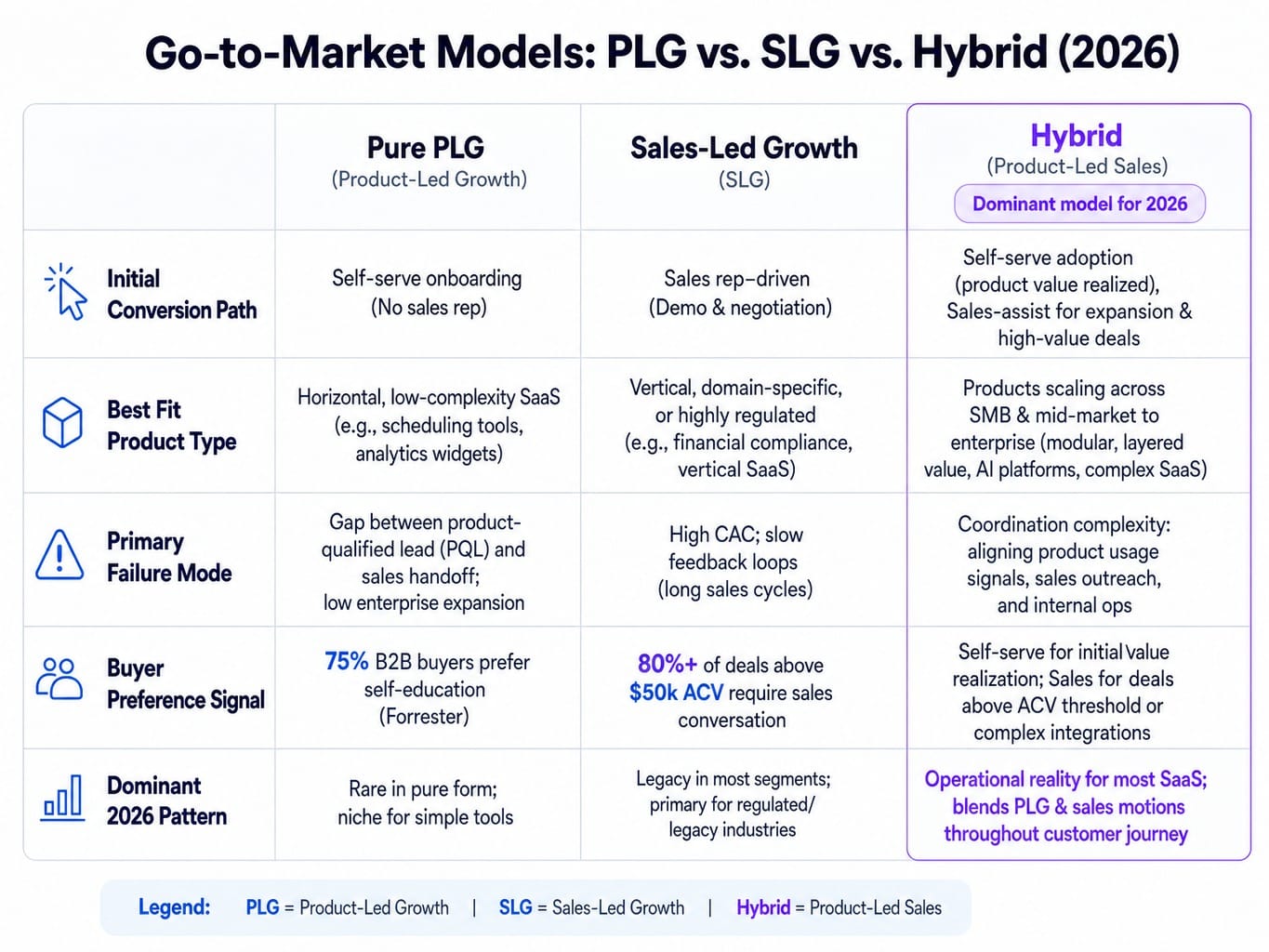
The debate over PLG versus sales-led growth (SLG) is the wrong question. The right question is which failure mode your organization is better equipped to tolerate, because every model has one. The market has largely moved past this binary choice, recognizing that the optimal model depends on product complexity and target customer.
Forrester data shows that 75% of B2B buyers prefer to self-educate rather than talk to a sales rep, which fuels the PLG fire. Yet, in parallel, over 80% of enterprise deals with an ACV above $50,000 still require a sales conversation to close. This tension explains why a horizontal tool like Calendly can thrive on pure PLG—the product is its own demo—while a vertical SaaS for financial compliance cannot. The latter's value is too domain-specific to be discovered without human guidance.
Where Pure PLG Fails: The PQL-to-Sales Handoff Gap
Pure PLG breaks down at the handoff. The model excels at generating Product Qualified Leads (PQLs) from usage signals, but it often fails to build a reliable bridge for routing high-intent accounts to a human. A team might define a PQL as any user who invites three teammates and uses the reporting module. That's a great start. But in most setups, that "lead" becomes a line item in a dashboard that a sales rep might check once a day, if at all. By then, the buying intent has cooled. The conversion window is gone.
This is where signal-based routing becomes critical. The fix isn't a better dashboard; it's an automated workflow. Using warehouse-native PQL models via reverse ETL tools like Hightouch or Census, you can push PQL events directly into your CRM the moment a user's behavior triggers a score. This PLG-to-PLS bridge doesn't just pass a lead; it provides the sales team with the exact context of why that user is qualified, enabling a timely and relevant conversation. PLG doesn't eliminate sales; it redefines the trigger for engagement from a form fill to a product-based intent signal.
Why Hybrid Is the Dominant 2026 Pattern
The market has settled on a hybrid model—often called product-led sales (PLS)—as the operational reality for most successful SaaS companies. Even brands synonymous with PLG eventually layer in a sales function to capture expansion revenue. Atlassian ran a famously sales-free model for years, but as enterprise adoption grew, they built a direct sales team to manage high-ACV contracts and complex procurement cycles.
This pattern is now the norm. Benchmarks from OpenView show that the fastest-growing PLG companies are those that successfully layer a sales team onto their self-serve motion once average contract value (ACV) crosses a certain threshold. The "PLG vs. SLG" debate is a false binary. The real strategic decision is not if human touch enters the user journey, but when and why. For most B2B SaaS in 2026, the answer is a self-serve motion for initial adoption and a sales-assist or sales-led motion for expansion, enterprise, and complex deals.
Five Metrics That Diagnose Whether Your PLG Motion Is Working
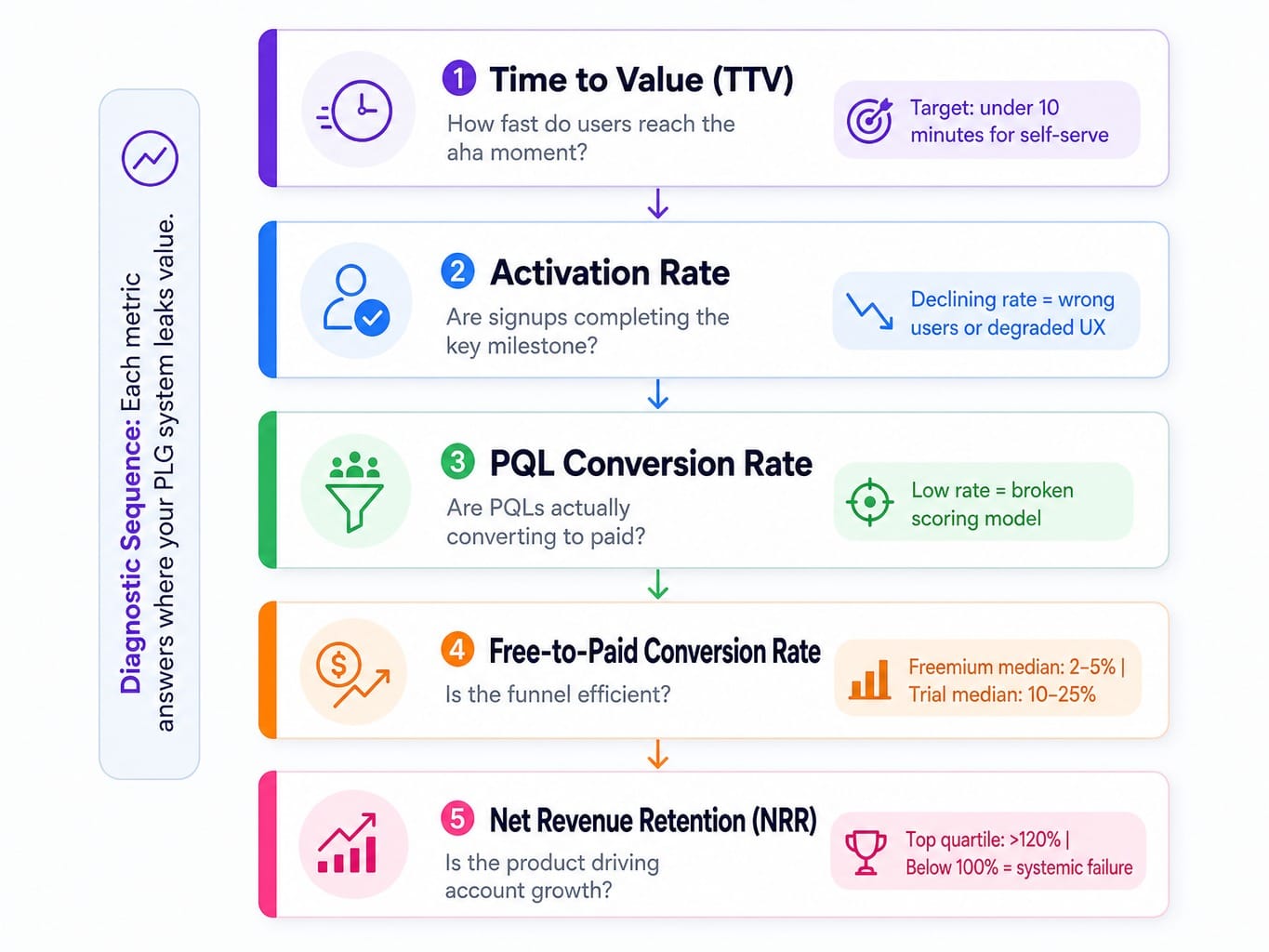
Most PLG teams track too many metrics and interpret none of them with sufficient depth. Your dashboard isn't the system; it's a reflection of the system's health. The five metrics below are not just KPIs to report—they are a diagnostic sequence. Each one answers a specific question about where your PLG execution system is leaking value.
- Time to Value (TTV): This measures how quickly a new user reaches their "aha moment"—the point where they experience the core value of your product. This isn't a textbook definition; it's a hard constraint. If your TTV exceeds 10 minutes for a self-serve product, your onboarding is either asking for too much information upfront or failing to guide the user to the one feature that makes them stick. A rising TTV is a leading indicator of a growing mismatch between your product's promise and its initial experience.
- Activation Rate: This is the percentage of new signups who complete a specific, predefined activation milestone (e.g., creating their first project, inviting a teammate). A declining activation rate with stable signup volume means your marketing is attracting the wrong users, or the product experience has degraded. This is a critical signal that your user onboarding flow requires immediate iteration.
- PQL Conversion Rate: This measures the percentage of PQLs that convert to a paid plan. If your PQL volume is high but your conversion rate is low, your PQL scoring model is broken. For example, you might score users who invite two teammates as a PQL, but discover this behavior correlates with casual exploration, not purchase intent. The real signal might be "created a saved report," a behavior you aren't even weighting. This metric diagnoses the integrity of your product-to-sales handoff.
- Free-to-Paid Conversion Rate: This is the ultimate measure of your funnel's efficiency. According to OpenView benchmarks, median conversion for freemium SaaS is 2-5%, while for free trials it's 10-25%. If your rates are below these floors, your monetization surface is misaligned with user value. You are either paywalling features too early (creating friction) or too late (giving away the value for free).
- Net Revenue Retention (NRR): This measures expansion revenue minus churn and downgrades. For a PLG company, an NRR below 100% is a systemic failure. It means your product is not generating enough value to drive seat expansion, usage-based growth, or upsells to offset customer churn. Top-quartile PLG companies consistently post NRR above 120%, indicating the product itself is a powerful driver of account growth.
Why Most PLG Implementations Stall at Execution, Not Strategy
Every PLG team has a backlog. It's filled with onboarding improvements, feature gating experiments, and conversion flow optimizations they know they should run. The problem is not a lack of ideas; it's the latency between identifying the change and shipping it. As the SlashExperts data shows, 85% of PLG failures are execution failures. Most teams ship meaningful PLG improvements on a monthly or quarterly cadence. But the compounding math of PLG requires weekly iteration. This latency is created by two specific execution bottlenecks.
Activation Cohort Decay: The Onboarding Problem Nobody Ships Fast Enough to Fix
Your activation rate is not a static number; it's a decaying asset. The onboarding flow that achieved a 35% activation rate with your early adopters will inevitably perform worse as you scale. As your PLG motion attracts less-technical or less-motivated mainstream users, the same flow might only produce an 18% activation rate six months later. This is activation cohort decay. The problem is that fixing it requires shipping a change.
Consider a project management SaaS that sees its activation rate fall from 35% to 18%. The team identifies the friction point, but shipping a revised onboarding flow takes eight weeks because it requires engineering tickets, design review, and QA. By the time the fix is live, two more months of degraded cohorts have churned. Tools like Appcues or Chameleon can reduce engineering dependency, but they don't solve the core problem: identifying what to change and shipping it at a cadence that outpaces the decay.
Monetization Surface Sprawl: When Feature Gating Creates More Problems Than Revenue
As a PLG product matures, its feature gating logic—which features are free, which are paywalled, which trigger upsell prompts—becomes a complex web of business rules. This monetization surface area often becomes disconnected from where users actually find value. A SaaS tool might gate its advanced reporting module, only to discover through usage telemetry that users who access reports in their first session convert at 3x the average rate. The gate isn't just a paywall; it's a barrier to activation.
But changing that gate is a high-latency operation. It can require pricing committee approval, updates to the billing system integration with Stripe Billing, and revisions to marketing pages. The change takes six weeks. In that time, thousands of users have been prevented from experiencing a core value driver. Monetization decisions in PLG are not set-and-forget. They are hypotheses that demand continuous experimentation and rapid deployment, creating a cycle of coordination overhead and engineering debt that slows the entire growth engine.
Read more: The Best Way to Prioritize CRO Tests (And Why Most Scoring Models Fail)
Building a PLG Motion That Ships Continuously
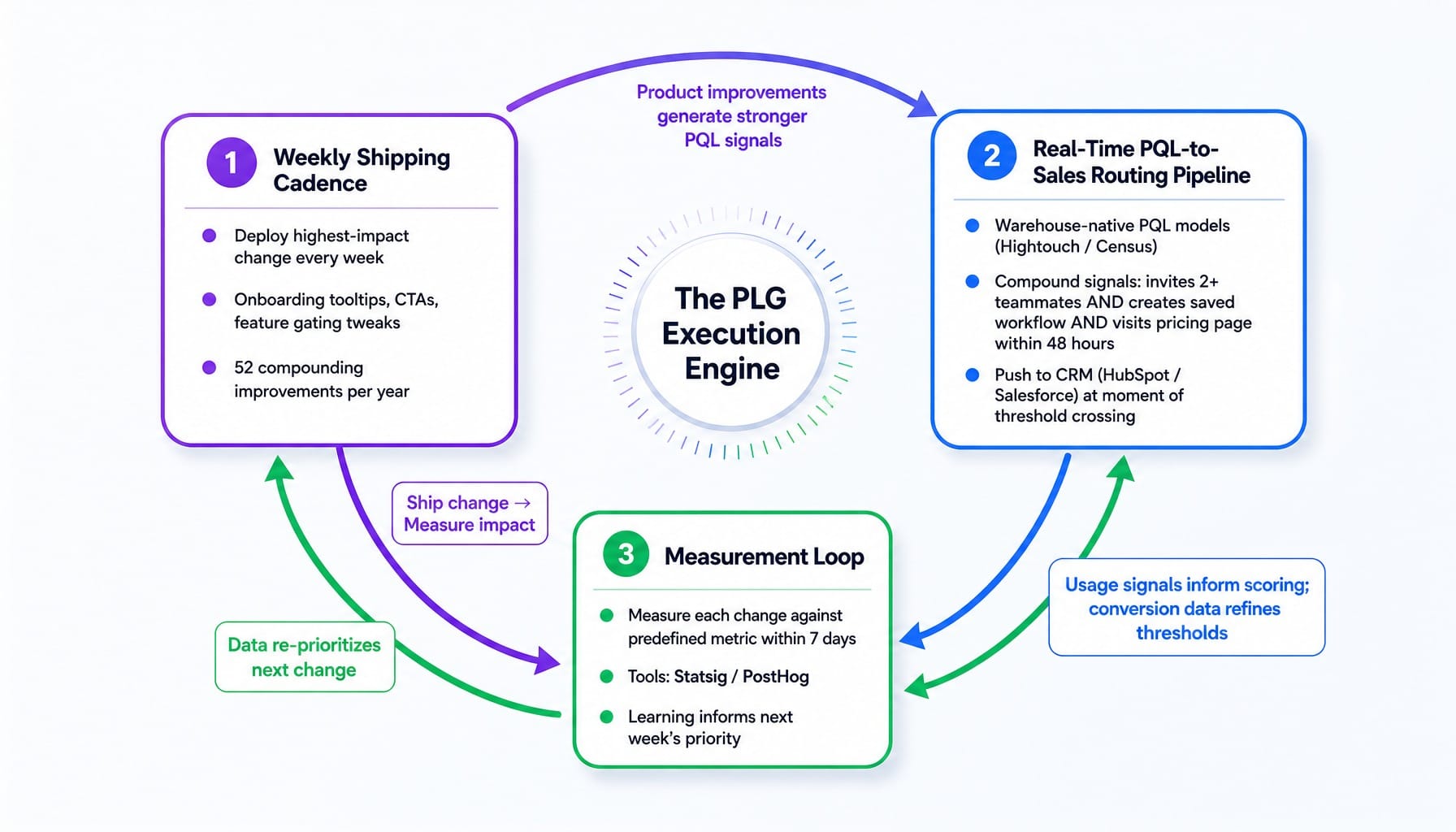
The operational architecture of a working SaaS PLG motion has three components that most guides ignore. They aren't strategic; they are logistical. But in PLG, logistics are where growth lives or dies.
First, establish a weekly shipping cadence. This is not a sprint cycle or a quarterly roadmap review. This is a commitment to deploying the single highest-impact change to the product experience every week. It could be a revised onboarding tooltip, a new CTA on the pricing page, or a tweak to your feature gating logic. The compounding math is undeniable: 52 small, measured improvements a year will outperform four large quarterly pushes. The difference is exponential because each weekly release informs the priority of the next.
Second, build a PQL-to-sales routing pipeline that operates in real-time. Batch processing of leads is a relic of the sales-led era. A modern PLG-to-PLS bridge uses warehouse-native PQL models in tools like Hightouch or Census to push product usage signals directly into HubSpot or Salesforce the moment a user crosses a behavioral threshold. This routing must be based on compound signals—for instance, a user who invites 2+ teammates AND creates a saved workflow AND visits the pricing page within 48 hours. This signal-based routing ensures sales engages with context at the peak of a user's intent.
Third, close the measurement loop. Every change you ship must be measured against a predefined success metric—activation rate, free-to-paid conversion, expansion revenue—within seven days. Experimentation infrastructure from tools like Statsig or PostHog is essential for this. If the change moved the metric, it validates the hypothesis and informs the next priority. If it didn't, the learning is just as valuable: you now know what to stop doing. This tight feedback loop is what transforms a series of random acts of optimization into a compounding growth system.
Read more: Marketing Task Prioritization for Lean Teams: A Framework That Actually Works
When the Shipping Gap Is the Growth Bottleneck
This entire article builds to a single, unavoidable tension: a successful SaaS PLG motion demands continuous, weekly iteration across onboarding, feature gating, and conversion flows. But most lean marketing and product teams cannot sustain that cadence. The shipping gap—the latency between knowing what to fix and actually deploying the fix—is the single biggest reason PLG motions stall. Your backlog is full of high-impact changes that never see the light of day because every deployment requires cross-functional coordination, engineering tickets, and manual prioritization.
Spike AI is the execution layer designed to close that shipping gap.
Instead of letting high-impact optimizations die in a backlog, Spike AI identifies the single most critical change across your website, conversion flows, and user experience each week—and then deploys it. The activation cohort decay that requires constant onboarding iteration? Spike AI ships those changes weekly. The monetization surface experiments that get stuck behind engineering tickets? Spike AI prioritizes and deploys pricing page and CTA tests directly. The measurement loop that requires immediate feedback? Spike AI measures the impact of each release and uses the data to re-prioritize for the next one.
The PLG flywheel only spins if changes ship fast enough to compound. Spike AI is the shipping engine.
See how Spike AI would prioritize your PLG optimization backlog
Conclusion: From Strategy to Execution System
The single most important belief shift for any team running a SaaS PLG motion is this: PLG is not a go-to-market strategy you adopt. It is an execution commitment you either sustain or abandon.
The industry has converged on the PLG label, but this has not produced a convergence on the operational discipline the model demands. The teams winning with product-led growth in 2026 are not the ones with the cleverest freemium model or the most sophisticated PQL definition. They are the ones that have built a system to ship meaningful improvements to the product experience every single week, measure the result, and feed that learning into the next cycle.
In today's market, the competitive advantage in PLG is not the model. It is the shipping velocity.
Frequently Asked Questions
What is a reverse trial and when should a SaaS company use one instead of freemium?
A reverse trial gives every new user full access to a paid tier for a limited time (e.g., 14 days), then automatically downgrades them to a free plan if they don't convert. You should use it when your product's core value is locked behind premium features. If the "aha moment" lives in the paid plan, a freemium model will never surface it effectively. Reverse trials work best when the value gap between the free and paid experience is significantly larger than the psychological friction of making the first payment.
How do you set up PQL scoring using product usage data without a dedicated data team?
Start with a simple threshold model based on the 2-3 in-product behaviors that correlate most strongly with conversion. Product analytics tools like Amplitude or Mixpanel can help you identify these actions from historical user data. Then, use a reverse ETL platform like Hightouch or Census to push those behavioral signals directly into your CRM. This creates a warehouse-native PQL pipeline without requiring a data engineering team to build and maintain custom infrastructure.
Can enterprise SaaS companies with high ACV successfully adopt product-led growth?
Yes, but almost always as a product-led sales (PLS) motion, not pure self-serve. In this model, the product drives initial bottom-up adoption within a single team or department. A sales team then engages once product usage signals indicate expansion potential at the account level (a Product-Qualified Account). Companies like Datadog and Snyk are prime examples: individual developers adopt the free or low-cost tier, and the sales team engages when usage crosses a threshold that signals an enterprise-wide opportunity.
How does usage-based pricing interact with a product-led growth strategy?
Usage-based pricing is a natural fit for PLG because it aligns cost directly with value, reducing friction at signup and creating a natural path for expansion revenue. However, it can create forecasting complexity for buyers. The most effective models often blend a usage-based component with a stable platform fee or seat minimum. This provides predictable baseline revenue for the vendor while preserving the expansion upside that makes PLG economics so powerful.
When should a PLG company layer in an outbound sales team?
You should layer in an outbound or sales-assist function when you observe a growing number of Product-Qualified Accounts (PQAs)—accounts with multiple active users who are getting value but have not self-served into a paid plan. This often happens when ACV rises above $10-15K or when the economic buyer is different from the end user. A widening gap between your PQL volume and your paid conversion rate is the critical signal that users want the product, but the purchase requires a human conversation.