
SEO Prioritization: A Scoring Framework for Shipping What Matters First

TLDR
- Most SEO prioritization fails due to recency bias, tool-driven audit chasing, and a lack of shared scoring language—not a lack of ideas.
- Build a weighted scoring model using four SEO-specific dimensions: Revenue Proximity, Traffic Potential Delta, Implementation Effort, and Decay Risk.
- Quantify the cost of not doing a task. A decaying page losing traffic has a calculable negative impact on the pipeline that often outweighs the potential of a new content piece.
- Prioritize across technical, content, and off-page SEO by identifying your site's single biggest constraint, not by following a rigid "technical first" dogma.
- Translate SEO priorities into business language (pipeline impact, revenue at risk) to get stakeholder buy-in. "Fixing keyword cannibalization" becomes "recovering $6,000/month in an at-risk pipeline."
Your team just wrapped a quarterly SEO audit. The spreadsheet is a monument to good intentions: 47 recommendations spanning broken canonicals, thin content, missing schema, keyword cannibalization, three major content gaps, a mobile speed issue, and a backlink cleanup.
In a 45-minute meeting, you argue about what to tackle first. The discussion defaults to whatever the SEO tool flagged as 'critical,' which turns out to be 200 pages missing alt text.
Three months later, the high-impact content gaps are still untouched, a key commercial page continues to be suppressed by cannibalization, and the backlog has only grown. The team feels busy but isn't moving the needle.
This isn't a failure of strategy. It's a failure of system design.
Effective seo prioritization isn't about having more ideas or better frameworks; it's about having a repeatable scoring system that connects every task to a business outcome. This guide provides that system. You'll learn how to build a scoring model, quantify what deprioritization actually costs, and communicate priorities in language that gets executive buy-in.
Why Most SEO Prioritization Defaults to Gut Feel (and Why That Compounds)
Most marketing teams don't actually prioritize SEO—they triage reactively. This happens for three reasons, all of which are symptoms of a broken execution system, not a lack of knowledge.
First is recency bias. The team works on whatever was flagged most recently, whether it's a new Search Console alert, a Slack message from the CEO about a competitor's ranking, or the top issue from the latest Screaming Frog crawl. Urgency is confused with importance, and the backlog becomes a reflection of the past 72 hours of notifications.
Second is tool-driven audit chasing. SEO tools like Ahrefs, Semrush, or Sitebulb are designed to surface hundreds of issues, ranked by their own internal severity logic. This logic is almost always disconnected from your specific business impact. A team that spends a quarter fixing 500 tool-flagged "critical" redirect chains on low-traffic pages while their highest-traffic blog post decays from position 3 to position 11 has let the tool set their priorities. They've optimized for the audit report, not for revenue.
Read more: Ahrefs vs Semrush in 2026: Which SEO Tool Fits How Your Team Actually Works
Finally, there's the loudest-voice-wins problem. In cross-functional teams, the product manager who wants a new landing page or the content lead who wants to publish a new pillar page often overrides the SEO lead's recommendation because there's no shared scoring language. Without a model that translates "fixing index bloat" into measurable business terms, the decision defaults to whoever has the strongest opinion or the most direct line to the budget. These aren't discipline problems; they are system design failures.
How to Build an SEO Prioritization Scoring Model That Connects to Revenue
Off-the-shelf frameworks like ICE (Impact, Confidence, Ease) or the RICE framework are useful starting points, but they often fail for SEO. They were designed for product management, where "reach" is more deterministic and "impact" is less volatile. SEO tasks have unique properties that generic scoring misses: SERP volatility can change an impact score weekly, implementation often depends on engineering teams you don't control, and the "reach" of a fix is probabilistic, not guaranteed.
You need a weighted scoring model built for SEO's specific constraints. The average enterprise SEO audit surfaces over 100 recommendations, but a lean team can realistically ship only 3-5 meaningful changes per month. Scoring isn't optional; it's essential.
For example, consider two competing tasks: (a) fixing 15 broken internal links on low-traffic pages and (b) rewriting the meta title and H1 of a page ranking 6-10 for a high-commercial-intent keyword. An audit tool might flag (a) as more urgent. But a proper scoring model, as we'll build below, correctly surfaces (b) as the higher-priority task because its connection to revenue is more direct and its traffic potential is quantifiable.
The Four Scoring Dimensions for SEO Tasks
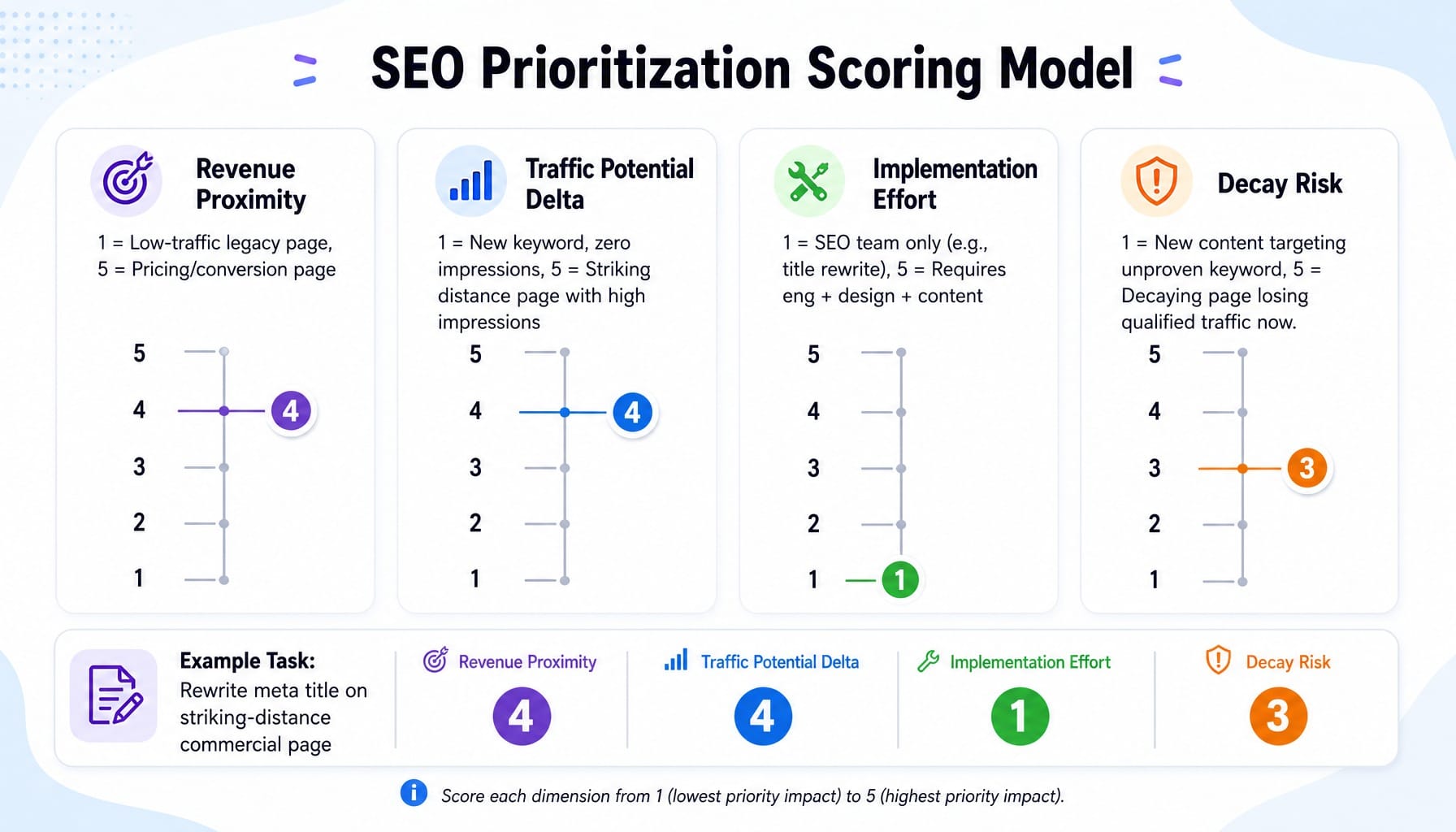
Your seo prioritization framework should be a simple spreadsheet with tasks in rows and these four dimensions as columns, each rated on a 1-5 scale.
- Revenue Proximity (1-5): How close is this task to a page that directly generates leads or revenue? A technical fix on your pricing page scores a 5. The same fix on a 3-year-old blog post about a deprecated feature scores a 1. This dimension forces you to map every SEO task back to a business-critical URL.
- Traffic Potential Delta (1-5): What is the realistic, incremental traffic gain if this task succeeds? This isn't a guess. Use Google Search Console impression data and standard click curve modeling. A page with 5,000 monthly impressions at position 8 has a massive, quantifiable upside if moved to position 3. A task to rank for a brand-new, zero-impression keyword has a much lower, more speculative score.
- Implementation Effort (1-5): This isn't just about time; it's about dependencies. A task that only requires the SEO team (e.g., a title tag rewrite) is a 1. A task that requires engineering, design, and content resources is a 5. Cross-functional dependencies introduce latency and risk, which must be reflected in the score.
- Decay Risk (1-5): Is this task protecting existing traffic or capturing new traffic? A content refresh on a decaying page that currently drives 200 qualified visits/month is more urgent (scores a 5) than creating a new content piece targeting an unproven keyword (scores a 2). This dimension prioritizes defensibility.
Calibrating Scores Across Technical, Content, and Link Tasks
The biggest challenge in seo action prioritization is scoring different work types on the same scale. How do you compare resolving index bloat to writing a new comparison page? The answer is anchoring.
Pick one completed task from the last quarter whose impact you can measure. Assign it benchmark scores, and then score everything else relative to that anchor. For example, if a title tag rewrite on a striking-distance keyword moved a page from position 7 to position 3 and added 40 qualified visits/month, that task becomes your benchmark "4 out of 5" on Traffic Potential Delta. Every other task is now scored relative to that known outcome.
This process of backlog grooming and relative scoring prevents score inflation and grounds your model in reality. It also helps you avoid common mistakes, like scoring all technical fixes as high-effort. Many technical tasks—like fixing canonicals, removing noindex tags, or adding internal links via a CMS—can be shipped in under an hour without any engineering support. Calibration is what makes a scoring model trustworthy over time.
The Cost of Delay: What Deprioritized SEO Tasks Actually Cost You
Most prioritization frameworks only measure the value of doing a task. They never quantify the cost of not doing it. In SEO, delay has a compounding cost because search rankings are competitive and decay is nonlinear. This concept, borrowed from lean product management's Weighted Shortest Job First (WSJF) model, is a powerful lens for seo prioritization techniques.
Consider this concrete example: A B2B SaaS company has a blog post ranking at position 4 for a keyword that drives 120 qualified visits/month. The post is 18 months old, competitors have published fresher content, and decay curve analysis shows it's dropping 1-2 positions per quarter.
The team decides to deprioritize the content refresh for one quarter to work on a new, speculative content piece instead. During that quarter, the post drops from position 4 (approx. 8% CTR) to position 7 (approx. 3.5% CTR). Based on click curve modeling, that's a loss of roughly 65 visits/month. At a 3% conversion rate and a $500 average deal value, that's over $975/month in pipeline value eroding—nearly $3,000 over the quarter. The new content they prioritized instead will take 4-6 months to rank and may never reach that same traffic level.
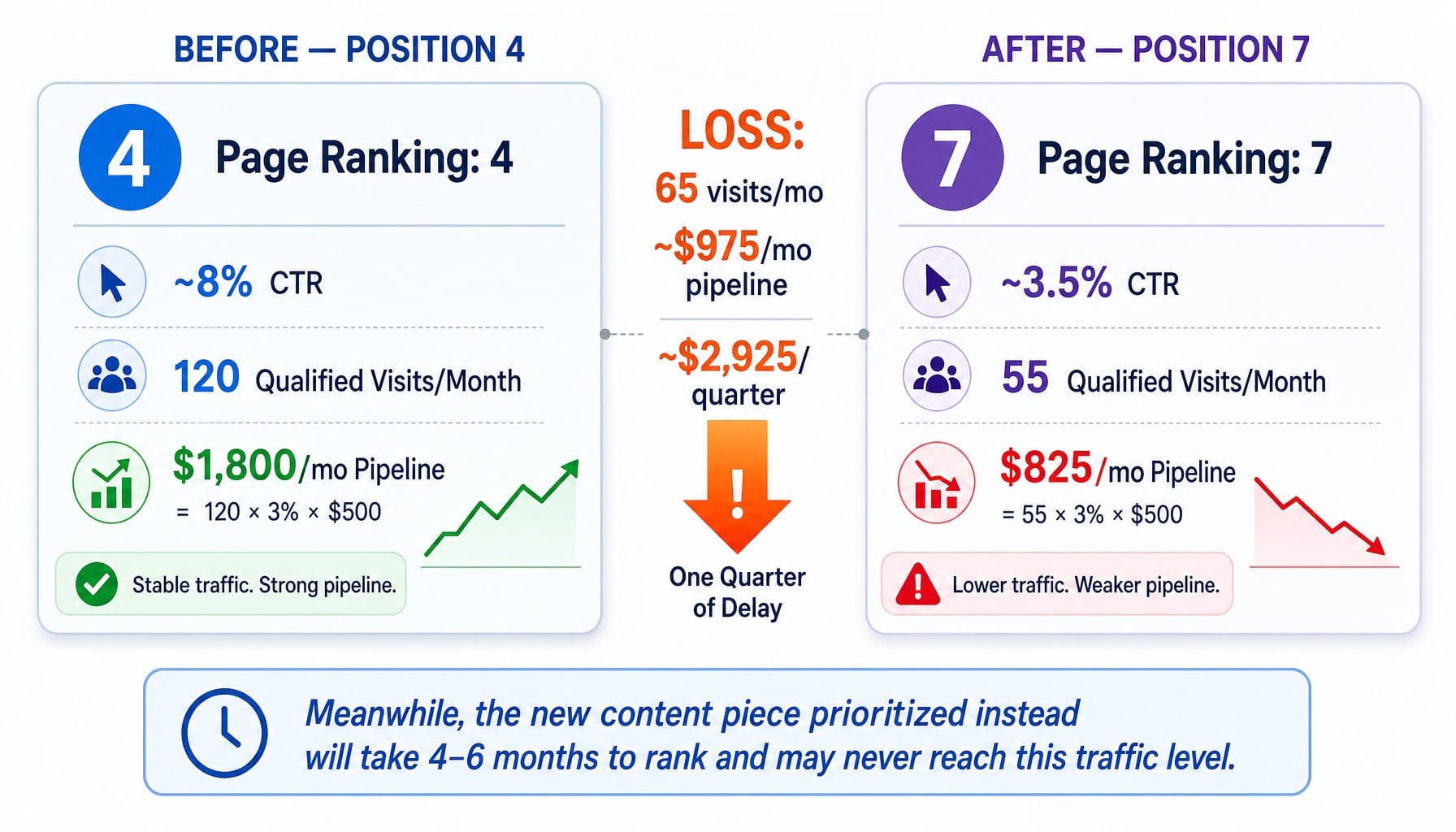
The cost of delay isn't a hypothetical. It's a calculable loss of opportunity. You can run this same estimation for your own decaying pages using Search Console data. It should be a fifth scoring dimension in your model, or at the very least, a critical tiebreaker when two tasks have similar priority scores.
Technical SEO vs. Content vs. Off-Page: How to Prioritize Across Pillars
A common piece of advice is to always prioritize technical SEO fixes first. This is only true when technical issues are your site's binding constraint—when crawlability, indexation, or rendering problems are preventing Google from even seeing your content. For a site that is technically sound but has thin content on high-value pages, technical fixes are low-priority, regardless of what an audit tool says.
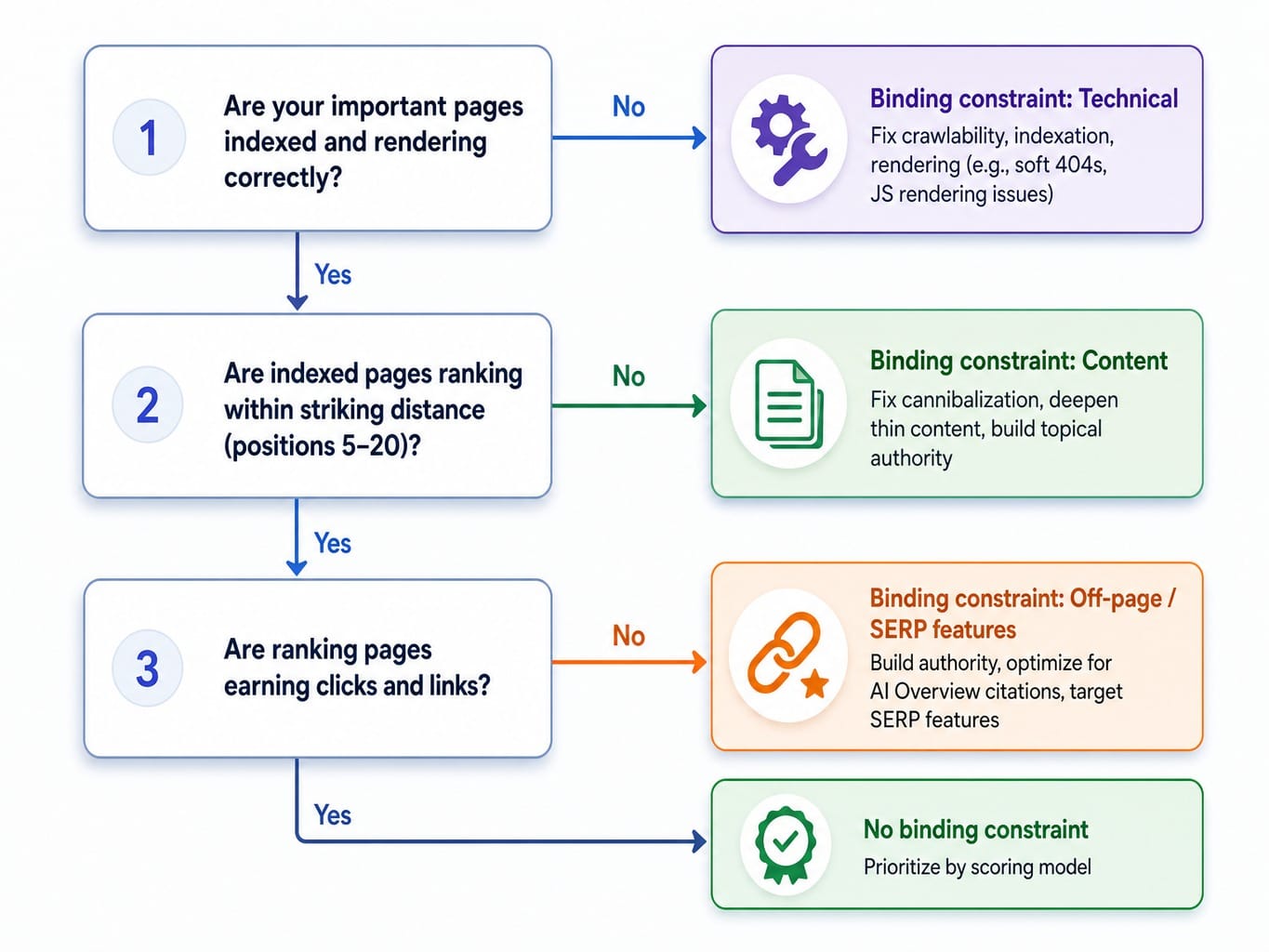
To determine your next sprint's focus, run this simple diagnostic to find your binding constraint:
- Are your important pages indexed and rendered correctly? Check your Google Search Console coverage report and run a JavaScript crawl in Screaming Frog. If the answer is no, your binding constraint is technical. Problems like soft 404s or client-side rendering issues mean nothing else matters until Google can see your pages.
- Are your indexed pages ranking for their target keywords within striking distance (positions 5-20)? If the answer is no, your binding constraint is content quality or topical authority. Your site is visible, but the content isn't relevant or comprehensive enough to compete. This is where you prioritize fixing cannibalization clustering or deepening thin content.
- Are your pages ranking but not earning clicks or links? If yes, your binding constraint is off-page authority or SERP feature displacement. Your content is good, but it lacks the authority to win, or it's being pushed down by AI Overviews, video carousels, and other features.
The rise of AI Overviews adds a new layer. If your target SERPs are dominated by AI-generated answers, prioritize content restructuring for citation eligibility—direct answers, unique data, and non-commodity insights that AI systems are more likely to extract. As Google's own guidance suggests, this form of Answer Engine Optimization (AEO) is still SEO, but it shifts the priority from chasing a blue link to becoming a citable source.
How to Present SEO Priorities to Stakeholders Without Losing Credibility
Many SEO leads lose prioritization battles not because their analysis is wrong, but because they present their roadmap in SEO language ("crawl budget," "index bloat") instead of business language ("pipeline impact," "revenue at risk"). Your scoring model provides the raw material to fix this.
Consider this before-and-after reframing:
- Before: "We need to fix keyword cannibalization across 12 blog posts targeting CRM-related terms." (This sounds like an internal SEO problem.)
- After: "Twelve of our blog posts are competing against each other for the same searches. This is suppressing our best-performing page, which currently drives 85 qualified visits/month. Resolving this could recover an estimated 40 additional qualified visits/month—roughly $6,000/month in pipeline at our current conversion rate." (This is a business opportunity.)
The second version uses the Revenue Proximity and Traffic Potential Delta scores from your model to translate an SEO task into a business case. Present your priorities in a simple three-column format in Notion or Google Looker Studio: Task → Expected Business Impact → Effort/Timeline. This depersonalizes the decision and frames your work around the outcomes the rest of the business cares about.
Read more: Data-Driven CRO: Evolve Your Marketing Strategy for Revenue
What Happens When Prioritization Needs to Run Continuously
This entire article outlines a system: a scoring model with four dimensions, cost-of-delay analysis, cross-pillar diagnostics, and stakeholder translation. But for a lean team, maintaining this system manually is the exact bandwidth problem that caused the prioritization failure in the first place. SERP conditions, competitor actions, and page performance change weekly, demanding constant re-evaluation.
The gap isn't more data or another dashboard; it's the lack of a system that can continuously run this logic. Platforms that unify marketing goals with task management represent a step forward, but the real breakthrough comes when prioritization and execution are fully automated. This is where Spike AI closes the loop. It doesn't hand you a longer, tool-generated backlog. Instead, its prioritization engine continuously identifies the single highest-impact move across your entire marketing surface—SEO, CRO, and ads—scores it against business outcomes, and then executes it.
It's the difference between a tool that shows you problems and a system that resolves them in priority order. Spike AI turns your backlog into a weekly shipping cadence that compounds, handling the heavy lifting of prioritization and execution so you can focus on strategy.
See how Spike AI prioritizes and ships your highest-impact SEO, content, and CRO changes every week.
From Backlog to Cadence
Effective seo prioritization is not a quarterly planning exercise. It is a continuous scoring system that must adapt as conditions change. Most teams fail at this not because they lack frameworks, but because they lack a repeatable model that ties every task to business impact and accounts for the cost of inaction.
The scoring model, cost-of-delay analysis, and constraint-based diagnosis described here give you that model. But the real shift happens when you move from planning to shipping. The teams that compound SEO results are not the ones with the longest task lists—they are the ones that ship the right task every single week and re-prioritize the rest.
Frequently Asked Questions
How often should you re-evaluate your SEO prioritization backlog?
Re-score your backlog monthly at a minimum, or whenever a significant SERP shift occurs (e.g., an algorithm update or AI Overview expansion). The Traffic Potential and Decay Risk dimensions change with SERP conditions, so a low-priority task last month may become urgent. Treat the backlog as a living queue, not a static roadmap.
How do you prioritize SEO tasks across multiple websites or domains?
Score each domain's backlog independently using the same four-dimension model, then compare the top-scoring task from each domain. The initiative with the highest revenue-proximity score and lowest implementation effort gets resources first. Avoid splitting effort equally; concentrated work on one site compounds faster.
What SEO tasks typically deliver the fastest measurable results?
Title tag and meta description rewrites on "striking distance" pages (positions 5-15) often show movement in 2-4 weeks. Internal linking to high-value orphaned pages and canonical tag fixes on duplicate content clusters also tend to produce fast, measurable impact by removing existing suppression rather than building new authority.
How do you handle conflicting SEO priorities between product and marketing teams?
Use the shared scoring model to depersonalize the decision. When both teams present competing priorities, score each task on the same four dimensions (revenue proximity, traffic potential, effort, decay risk). The model provides a common language for tradeoffs and removes opinion from the process.
How should AI Overviews change your SEO prioritization in 2025-2026?
If AI Overviews dominate your target SERPs, deprioritize tasks aimed at traditional blue-link rankings for those queries. Instead, prioritize content restructuring for citation eligibility: adding direct answers, structured data, and non-commodity insights. This shifts the goal from "ranking" to "being the source."