What Is Autonomous Marketing? The Practitioner's Guide for 2026

TLDR
- Autonomous marketing is not advanced automation; it's a system where AI agents make decisions, execute actions, and learn from outcomes without human-built rules for each step.
- Most platforms marketed as "autonomous" are actually "intelligent automation"—they recommend changes but still require a human to approve and ship them.
- True autonomy requires a closed-loop system that can ingest data, prioritize actions based on impact, execute changes, and measure results to inform the next cycle.
- Your autonomous marketing platform will fail if your data infrastructure isn't ready. You need a unified customer identity layer, a clean event taxonomy, and sufficient traffic volume for the system to learn effectively.
- Safe autonomy depends on governance. You must define scope constraints (what the system can touch), escalation thresholds (when to ask for help), and brand compliance rails (what the system can't say).
Autonomous marketing is one of the most misused terms in modern martech. You bought the tool. You saw the case study. And yet, you're still spending 12 hours a week building workflows, writing rules, and manually reviewing campaign performance. The platform automated tasks, but it didn't make a single decision on its own.
This is the core tension for marketing and RevOps leaders today. The word "autonomous" is being applied to tools that are fundamentally still rule-based automation, just with a better user interface. They surface insights, but the gap between identifying what needs to change and actually shipping that change remains entirely on your plate.
This guide closes that gap. By the end, you will understand what autonomous marketing actually means at a systems level, where your current stack falls on the autonomy spectrum, and what infrastructure and governance you need before any platform can deliver on its promise.
What Is Autonomous Marketing?
Autonomous marketing is a system in which AI agents independently plan, execute, test, and optimize marketing activities based on goals and data—without requiring human-built rules or manual triggers for each action. The system isn't just following a script; it's writing and rewriting the script in real time to achieve a defined business outcome.
This is fundamentally different from marketing automation. Automation executes predefined workflows that a human designed. Autonomous marketing determines what workflow to create, when to run it, and how to adjust it based on outcomes.
A simple analogy makes this clear:
- Marketing Automation is cruise control. You set the speed and the direction, and the system maintains it. It executes a static rule.
- Autonomous Marketing is a self-driving car. You provide the destination (the goal, e.g., "increase qualified leads by 15%"), and the system chooses the route, adjusts speed for traffic, and reroutes around accidents. It makes dynamic decisions.
The key differentiator is decisioning. An autonomous system has a reward function or objective it optimizes toward, not a static ruleset it follows. While most platforms marketed as autonomous still require significant human configuration, the degree to which they can make independent decisions is what truly defines their level of autonomy.
The Autonomy Spectrum: Where Your Martech Stack Actually Falls
Most marketing teams believe they are using autonomous marketing because their vendor says so. But the gap between "automated" and "autonomous" isn't binary—it's a spectrum. Understanding where your tools sit on this spectrum is the first step to diagnosing your execution bottlenecks.
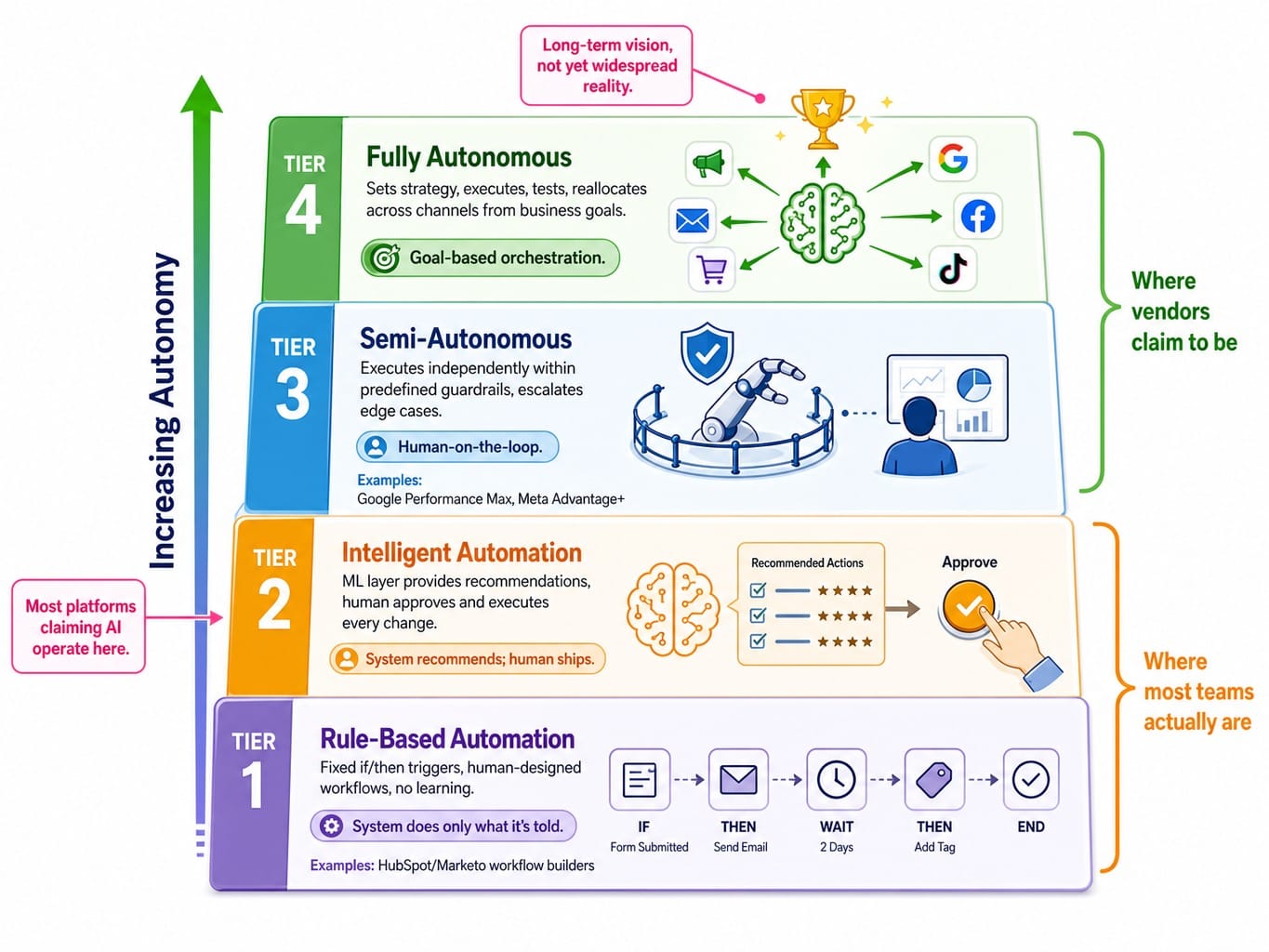
Here is a four-tier model you can use as a diagnostic:
- Rule-Based Automation: This is the foundation of most martech stacks. It operates on fixed if/then triggers and human-designed workflows. Think HubSpot or Marketo workflow builders. There is no learning; the system only does what it's explicitly told.
- Intelligent Automation: This tier introduces a machine learning layer that provides recommendations. The system suggests optimizations, drafts content, or identifies underperforming segments, but a human must approve and execute every change. This is where most platforms claiming "AI" currently operate.
- Semi-Autonomous: The system can execute actions independently within predefined guardrails. It learns from outcomes and escalates edge cases or significant deviations for human review. This is human-on-the-loop governance. Google Performance Max and Meta Advantage+ campaigns are good examples, autonomously allocating budget and creative within a human-defined campaign structure.
- Fully Autonomous: The system can set strategy, execute, test, and reallocate resources across channels based on high-level business goals, requiring minimal human oversight. This level of goal-based marketing and orchestration is the long-term vision for the category but is not yet a widespread reality.
Most teams will find they operate at Tier 1 or 2, even while using tools that market themselves as Tier 4.
Why Most 'Autonomous' Platforms Are Still Tier 2
The majority of platforms using the word "autonomous" today are actually intelligent automation (Tier 2) with a polished UX. They are recommendation engines, not decision engines.
Consider this common scenario: your platform's AI, perhaps something like HubSpot Breeze AI or Salesforce Marketing Cloud with Agentforce, analyzes engagement data and recommends changing an email subject line to improve open rates. It might even generate a few options using generative AI. But the marketer must still review the suggestion, approve it, and schedule the A/B test. The system recommended; the human shipped. That is not autonomy.
The test is whether the system can act on its own recommendation without a human in the approval chain. Platforms like Google Performance Max approach Tier 3 because they do act—they shift budget between audiences and creative assets in real time without asking for permission on every micro-decision. But even these systems are semi-autonomous; they operate within the constraints of goals, budgets, and creative assets provided by a human. The label "autonomous" is a marketing claim, not a technical classification. You now have a framework to see through it.
What True Autonomy Requires From the System
Genuine autonomy, even at the semi-autonomous level, is separated from sophisticated automation by three core technical capabilities. When evaluating any platform, ask vendors if their system has:
- A Closed Feedback Loop: The system must be able to measure the outcome of its actions and adjust its next move without human re-intervention. This goes beyond simple A/B testing. It requires models like multi-armed bandit allocation, which dynamically shifts resources to winning variations in real time, continuously refining performance instead of waiting for a test to conclude.
- Cross-Channel Signal Integration: The system needs to ingest and synthesize data from multiple sources—website behavior, ad platforms, CRM, search rankings—to make holistic decisions. An action in one channel must inform decisions in another without a marketer manually piping data between tools. This requires a composable martech architecture or a unified data fabric.
- Goal-Based Optimization: The system must work backward from a business outcome (e.g., revenue, qualified leads) rather than forward from a human-designed workflow. It operates on a "reward function" that defines success, allowing it to explore novel strategies to maximize that reward, rather than just optimizing the steps in a predefined path.
Read more: Stop Syncing Strategy and Execution: Platforms That Unify Marketing Goals With Task Management
How Autonomous Marketing Systems Actually Make Decisions
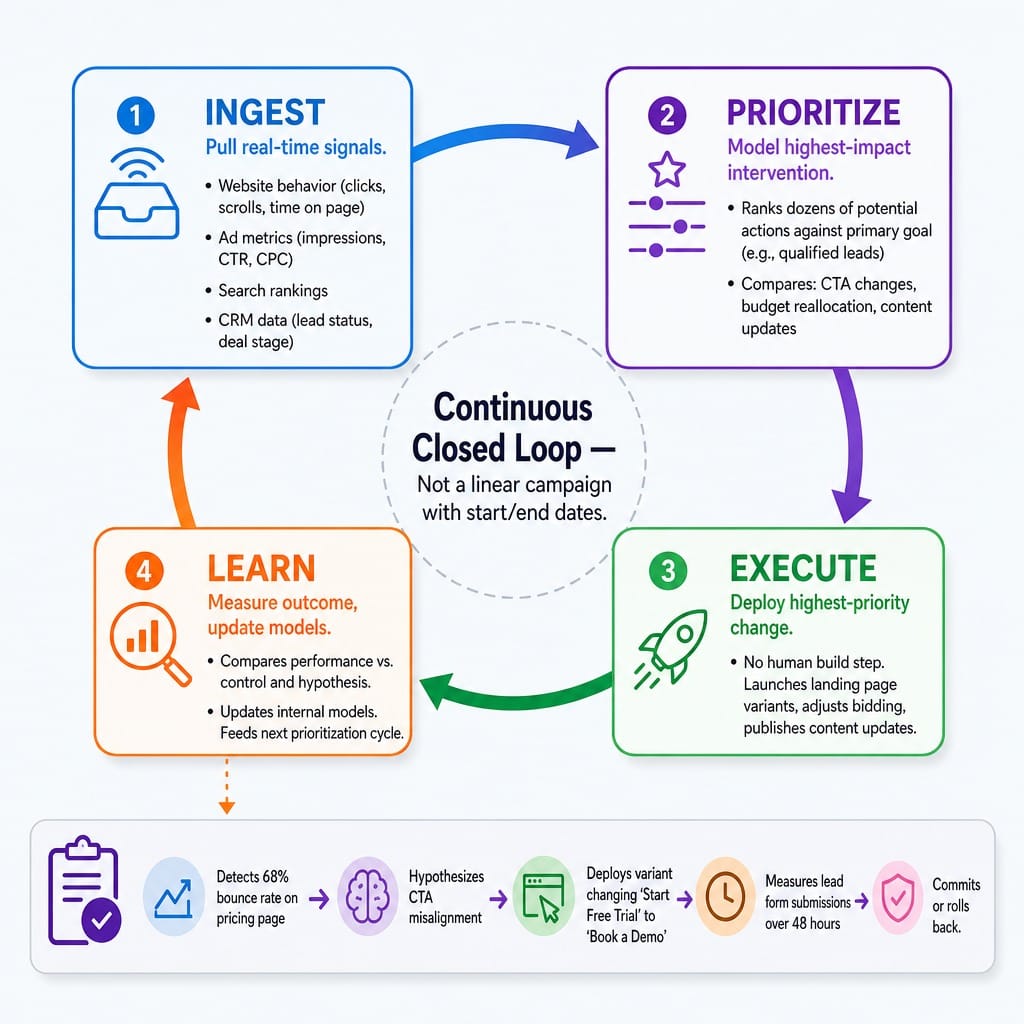
An autonomous marketing system operates as a continuous closed loop, not a linear campaign with a start and end date. This loop is the engine of outcome-driven optimization. It consists of four phases:
- Ingest: The system constantly pulls in real-time signals. This includes website behavioral data (clicks, scrolls, time on page), ad performance metrics (impressions, CTR, CPC), search rankings, and CRM data (lead status, deal stage).
- Prioritize: Using this data, the system models which potential intervention will have the highest projected impact on the primary goal (e.g., qualified leads). It might rank dozens of potential actions, from changing a CTA on a landing page to reallocating budget from a low-performing ad set.
- Execute: The system deploys the highest-priority change without waiting for a human to build it. This could be launching a new landing page variant, adjusting a bidding strategy, or publishing an updated piece of content.
- Learn: It immediately begins measuring the outcome of the change, comparing performance against the control and its initial hypothesis. This new data updates its internal models, improving the quality of the next prioritization cycle. The feedback loop velocity is critical.
Imagine this on a B2B SaaS site: the system detects a 68% bounce rate on the pricing page for traffic coming from a specific ad campaign. It hypothesizes the CTA is misaligned. It generates and deploys a variant changing the CTA from "Start Free Trial" to "Book a Demo." It measures the impact on lead form submissions over 48 hours. If conversions increase, the change is committed. If not, it's rolled back, and the system learns from the failed test. This is the exploration-exploitation tradeoff in action—the system must balance testing new ideas against doubling down on what already works.
Read more: Data-Driven CRO Strategies: Identifying Marketing Opportunities for True Conversion Optimization
What Data Infrastructure You Need Before Autonomous Marketing Works
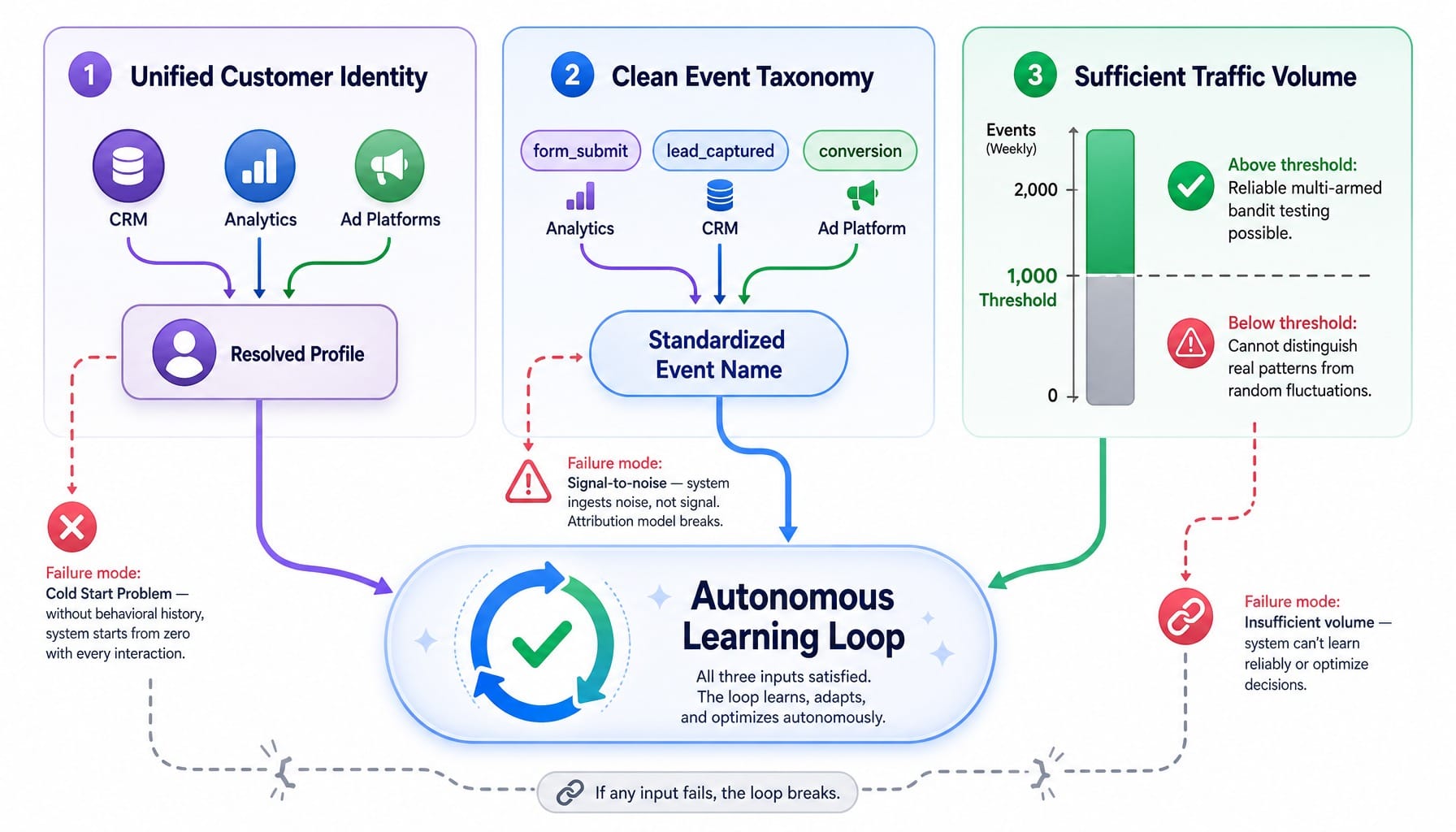
No autonomous marketing platform will deliver results if your data infrastructure cannot support it—and most B2B SaaS companies discover this after the purchase, not before. The hidden infrastructure debt is the primary reason these initiatives underperform. Before you talk to any vendor, audit these three prerequisites:
- Unified Customer Identity: If your CRM, analytics platform (like HubSpot), and ad platforms can't resolve the same visitor into a single profile across sessions and channels, the system has no coherent signal to learn from. This triggers the cold start problem: without behavioral history, the system starts from zero with every interaction, preventing it from making informed personalization or segmentation decisions.
- Clean Event Taxonomy: If your tracking fires inconsistently or uses different naming conventions for the same action, the system's feedback loop ingests noise, not signal. For example, if a demo request is tracked as "form_submit" in your analytics, "lead_captured" in your CRM, and "conversion" in your ad platform, the system can't build a reliable attribution model. This signal-to-noise issue is a common point of failure.
Sufficient Traffic Volume: Autonomous systems need a statistically significant amount of data to distinguish real patterns from random fluctuations. A site with 500 monthly visitors cannot run a meaningful multi-armed bandit test. As a practical threshold, most autonomous optimization requires at least 1,000 weekly conversion-relevant events (e.g., clicks on a primary CTA, form submissions) to produce reliable learning.
Guardrails and Governance: Keeping Autonomous Systems Safe
Autonomy without governance is not a feature; it's a liability. The legitimate fear—"What happens when the system makes a wrong decision?"—is addressed not by removing autonomy, but by defining the boundaries within which it operates. A mature deployment relies on three layers of governance:
- Scope Constraints: These define what the system is allowed to modify. You can restrict the system to specific pages, ad campaigns, budget ranges, or content modules. A system that can rewrite your homepage headline without approval is poorly scoped. A system allowed to optimize landing pages within a specific /growth subfolder is properly constrained.
- Escalation Thresholds: These define when the system must pause and request human review. For example: if a newly deployed variant causes the conversion rate to drop by more than 15% within 48 hours, the system should automatically revert to the previous version and flag the event for a human. This is human-on-the-loop governance. You aren't approving every action, but the system knows when to ask for help.
- Brand and Compliance Rails: These are content boundaries the system cannot cross. This includes defining brand tone, specific claims the company can and cannot make, forbidden language (e.g., competitor names), and mandatory disclaimers. In regulated industries like finance or healthcare, these rails are non-negotiable and must be far stricter, but the framework is the same.
Autonomous does not mean uncontrolled. It means the system operates independently within a trusted, human-defined framework.
How Spike AI Closes the Gap Between Automation and Autonomy
The framework of this article highlights a specific tension: most marketing teams are stuck at Tier 2 of the autonomy spectrum. You have tools that surface insights and recommendations, but the gap between identifying what needs to change and actually shipping that change still falls entirely on your plate. Even with the right data, you lack the bandwidth to act.
Spike AI is built to resolve this execution gap. It is the system that operates the closed loop: it identifies the highest-impact move across your website, SEO, and ads, then executes it for you.
If your team recognizes itself at Tier 2—drowning in dashboards that recommend but don't ship—Spike AI is designed to move you to Tier 3. It's a system that prioritizes, executes, measures, and re-prioritizes in a continuous weekly loop. Where other tools give you homework, Spike AI deploys the fix.
This happens through a weekly cadence that compounds. Each release—a landing page variant, a technical SEO fix, an ad copy update—feeds the next prioritization cycle. You stay in control of approvals, deciding what goes live. The system handles everything else, turning your backlog into a predictable rhythm of shipped improvements that move the needle on qualified leads.
See how Spike AI identifies and ships your highest-impact marketing fix every week
Your Next Move: From Buying Tools to Building Capability
The single most important shift is this: autonomous marketing is not a product you purchase. It is a capability level your organization reaches when the right data infrastructure, governance model, and execution system are in place.
Most teams calling their marketing "autonomous" are still operating rule-based automation with better interfaces. The real transformation happens when the system can independently identify what to change, ship the change, measure the result, and re-prioritize—without a marketer rebuilding a workflow for each cycle.
The teams that will compound growth over the next two years won't be the ones with the most tools. They will be the ones that have closed the latency-to-action gap between a critical insight and a shipped change.
Frequently Asked Questions
Is autonomous marketing safe for regulated industries like finance or healthcare?
Yes, but it requires stricter governance. In regulated industries, the system must operate within pre-defined compliance boundaries—approved language, mandatory disclaimers, and escalation triggers for any content touching regulated claims. The governance framework of scope constraints, escalation thresholds, and compliance rails applies universally; regulated industries simply set tighter parameters at each layer.
What happens when an autonomous marketing system makes a wrong decision?
A well-governed system includes auto-revert mechanisms. If a deployed change degrades performance beyond a defined threshold (e.g., conversion rate drops 15% in 48 hours), the system rolls back to the previous version and flags the decision for human review. The risk isn't that the system makes mistakes—all optimization involves failed tests—but that it lacks the guardrails to detect and correct them quickly.
Are autonomous marketing platforms replacing marketing operations roles?
They are changing the role, not eliminating it. Marketing operations shifts from building and managing individual campaigns to supervising system behavior, defining governance, and interpreting strategic outcomes. The skillset evolves from campaign execution to system oversight—closer to managing a deployment pipeline than manually scheduling emails.
How do you measure ROI of an autonomous marketing platform versus traditional automation?
Traditional automation ROI is measured by efficiency—time saved on manual tasks. Autonomous marketing ROI is measured by outcome velocity: the number of revenue-impacting changes shipped per week, the compounding conversion lift over quarters, and the reduction in latency between identifying an opportunity and deploying a fix. Efficiency is a byproduct, not the primary metric.
Can autonomous marketing platforms handle creative production and testing automatically?
Partially. Current systems can generate and test variations of copy, CTAs, and layout elements within brand guidelines. They cannot yet produce original brand campaigns or complex creative assets from scratch. The capability today is autonomous creative testing—generating variants and allocating traffic to winners—not autonomous creative strategy.
What skills does a marketing team need to manage an autonomous marketing system?
The critical skills shift from campaign building to system configuration and interpretation. This includes defining business goals for the system to optimize toward, setting governance parameters, and interpreting why the system made certain decisions. Teams also need data literacy to understand event taxonomies and attribution models to ensure the system's learning loop is producing reliable signals.