B2B SaaS Demand Generation: Why Shipping Speed Beats Strategy in 2026

TLDR
- Most B2B SaaS demand generation programs fail because of slow execution speed, not poor strategy. Shipping latency compresses the number of experiments a team can run, making it mathematically impossible for results to compound.
- Replace MQLs with Marketing Qualified Accounts (MQAs) and align sales and marketing around shared pipeline metrics like pipeline velocity and Qualified Pipeline Created (QPC) ratio.
- Your ICP definition should be based on revenue signals (like recent funding or hiring for specific roles) and intent data, not just firmographics (company size, industry).
- Ungate the vast majority of your content to maximize reach and dark-funnel amplification. Measure content success by its downstream pipeline contribution, not form fills.
- AI's real value in demand gen isn't creating more content; it's compressing the plan-build-ship cycle from weeks to days, solving the execution bottleneck that stalls most programs.
Your three-person marketing team spent Q1 building the perfect B2B SaaS demand generation strategy. The ICP was defined with razor-sharp precision. The content calendar was mapped to the buyer's journey. LinkedIn campaigns were designed, and intent signal providers were evaluated. It was a masterpiece of strategic planning.
By the end of Q2, you'd shipped exactly four meaningful changes to your website and published six new articles. Your pipeline looked identical to Q4.
The strategy was correct. The execution cadence was the bottleneck.
This isn't a strategy problem. It's a shipping problem. For most lean B2B SaaS teams, the gap between knowing what to do and actually deploying it across content, your website, SEO, and ads eats weeks per change. This latency compresses the number of meaningful experiments you can run per quarter to single digits, making it statistically impossible for demand to compound.
This guide is different. It's not another playbook of abstract frameworks. It's a diagnosis of why most demand gen programs stall and a prescriptive plan for building an engine with a shipping cadence that actually builds pipeline.
What Is B2B SaaS Demand Generation?
B2B SaaS demand generation is the practice of creating awareness, educating buying committees, and building purchase intent before prospects enter an active evaluation cycle. It operates across content, SEO, paid media, community, and product experiences to generate pipeline—not just leads.
Crucially, demand gen is not "top-of-funnel marketing." It spans the entire buyer journey, from a prospect's first encounter with your brand to post-sale advocacy that feeds word-of-mouth loops.
A significant portion of this activity happens in the dark funnel—Slack communities, peer conversations, LinkedIn feeds, and podcast mentions where attribution is invisible. This means effective demand generation requires conviction in activities whose direct ROI cannot be measured at the touchpoint level. You are building brand affinity and trust with an audience, most of whom will never click a tracked link but will remember your name when a need arises.
For SaaS specifically, this discipline must account for complex buying committees (not individual buyers), long evaluation cycles that can stretch from three to nine months, and the critical intersection with product-led growth (PLG) motions where the product itself is a core part of the demand engine.
Demand Generation vs. Lead Generation: When Each One Wins
Demand generation creates buying intent before prospects are ready to evaluate. Lead generation captures contact information from prospects who are already showing interest. They are not opposites; they are sequential phases of a healthy marketing system. One creates the opportunity, the other converts it.
Read More: 7 B2B Lead Generation Strategies that Build Pipeline (not just MQLs)
So, which should you focus on? Here is the conditional verdict:
Lead generation wins when you have a transactional product with a short sales cycle and high existing inbound volume. For example, a PLG SaaS company at $2M ARR with strong organic traffic from a well-established brand should optimize lead capture with better forms and gated assets before investing heavily in new demand creation. The demand is already there; the job is to capture it efficiently.
Demand generation wins when you sell to buying committees, your average contract value (ACV) is above $15,000, and your sales cycle exceeds 60 days. In this scenario, no single lead matters. You need to build conviction across an entire account over months, a process that gated content and form fills actively hinder.
Why Most SaaS Demand Gen Programs Stall After Quarter One
The typical SaaS marketing team ships between 8 and 12 meaningful changes per quarter across their website, content, and campaigns. At that velocity, demand generation cannot compound—it can only plateau.
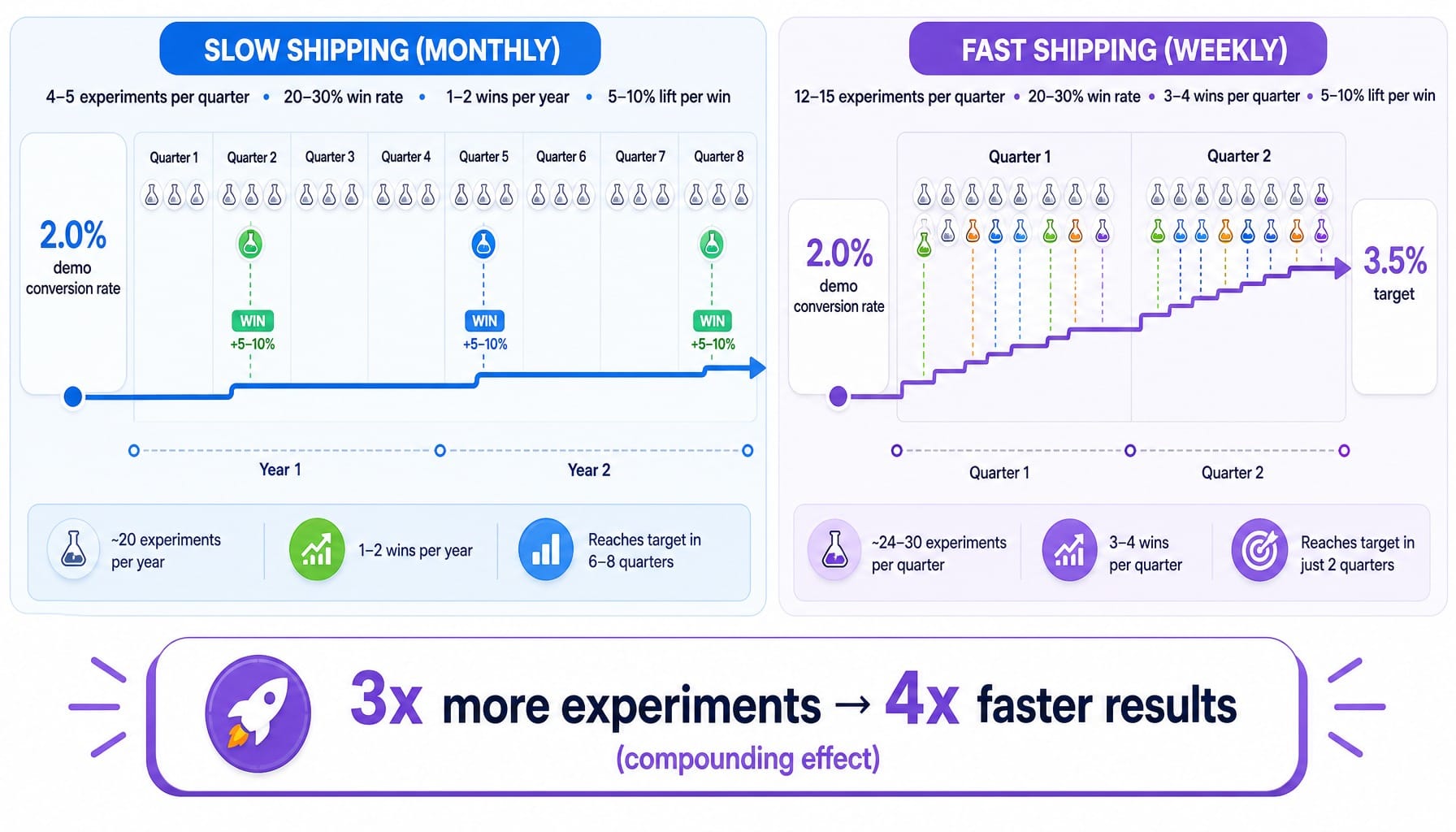
Let's do the math. Your team has a website with a 2% demo request conversion rate and a goal to reach 3.5%. Each optimization experiment—a new landing page headline, a different CTA, a revised content angle, a fresh ad creative—takes two to three weeks to plan, approve, build, deploy, and measure.
At that pace, you run four to five experiments per quarter. With a typical A/B test win rate of 20-30%, you get one or two winning tests. A good winner might yield a 5-10% lift. To achieve the 75% cumulative lift needed to get from 2% to 3.5%, you need 6-8 quarters of flawless execution. And that's if nothing else changes.
Now, contrast this with a team that has a system to ship weekly. They run 12-15 experiments per quarter, generating three to four winners. The gains start compounding. They can reach the same 3.5% conversion target in just two quarters. The math is not subtle.
This shipping latency stems from three root causes:
- The Specialist Gap: A lean team with one or two generalist marketers cannot execute across SEO, CRO, content, and paid media with the depth each channel requires to find winning experiments.
- The Coordination Tax: Every change requires a cycle of discussion, planning, approval, and handoff across multiple tools and people. This coordination overhead is the invisible friction that stretches a two-day task into a two-week project.
- Prioritization Paralysis: With dozens of potential improvements and no clear model for which one will move pipeline most, teams default to gut feel, recency bias, or whoever was most vocal in the last meeting. Effort gets spread thin across low-impact activities.
Your demand gen strategy was never wrong. Your shipping cadence made it impossible for the strategy to produce results.
Read more: The Marketing Prioritization Framework That Replaces Gut Feel With Compounding Wins
How to Build a SaaS Demand Gen Engine That Ships Weekly
Building a demand gen engine isn't about choosing from a menu of tactics. It's about executing a sequence of steps where each one builds on the last. Skipping Step 1 makes Steps 3-5 ineffective. The order matters because it aligns your resources with market reality before you ever spend a dollar on ads.
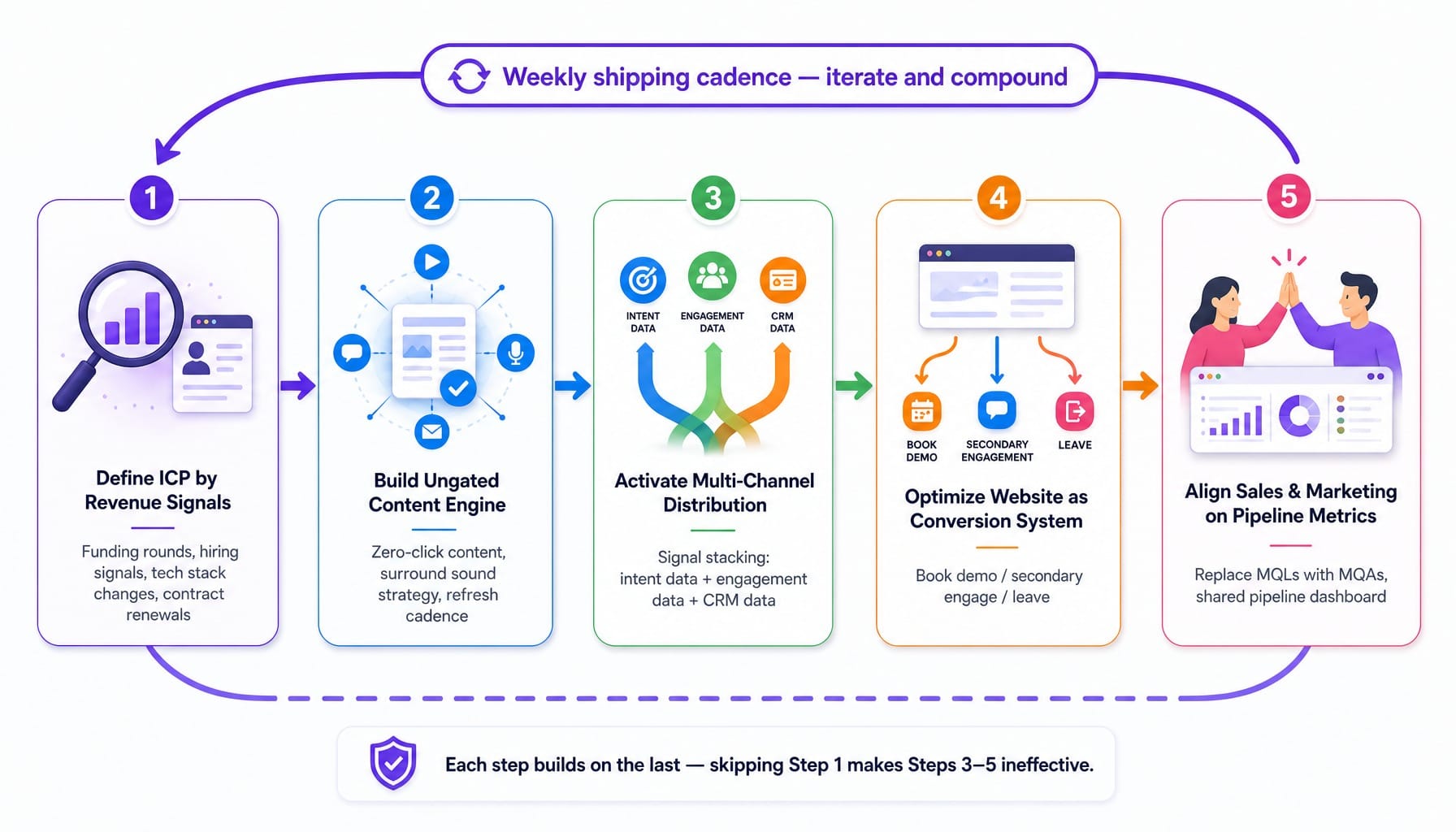
Step 1: Define Your ICP by Revenue Signals, Not Firmographics
Most ICP definitions are static, demographic profiles: industry, company size, employee count, job title. This leads to broad targeting and wasted spend because it describes who a company is, not what they are doing.
A revenue-qualified ICP adds behavioral and situational signals that indicate purchase intent. These are triggers that suggest a company is actively feeling the pain your software solves. Examples include:
- A recent funding round ($10M+ Series A/B)
- Hiring for specific roles (e.g., "Head of RevOps," "Data Engineer")
- Changes in their tech stack (e.g., just installed HubSpot, just dropped a competitor)
- Competitor contract renewal timing
You can find these signals using tools like Clay for data enrichment, 6sense or Bombora for intent data, and Apollo.io for contact and company information.
Common Failure Mode: Teams define their ICP once during a strategy offsite and then treat it as a sacred text. A strong ICP is a living document, updated quarterly as your product evolves and you learn more about which signals correlate with closed-won deals. The output of this step is a shared profile, referenced by both sales and marketing, that includes firmographic, behavioral, and signal-based criteria.
Step 2: Build an Ungated Content Engine Around Buyer Problems
In 2026, gating content is a losing trade. You capture an email address, but you sacrifice the reach, shareability, and dark-funnel amplification that truly drive demand creation. Your engine should produce zero-click content: LinkedIn posts, podcast appearances, short-form videos, and SEO articles that deliver their full value without a form fill.
This approach fuels a surround sound strategy, where your ICP encounters your brand's expertise repeatedly across different channels in organic contexts. They see a post from your CEO on LinkedIn, hear your Head of Product on a podcast, and find your article on Google—all before they ever visit your website.
Remember the content decay curve: most SaaS blog posts lose 60-70% of their traffic within 12 months if not systematically refreshed. Your engine must therefore include a refresh cadence, not just a publishing cadence, to keep top-performing assets relevant.
Common Failure Mode: Teams publish content on a rigid calendar without measuring which pieces actually generate downstream pipeline. This leads to a content library that grows in volume but doesn't compound in value. The goal isn't more content; it's more content that works.
Step 3: Activate Multi-Channel Distribution With Signal Stacking
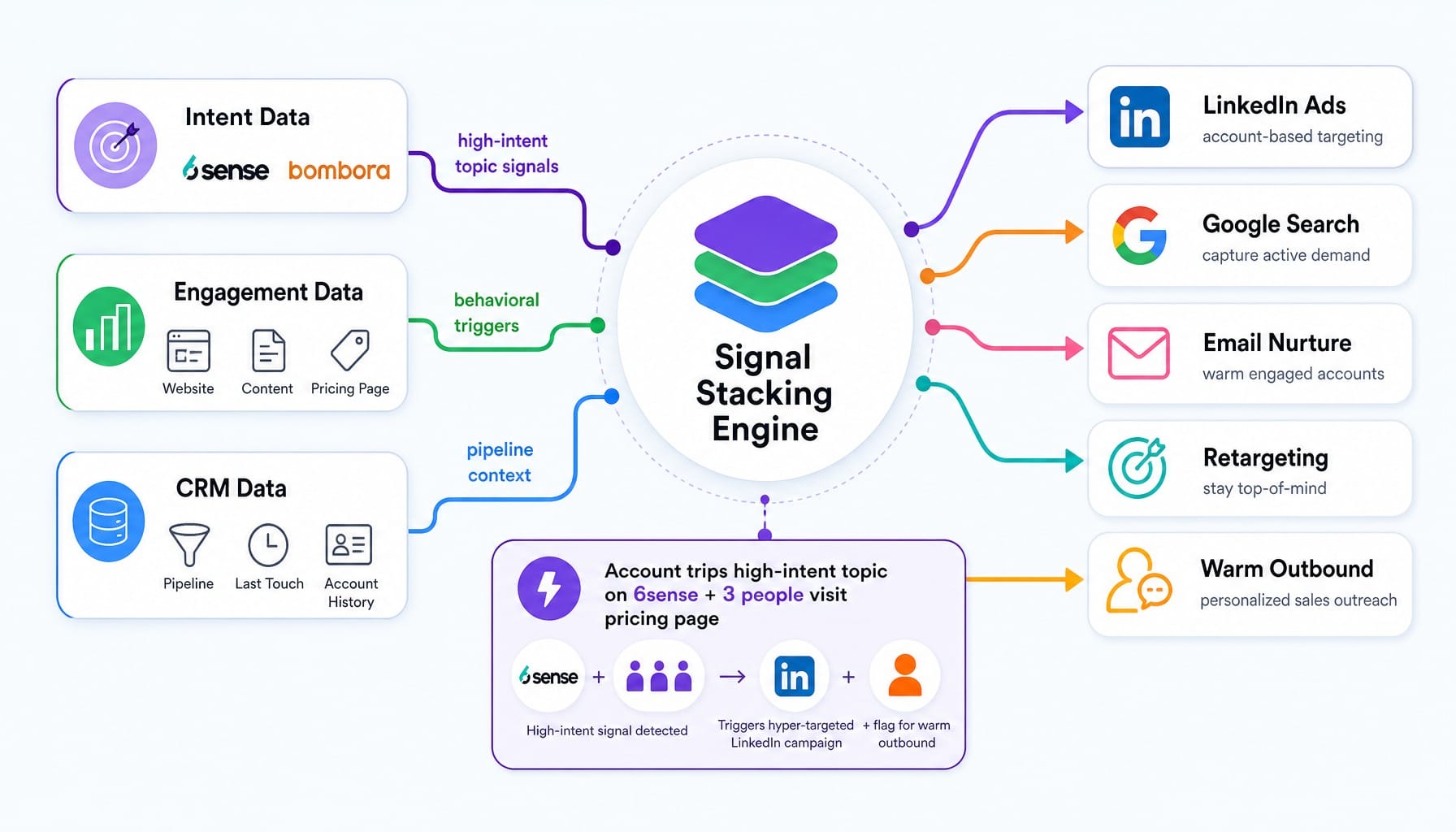
Channel selection matters less than signal coordination. Signal stacking is the practice of layering intent data (from platforms like 6sense), engagement data (website visits, content views), and CRM data (deal stage, last touch) to trigger the right message on the right channel at the right time.
The core channels for B2B SaaS demand gen remain consistent:
- LinkedIn Ads: For precise account-based targeting.
- Google Search: For capturing active demand.
- Email Nurture: For warming engaged accounts.
- Retargeting: For staying top-of-mind with website visitors.
The key is making them work together. For example, an account that trips a high-intent topic on 6sense and has three people visit your pricing page should be added to a hyper-targeted LinkedIn campaign and simultaneously flagged for warm outbound—a personalized outreach from a sales rep referencing their likely interest.
Read more: Marketing Channel Prioritization for 2026: Where Your Budget Actually Compounds
Common Failure Mode: Running all channels in parallel without coordinating signals. The result is a disjointed experience where the same account gets a cold top-of-funnel ad on LinkedIn and a warm mid-funnel email sequence in the same week, signaling to the prospect that your marketing is automated, not intelligent.
Step 4: Optimize the Website as a Conversion System, Not a Brochure
Your website is where your demand generation efforts either convert into pipeline or leak into the void. Yet for most SaaS companies, it's the highest-traffic asset that is also the least frequently optimized. It's designed once and updated quarterly.
Think of your website as a system with three possible outcomes for a qualified visitor:
- They book a demo. (Ideal)
- They engage with a secondary program. (e.g., subscribe to a newsletter, view an interactive demo). (Acceptable)
- They leave. (Failure)
Each of these outcomes must be measured and optimized independently. Use tools like Mutiny for on-site personalization, Navattic for interactive product demos that capture engagement without a form fill, and Qualified for routing high-intent visitors to live sales conversations. The goal is to maximize valuable actions and minimize bounces.
Common Failure Mode: Teams invest heavily in driving traffic but never systematically test the pages that traffic lands on. This is the marketing equivalent of spending a fortune to fill a leaky bucket. A weekly or bi-weekly cadence of website experimentation is non-negotiable.
Step 5: Align Sales and Marketing Around Pipeline Metrics, Not MQLs
The Marketing Qualified Lead (MQL) handoff is the single biggest source of sales and marketing misalignment. When marketing is measured on MQL volume and sales is measured on closed revenue, the incentives inevitably diverge. Marketing hits its number by sending over low-quality leads, and sales ignores them, creating a cycle of mistrust.
The fix is to replace MQLs with Marketing Qualified Accounts (MQAs) and establish the MQA-to-SQL conversion rate as the shared KPI.
Here's the practical implementation:
- Define MQA criteria jointly with the sales team, incorporating the firmographic and signal-based triggers from Step 1.
- Build a shared pipeline dashboard in your CRM (like HubSpot) or a revenue attribution platform (like Dreamdata or HockeyStack).
- Run a weekly pipeline review where both teams look at the same numbers: new MQAs, MQA-to-SQL conversion rate, pipeline velocity, and closed-won deals from marketing-sourced accounts.
Also, add a simple, free-text "How did you hear about us?" field to every demo request form. This practice of self-reported attribution is your best tool for capturing dark funnel activity that software will always miss.
Common Failure Mode: Marketing reports "pipeline influenced" while sales reports "pipeline sourced," and the two numbers never reconcile. A shared MQA definition and a single source of truth for pipeline metrics are the only way to fix this.
The Demand Gen Metrics Your Board Actually Needs to See
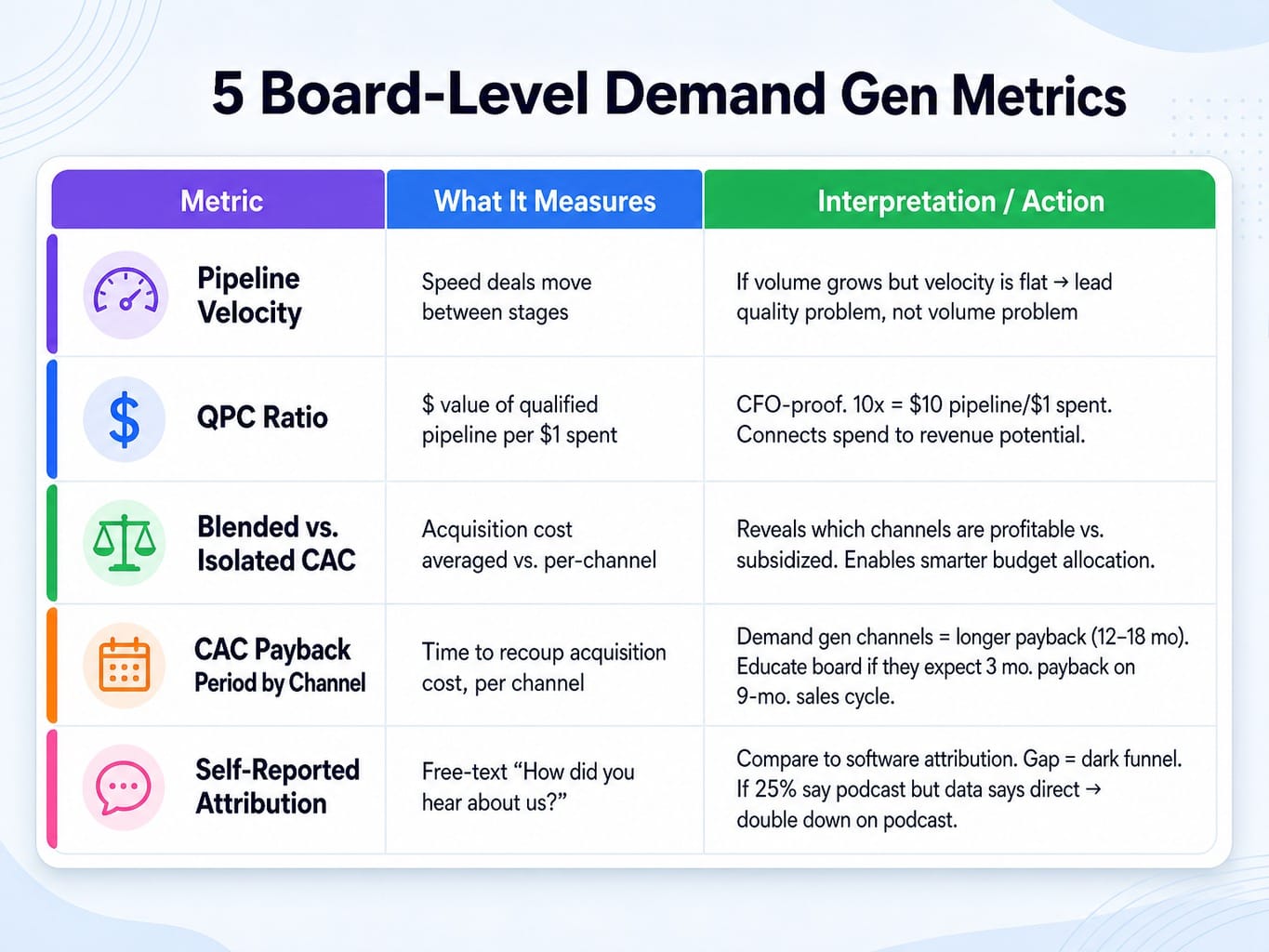
Your board doesn't care about MQL volume, cost per lead, or impressions. They care about growth, efficiency, and predictability. The five metrics that prove your demand generation program is working are pipeline velocity, QPC ratio, blended vs. isolated CAC, CAC payback period, and self-reported attribution.
- Pipeline Velocity: This measures how fast deals move from one stage to the next. Interpretation: If deal volume is growing but velocity is flat or decreasing, you have a lead quality problem, not a lead volume problem.
- QPC Ratio (Qualified Pipeline Created): This is the dollar value of qualified pipeline generated for every dollar of marketing spend. Interpretation: This is the CFO-proof metric. A QPC ratio of 10x means for every $1 you spend, you generate $10 in qualified pipeline, connecting marketing spend directly to revenue potential.
- Blended CAC vs. Isolated CAC: Blended Customer Acquisition Cost (CAC) averages costs across all channels, hiding inefficiency. Report both blended and channel-isolated CAC. Interpretation: This reveals which channels are profitable and which are being subsidized by others, allowing for smarter budget allocation.
- CAC Payback Period by Channel: This measures how long it takes to recoup the cost of acquiring a customer, broken down by channel. Interpretation: Demand gen channels often have longer payback periods than lead gen channels. If your board expects a 3-month payback on a 9-month sales cycle, you must educate them that demand gen is a 12-18 month investment. Reporting monthly ROI will kill the program before it works.
- Self-Reported Attribution: The raw data from your "How did you hear about us?" field. Interpretation: Compare this qualitative data to your software attribution. The gap is your dark funnel. If 25% of customers say "podcast" but your software attributes them to "direct traffic," you know where to double down.
How AI Changes the Demand Gen Shipping Problem in 2026
The AI content saturation problem is real. By 2026, every SaaS company can generate articles, scripts, and social posts with AI. Content volume is no longer a differentiator.
What remains scarce is the ability to identify the single highest-impact change across your entire marketing surface—SEO, website, content, and ads—and then ship it this week, without an engineering ticket or an agency brief.
AI's real role in demand generation isn't better content creation; it's solving the three root causes of shipping latency:
- The Specialist Gap: AI-powered platforms can perform cross-channel analysis that would otherwise require three or four human specialists, identifying optimization opportunities in SEO, CRO, and paid media simultaneously.
- The Coordination Tax: By integrating marketing goals with task execution, AI can compress the plan-approve-build-deploy cycle from weeks to days.
- Prioritization Paralysis: AI can model the potential pipeline impact of various changes, replacing gut-feel prioritization with a data-driven roadmap.
This doesn't mean AI replaces strategic judgment. It removes the execution bottleneck that prevents your strategic judgment from ever reaching production. Its value isn't generating more stuff; it's shipping the right changes faster.
How Spike AI Turns Your Demand Gen Backlog Into a Weekly Shipping Cadence
This article has built a specific tension: demand generation fails because lean teams cannot ship changes fast enough across their website, SEO, content, and ads. You're bottlenecked by a lack of specialist depth, coordination overhead, and prioritization guesswork. The solution isn't a better strategy document; it's a system that compresses the time between identifying the highest-impact change and deploying it.
This is exactly what Spike AI is built for. We close the shipping-latency gap.
Spike AI is a marketing execution engine that continuously identifies the single highest-impact move across your website (CRO), SEO/AEO, and ads—then executes it. Every week. No engineering tickets. No agency briefs. No backlog anxiety.
This creates the compounding cadence that demand generation requires. Each weekly release is measured, and the results feed the next cycle of re-prioritization and deployment. The team that was struggling to run 4-5 experiments per quarter can now run 12-15, because the execution layer is handled.
With our platform, your role shifts from operator to orchestrator. You approve the high-impact changes Spike AI identifies, and we handle the heavy lifting of getting it shipped. The result is a demand gen program that compounds, week after week.
See how Spike AI ships your highest-impact marketing changes weekly
From Strategy to Shipping
The single most important belief shift for any B2B SaaS marketer is this: demand generation is not a strategy discipline; it is a shipping discipline. The teams that consistently build pipeline are not the ones with the most elaborate playbooks. They are the ones that ship the most meaningful, data-informed changes per quarter across their website, content, and campaigns.
We defined demand gen, distinguished it from lead gen, and diagnosed why most programs stall due to shipping latency. We prescribed a 5-step engine built for a weekly cadence and identified the metrics that prove it's working.
Now, look at your own team. Count how many meaningful changes you shipped last quarter. If the number is under 10, your demand gen program isn't broken—it's bottlenecked. Fix the cadence, and the strategy you already have will finally start to compound.
Frequently Asked Questions
Should SaaS companies gate or ungate their content for demand generation?
Ungate the vast majority of your content. Gating trades broad reach and dark-funnel amplification for an email address that often has low purchase intent. Reserve gating only for exceptionally high-value assets like proprietary research reports where the perceived value justifies the friction. Even then, measure whether that gated content generates downstream pipeline, not just form fills.
How does demand generation work differently for PLG vs sales-led SaaS?
In PLG, demand gen drives users to a self-serve product experience where the product itself is the primary conversion asset. In sales-led models, demand gen drives qualified accounts to a demo request where a human closes the deal. The channel mix can be similar, but the conversion architecture and core metrics (e.g., product signups and activation rate vs. demo requests and SQL rate) are fundamentally different.
What budget split should a SaaS company use between demand gen and lead gen?
There is no universal ratio. Start by measuring your current pipeline sources. If over 70% of revenue comes from outbound or paid lead gen, shift 10-20% of that budget to demand creation activities and measure the pipeline impact over two quarters. At maturity, companies with ACVs above $25k and sales cycles over 90 days often find a 60/40 demand-gen-heavy split to be effective.
How do you track dark funnel activity in a SaaS demand gen program?
Add a mandatory, free-text "How did you hear about us?" field to every demo request and signup form. Compare the responses to your multi-touch attribution data; the gap reveals your dark funnel. Common sources include peer recommendations, Slack communities, podcast mentions, and LinkedIn posts that never generate a trackable click. Self-reported attribution is imperfect but consistently surfaces channels that software attribution misses entirely.
How do you run demand generation for a SaaS company selling to enterprise buying committees?
Shift from individual lead targeting to account-level engagement. Use platforms like 6sense or Demandbase to identify accounts showing collective research behavior across multiple stakeholders. Then, run multi-threaded campaigns that reach the economic buyer, technical evaluator, and end-user with role-specific messaging. Measure buying group penetration—the percentage of target accounts where you've engaged three or more committee members—as your leading indicator of success.