Frase Review 2026: Where It Delivers, Where It Falls Short, and Who Should Actually Buy It

TL;DR
- Best Feature: Frase's strongest value is its content brief generation, which compresses a 60-minute manual SERP analysis and research workflow into under 10 minutes.
- Hidden Cost: The advertised monthly price is misleading. For any serious content team, the unlimited AI writing add-on ($35/mo) is mandatory, increasing the real cost by 40-70%.
- Biggest Limitation: Frase is built for solo creators, not teams. The lack of native collaboration, approval workflows, and deep CMS integration creates significant friction for multi-person content operations.
- Versus Competitors: Frase is best for solo creators valuing research depth and AEO tracking. Surfer SEO is better for teams wanting prescriptive, real-time optimization. Clearscope is the choice for enterprise teams needing a clean editorial experience and simplicity.
- The Verdict: Frase is worth it for solo bloggers and small teams who use it for SERP research and optimization scoring, but its value as an all-in-one platform has diminished against cheaper LLM-native workflows and more team-friendly alternatives.
When Frase.io launched, it solved a genuine execution bottleneck. Manually pulling SERP data, analyzing competitor heading structures, researching questions, and building a content brief was a tedious, hour-long process for every single article. A dedicated tool that automated this was a clear win.
But the content landscape of 2026 is fundamentally different. With a single prompt, ChatGPT or Claude can generate a comprehensive content outline. Free tools can scrape SERP data. The core problem Frase was built to solve has been partially commoditized.
This reality reframes the question. It's no longer, "Is Frase a good tool?" but rather, "Does Frase still solve a problem that cheaper or free alternatives don't?"
This is not another feature walkthrough or an affiliate-driven recommendation. This is a practitioner's evaluation of where Frase genuinely earns its subscription in a modern content workflow. We'll analyze the real monthly cost of its credit system, compare it directly to Surfer SEO and Clearscope, and provide a clear decision framework for who should—and should not—be paying for it in 2026.
What Frase Actually Does in 2026 (Beyond the Marketing Copy)
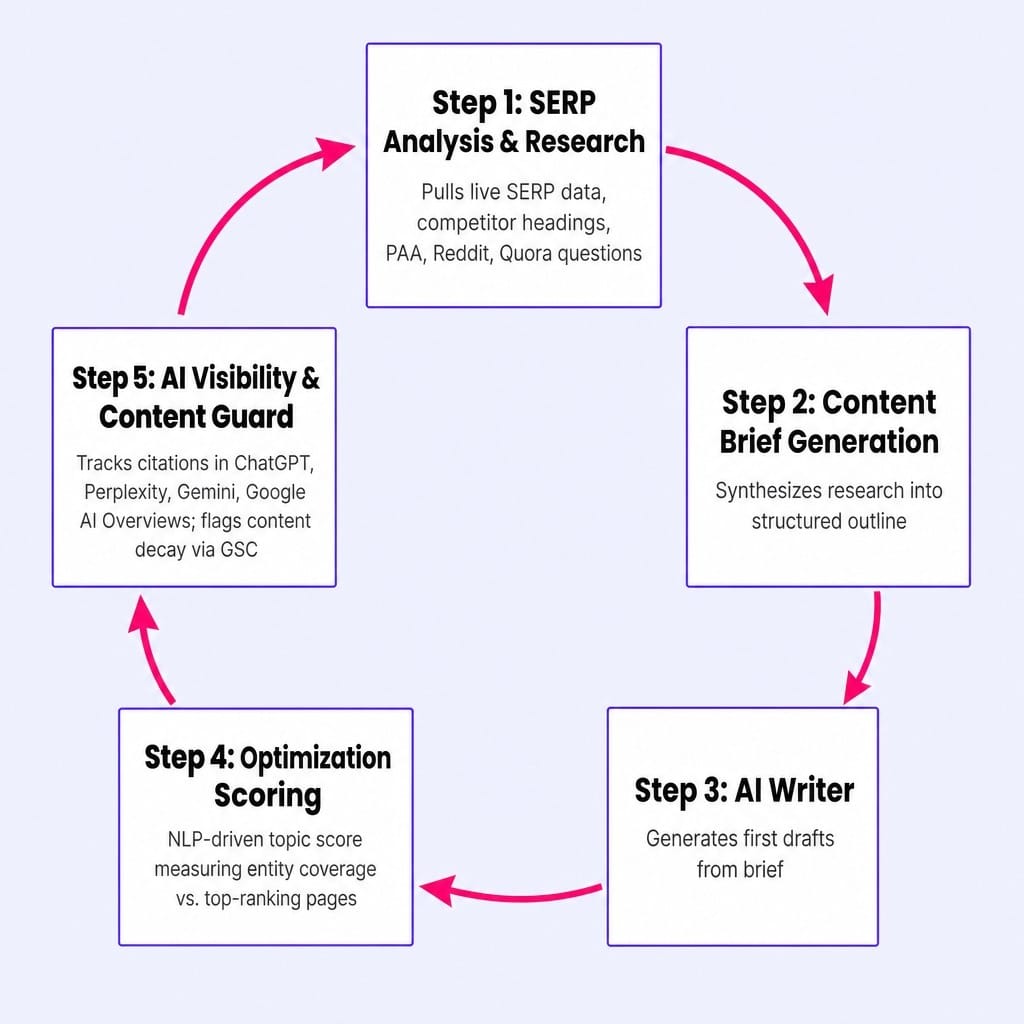
Most Frase reviews you find online are describing a product that is years out of date. Frase has evolved from a simple brief generator into what it now calls a "content loop"—a system designed to manage the entire lifecycle: research, create, publish, monitor, and fix.
For a content marketer targeting "best project management software," this loop translates into five core capabilities:
- SERP Analysis & Research: This is the foundation. Frase pulls live SERP data for your target keyword, showing you competitor heading structures, average word counts, and domain authority. It also integrates question research, scraping People Also Ask (PAA), Reddit, and Quora to surface what users are actually asking.
- Content Brief Generation: It synthesizes the research into a structured content brief, providing an actionable outline based on the SERP pull and question research.
- AI Writer: Frase has an integrated AI writer that can generate first drafts based on the brief, supposedly in your brand's voice.
- Optimization Scoring: As you write or paste content into the editor, Frase provides a real-time topic score. This NLP-driven score analyzes your draft's entity coverage and semantic relevance against the top-ranking pages, highlighting topical gaps.
- AI Visibility & Content Guard: These are the newest, most strategic additions. AI Visibility tracks whether your content is cited in answers from ChatGPT, Perplexity, Claude, Gemini, and Google AI Overviews. Content Guard uses Google Search Console integration to automate content decay detection, flagging pages that are losing traffic and drafting potential fixes.
The AI visibility tracking is Frase's bet on the future of answer engine optimization. It monitors if you're being cited, but it's important to be clear: it's a monitoring tool, not an optimization feature that restructures your content for better zero-click optimization.
Where Frase Genuinely Earns Its Price
Frase's value isn't in any single feature—it's in the workflow compression. It collapses what was once a multi-tool, context-switching process (SERP scraper + question tool + outline builder + optimizer) into a single interface where research context flows directly into the draft and optimization phases.
Content Briefs That Actually Reflect SERP Reality
Frase's content brief generation remains its strongest, most defensible feature. It's not the AI that's special; it's the live content brief SERP pull.
Imagine a content manager briefing a freelance writer for an article on "CRM for startups." The manual workflow is a productivity killer: open 10 SERP results in different tabs, copy-paste heading structures into a Google Doc, run a separate search for PAA questions, find a relevant Reddit thread, and then try to synthesize it all into a coherent brief. This is a 45- to 60-minute task, easily.
Frase compresses this to under 10 minutes. It presents all the competitor H2s, PAA questions, and related queries in a clean interface that you can click to add to your outline. This is a real, measurable time-saver that directly impacts content velocity.
The limitation, of course, is that the brief's quality is entirely dependent on the SERP itself. For a competitive, well-populated SERP, the output is rich and actionable. For a thin, low-competition SERP or an emerging topic, the brief will be correspondingly weak. It's a mirror, not a crystal ball.
Optimization Scoring That Catches What You Miss
Frase's topic score serves a fundamentally different purpose than a grammar checker or readability tool. It's a gap-detection mechanism that uses a TF-IDF overlay and entity salience analysis to find what you missed.
For example, say you've written a draft on "email marketing automation" that feels comprehensive. You've covered drip campaigns and open rates. But your topic score is a 62/100. The optimization panel reveals why: your draft completely missed the concepts of "behavioral triggers," "list segmentation," and "deliverability"—topics that 8 of the 10 top-ranking pages cover in detail.
This is where the tool provides genuine information gain scoring. It forces you to address the subtopics and entities that Google's NLP models likely associate with topical authority for that query.
But it's crucial to understand the context. The score is relative to the current SERP leaders, not an absolute measure of quality. If the top 10 results are all mediocre, scoring a 95/100 against them just means your article is the best of a bad bunch. It's a tool for achieving competitive parity, not for guaranteeing excellence.
The Hidden Cost of Frase's Credit System
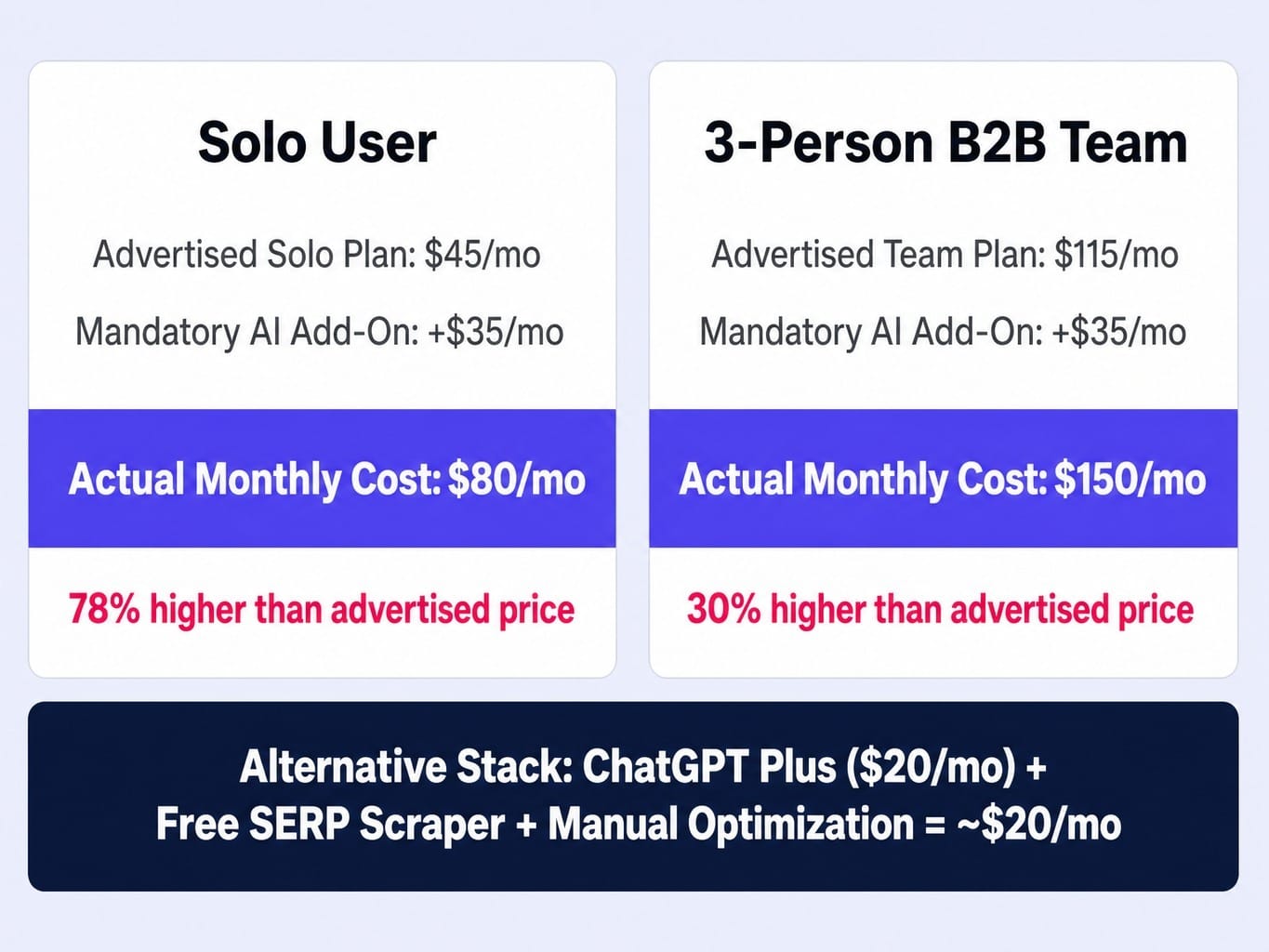
On the surface, Frase's pricing seems straightforward: the Solo plan starts around $45/month and the Team plan at $115/month. But these numbers rarely reflect what a content team actually spends.
The critical detail is Frase's credit-based system for AI writing. The base plans include a limited number of AI-generated characters, which gets consumed quickly when drafting articles. For any team with a regular publishing cadence, this limit becomes a major constraint.
This makes the "Pro AI Add-On" ($35/month for unlimited AI writing) effectively mandatory.
Let's do the math for a realistic scenario: a 3-person B2B SaaS content team publishing 20 articles per month.
- Advertised Team Plan: $115/month
- Mandatory Add-On: +$35/month
- Actual Monthly Cost: $150/month
For a solo user, the calculation is similar:
- Advertised Solo Plan: $45/month
- Mandatory Add-On: +$35/month
- Actual Monthly Cost: $80/month
This isn't to say Frase is overpriced. The point is that the advertised price and the actual operating cost diverge significantly. Compare that $150/month team cost to an alternative stack: a ChatGPT Plus subscription ($20/mo) for drafting, a free SERP scraper for research, and manual optimization. The value proposition becomes much less clear. Most affiliate-driven reviews conveniently ignore this math, but for anyone managing a budget, it's the most important part of the frase.io review.
Where Frase Falls Short in 2026
Frase is a good tool, but its core product assumptions are rooted in a pre-2023 content landscape. In 2026, two structural limitations stand out.
The Shrinking Moat: When ChatGPT and Claude Do the Same Job for Free
Frase's original value—AI-assisted content research and brief generation—has been partially commoditized by general-purpose LLMs. A well-crafted prompt in Claude or ChatGPT can now deliver a surprisingly effective content brief.
For example, a solo content marketer can now use a prompt like this in Claude:
"I'm writing an article on 'best CRM for small business'. Analyze the likely top 10 ranking pages for this keyword. Based on that analysis, generate a comprehensive article outline that includes a strong H1, logical H2s and H3s, and a list of key entities and concepts to cover. Identify any content gaps or unique angles I could take to create a more helpful resource."
The output won't be grounded in live SERP data—that remains Frase's key differentiator. But for many, the 80% solution from a $20/month ChatGPT subscription is good enough. It's directionally correct and costs nothing incremental.
This means Frase's moat now rests almost entirely on its live SERP data integration and its NLP-driven content scoring. The AI writing and brief generation features, while useful, are no longer the unique selling points they once were.
Collaboration and CMS Gaps That Slow Down Teams
Frase is fundamentally a single-player tool. It's built for an individual content creator, not for a team with a multi-step approval workflow. And let's be honest, that copy-paste-review-copy-back dance is where good content workflows go to die.
Here are the specific gaps that create friction:
- No Native Approval Workflow: You can't assign a draft to an editor for review or to a manager for approval within Frase.
- Limited Collaboration: Document sharing is a simple link. There's no role-based access, commenting, or suggestion mode comparable to Google Docs.
- Shallow CMS Integration: The WordPress and Webflow plugins exist, but they are basic. They don't support staging environments, scheduled publishing, or complex formatting.
- No Version History: There is no robust change tracking, making it difficult to revert to previous versions of a draft.
For a 4-person team where a writer drafts, an editor reviews, and a manager approves, the workflow breaks. The team inevitably copies the content out of Frase and into Google Docs for the review cycle, then copies it again into their CMS. This defeats the entire "single loop" promise and reintroduces the very friction the tool is meant to solve.
Frase vs. Surfer SEO vs. Clearscope: What Actually Differentiates Them
Every search for a frase review is implicitly a commercial investigation. You're not just asking is frase good, but "should I use Frase, Surfer, or Clearscope?" Here's how they actually differ on the points that matter.
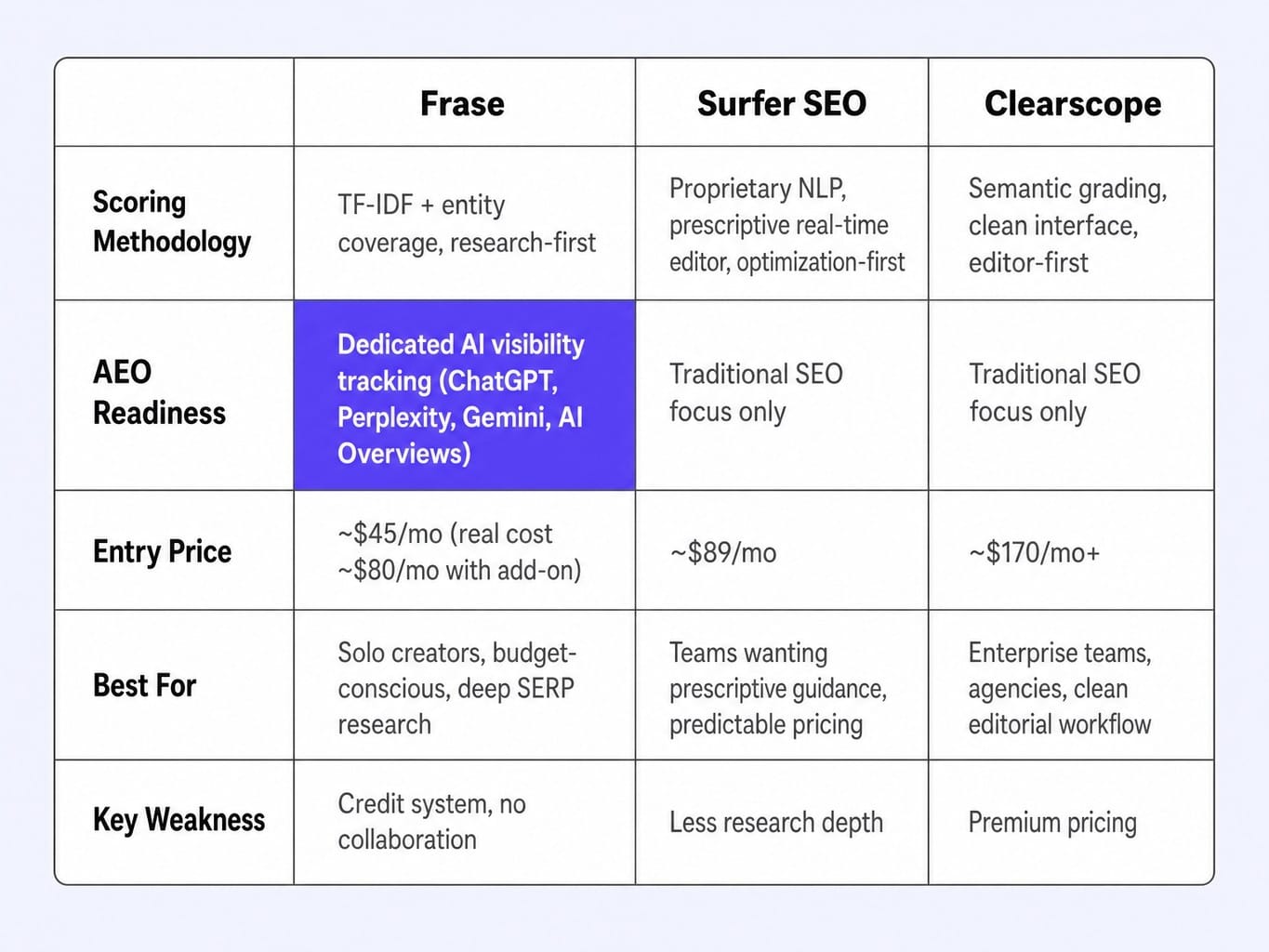
Scoring Methodology:
Frase: Uses TF-IDF with entity coverage. Its strength is in the research context it provides—competitor structures, PAA questions, and topic clusters. It's more of a research-first tool.
Surfer SEO: Uses its own NLP-based content scoring with a more granular, real-time editor. It's highly prescriptive, suggesting exact keyword counts, heading structures, and paragraph counts. It's an optimization-first tool.
Clearscope: Uses semantic grading with a focus on simplicity and editorial experience. Its interface is the cleanest, providing a straightforward content grade and a list of relevant terms. It's an editor-first tool.
AEO Readiness:
Frase: Is the only one of the three with a dedicated AI visibility tracking feature to monitor citations across answer engines like Perplexity and Google's AI Overviews. This gives it an edge for teams focused on answer engine optimization.
Surfer & Clearscope: Remain primarily focused on traditional SEO and Google's organic rankings. They help you create content that ranks, but they don't track your visibility in generative AI experiences.
Pricing Model:
Frase: Cheapest entry point (~$45/mo) but the credit system makes the real cost higher at scale.
Surfer SEO: Higher entry point (~$89/mo) but with more predictable, volume-based pricing.
Clearscope: Enterprise-priced (~$170/mo+) and positioned for larger teams who value simplicity and editorial workflow over granular features.
Read more: Surfer SEO vs Clearscope: Which Tool Fits Your Team's Actual Workflow in 2026
The Verdict:
- Choose Frase if: You're a solo creator or small team on a budget who values deep SERP research and wants to start tracking AEO visibility.
- Choose Surfer SEO if: Your team wants prescriptive, real-time optimization guidance and predictable pricing for a higher volume of content.
- Choose Clearscope if: You're an enterprise content team or agency that prioritizes a clean, simple editorial workflow and is willing to pay a premium for it.
Is Frase Worth It? A Decision Framework by Team Profile
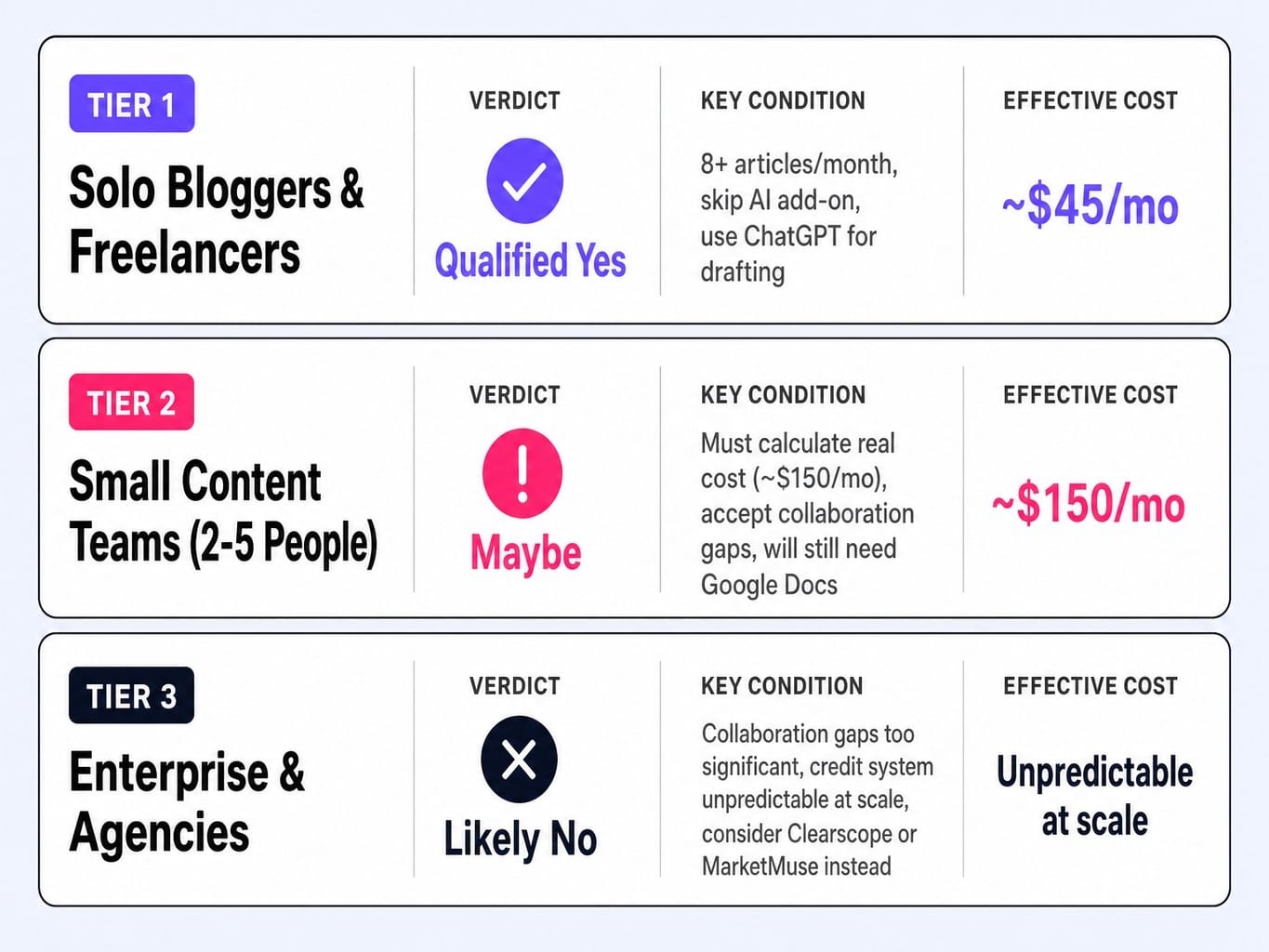
There is no single "yes" or "no" answer. Is Frase worth it depends entirely on your team's profile and workflow.
- For Solo Bloggers & Freelancers:
A qualified yes. At ~$45/month (if you skip the AI writer add-on and use ChatGPT for drafting), the SERP research and optimization scoring alone can justify the cost, especially if you publish 8+ articles per month. The time saved on brief creation is significant.
- For Small Content Teams (2-5 People) at B2B SaaS Companies:
Maybe. You must calculate your real monthly cost, including the mandatory AI writing add-on (~$150/mo for the Team plan). At that price, compare it directly to Surfer SEO's team offerings. Be prepared for the collaboration limitations to create workflow friction; you will still need Google Docs for your editorial review process.
- For Enterprise Content Operations & Agencies:
Likely no. Frase is not the right primary tool. The collaboration gaps are too significant, and the credit system becomes unpredictable and expensive at enterprise scale. Tools like Clearscope or MarketMuse offer far better team-based workflows. Frase's AI visibility tracking might be worth monitoring as a supplementary tool, but it shouldn't be the backbone of your operation.
Read more: Frase vs Clearscope in 2026: Which Tool Actually Improves Content Performance?
Frase remains a good tool that now solves a narrower problem than it did three years ago. Its strongest use case is SERP-grounded research and optimization for individuals. Its weakest is as an all-in-one content platform for teams needing collaboration, integration, and predictable costs.
When Content Optimization Is Only Half the Problem
This entire review has focused on a single question: how can you create better-optimized content? Frase, Surfer, and Clearscope are all built to answer that. But for growth marketers and RevOps leaders, a perfectly optimized article that gets a 99/100 topic score is only a partial victory.
Content optimization is one step in a much larger marketing execution system. It doesn't fix a broken landing page, a confusing user journey, or a leaky conversion funnel. The underlying goal isn't a higher topic score; it's more qualified leads and measurable revenue impact.
This is the execution gap. Teams get stuck optimizing individual pieces of content because it's tangible, while the highest-impact move might be a CTA change on a high-traffic page, a pricing page redesign, or a technical SEO fix.
Where Frase optimizes a single content workflow, Spike AI optimizes the entire marketing output system. It's the layer that sits above your content tools, continuously identifying the single highest-impact move across your entire website—whether that's a new article, a landing page A/B test, or a CRO fix—and then executes it. It shifts the focus from "is this content good?" to "what is the next marketing release that will most effectively grow qualified leads?"
See how Spike AI identifies and ships your highest-impact marketing move every week
Conclusion
Frase is a strong content research and optimization tool with a narrowing moat. Its SERP-grounded briefs and topic scoring remain genuinely useful, saving solo creators and small teams measurable time on every article.
However, its value proposition is less clear-cut than it was in 2022. The opaque credit system inflates the real monthly cost well beyond the sticker price. The rise of powerful, LLM-native workflows in ChatGPT and Claude has commoditized the AI-assisted brief generation layer. And its significant collaboration gaps create real friction for any team with more than one person in their content workflow.
The decision to buy Frase in 2026 requires a clear-eyed assessment of your team's needs. But before choosing any content optimization tool, ask a more fundamental question: is content optimization the constraint that is actually limiting your growth? Or is the real bottleneck somewhere else in your execution system entirely?
Frequently Asked Questions
Does Frase support content optimization for languages other than English?
Frase supports SERP analysis and optimization in about 8 languages, but the NLP-driven topic scoring and entity coverage are significantly less accurate outside of English. For non-English content, expect the suggestions to be directionally useful but not as granular as the English-language experience.
Can Frase generate full blog posts, or is it primarily a brief and optimization tool?
Frase's AI writer can generate full first drafts, but the output quality is comparable to what you'd get from a detailed prompt in ChatGPT or Claude. The tool's real strength isn't the draft itself, but the SERP-grounded research and optimization scoring that inform the writing process.
How does Frase's AI visibility tracking actually work for answer engine optimization?
Frase monitors if your content is cited in AI-generated answers from ChatGPT, Perplexity, Claude, Gemini, and Google AI Overviews. It tracks your share of voice and alerts you to changes. It is a visibility monitoring tool, not an active optimization feature that restructures your content for you.
Does Frase integrate with Google Search Console for content refresh workflows?
Yes, Frase's GSC integration helps identify content decay by pulling performance data for pages losing rankings or traffic. The "Content Guard" feature uses this to flag declining pages and draft potential fixes. The integration is functional but more basic than the inventory analysis in dedicated tools like MarketMuse.
Is Frase suitable for programmatic SEO at scale?
No, Frase is not designed for programmatic SEO. Its workflow is built around creating individual, in-depth documents. For teams producing hundreds of templated pages targeting long-tail variations, custom-built pipelines using LLM APIs are a much better fit. Frase's value is in depth per article, not volume.