Optimizely Pricing in 2026: What You'll Actually Pay (License + Hidden Costs)

TL;DR
- The License Fee Is a Down Payment: Optimizely pricing starts around $36,000/year for basic web experimentation and scales past $500,000. However, this is often less than 50% of your first-year total cost of ownership (TCO).
- Budget for Execution, Not Just the Tool: The real cost lies in implementation partners ($50K–$200K+), dedicated CRO staff ($90K+/year), and training. A mid-market company paying a $55K license should budget ~$175K for year one.
- Watch for Hidden Contract Costs: Most Optimizely contracts include annual price escalation clauses of 5–15% and steep overage charges if you exceed your traffic cap. These costs are negotiable before you sign.
- Calculate Your Cost-Per-Experiment: If your team runs fewer than 5 experiments per month, the platform is likely not worth the cost. If you're paying $80K/year for 30 experiments, that's over $2,600 per test—a rate that rarely delivers positive ROI.
- Negotiate Everything: Buyers who negotiate typically save 15–25% on their annual contract value (ACV). Leverage end-of-quarter timing, competing quotes, and multi-year commitments to reduce your cost.
Last updated: July 2026
Optimizely does not publish pricing on its website, but based on verified buyer data, plans start at approximately $36,000 per year for basic web experimentation and scale to $200,000–$500,000+ for enterprise-grade multi-product deployments.
But that license fee is the simplest, and least important, part of the Optimizely cost equation.
Most teams that regret the purchase don't regret the sticker price; they regret underestimating the total cost of execution. The implementation partners, specialized headcount, and operational overhead required to run experiments at a velocity that justifies the spend are where budgets truly break.
This guide breaks down the complete picture of Optimizely pricing. We'll cover the product-by-product license costs, expose the hidden fees that can inflate your real spend by 40–80%, and provide a clear verdict on who should—and shouldn't—buy the platform.
Optimizely Pricing by Product: What Each Module Actually Costs
Optimizely's strategy has shifted toward the "Optimizely One" Digital Experience Platform (DXP), which bundles multiple products. However, most B2B teams still evaluate and buy these modules individually or in smaller packages. The median annual contract value (ACV) for Optimizely, according to procurement data from Vendr, is $82,894 across more than 125 transactions.
Here's how the pricing breaks down for their core offerings in 2026.
It's important to note that bundling multiple products under the Optimizely One umbrella can yield discounts of 15–25% below the combined list price. However, this also locks you into a larger ACV and reduces your flexibility to drop underutilized modules at renewal time.
Read more: SaaS Pricing Strategy That Compounds: Models, Value Metrics, and Governance for 2026 | Spike AI
What Actually Drives Your Total Optimizely Cost
The license fee is typically 30–50% of your first-year Optimizely cost and an even smaller share of your three-year total cost of ownership. The rest is implementation, people, and operational overhead—and that's where most budgets break. A mid-market company paying an $80,000 license fee should budget for a total first-year outlay of $120,000 to $160,000.
Consider a typical B2B SaaS company with 400,000 monthly visitors. They sign for Optimizely Web Experimentation at $55,000 per year. They then discover they need a $40,000 systems integrator (SI) engagement for implementation, $15,000 in team training, and a half-FTE analyst (at a $45,000 loaded cost) to actually run the program. The real year-one cost is $155,000, nearly triple the license fee.
Implementation and Migration: $50K–$200K Before You Run a Single Test
Implementation is the most consistently underestimated line item in an Optimizely budget. The cost scales directly with your site's existing technical debt, not with the license price. This broad range breaks down into several components:
- SI Partner Fees: $30,000 – $120,000, depending on the complexity of your CMS and data sources.
- Internal Developer Hours: 80–200 hours for setting up tag management, refining the data layer, and configuring integrations.
- Data Migration & Training: If moving from another platform, this can add another $10,000–$25,000.
Many teams migrating from the sunsetted Google Optimize assumed a simple 4-week setup. In reality, they faced 12-week projects because their data layer wasn't structured for sophisticated experimentation, requiring a significant engineering investment before the first A/B test could even be launched.
The People Cost: Running Experiments Requires More Than a License
Optimizely is a power tool that demands skilled operators. Buying the platform without budgeting for the team to run it is like buying a commercial kitchen and expecting the same two people who run marketing to also become gourmet chefs.
A mature experimentation program requires a team covering research, design, development, copywriting, and analysis. For lean B2B SaaS teams, this is rarely feasible. A dedicated CRO analyst costs $70,000–$110,000 per year (loaded), while a fractional agency engagement to manage the program runs $8,000–$15,000 per month. The license is the entry ticket; the people are the operating cost.
Three-Year TCO Model: What a Mid-Market B2B Company Actually Spends
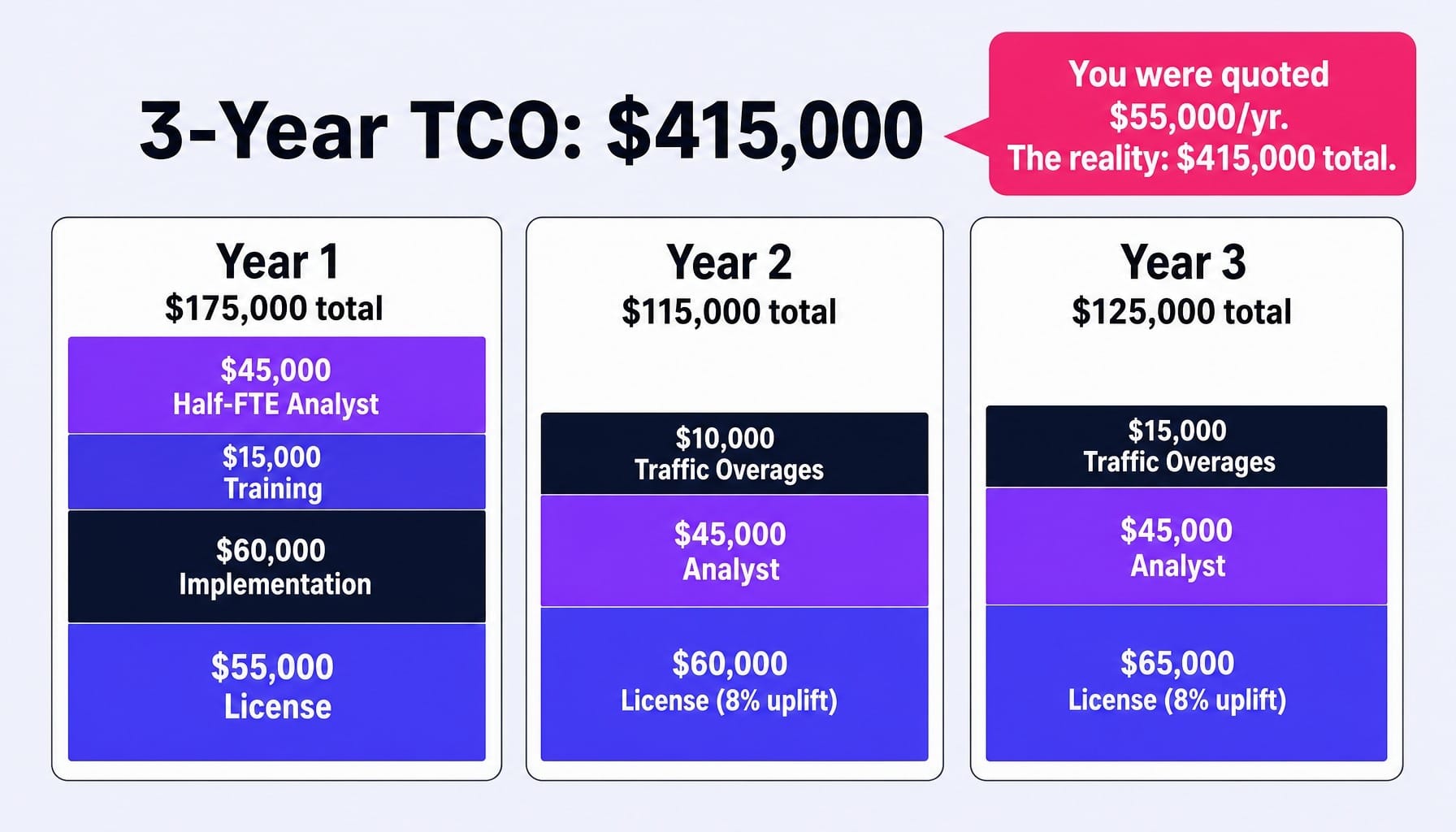
Let's model the three-year total cost of ownership for a mid-market B2B SaaS company (300k-500k monthly visitors) buying Web Experimentation and the Data Platform.
- Year 1: $55,000 License + $60,000 Implementation + $15,000 Training + $45,000 Half-FTE Analyst = $175,000
- Year 2: $60,000 License (8% renewal uplift) + $45,000 Analyst + $10,000 Traffic Overages = $115,000
- Year 3: $65,000 License (8% uplift) + $45,000 Analyst + $15,000 Traffic Overages = $125,000
The three-year TCO is approximately $415,000. This is the number to bring to your CFO, not the $55,000 sticker price from the initial sales call.
Renewal Traps and Overage Charges: What Happens After You Sign
Optimizely contracts typically include annual price escalation clauses of 5–15%, and most buyers don't negotiate them down before signing. The costs you incur after the ink is dry are often the most painful. Here are three risks to watch for.
First, renewal escalation. A $60,000 year-one contract with a 15% escalation clause becomes a $69,000 license in year two and a $79,000 license by year three—a 32% increase over the initial term that wasn't in the original budget. This is a standard SaaS practice, but it catches many teams by surprise.
Second, traffic overage charges. Your contract specifies a cap on Monthly Tracked Visitors (MTUs) or impressions. If you exceed this cap, you'll face overage fees that are typically 20–40% higher than your contracted per-unit rate. This creates a perverse incentive where successful marketing that grows your traffic costs you more. A B2B company that launches a viral campaign, exceeds their 500K MTU cap by 200K visitors, and gets hit with a surprise $4,000–$8,000 bill is a common story.
Third, auto-renewal clauses. Most Optimizely contracts auto-renew 60 to 90 days before the expiration date. If you miss the narrow cancellation window, you are locked in for another full year at the escalated rate. One G2 reviewer reported a surprise $24,000 auto-renewal bill for this exact reason.
Is Optimizely Worth It? A Verdict by Company Profile
Optimizely is not overpriced—it's mis-bought. The platform delivers genuine value at scale, but only if your organization has the traffic, team, and testing velocity to justify the investment. The key is to match the tool's power to your operational capacity.
- Buy Optimizely if... you are an enterprise B2B SaaS or e-commerce company with 1M+ monthly visitors, a dedicated experimentation team of 3+ people (including a developer and analyst), and a total CRO budget over $200,000 per year. For you, Optimizely's advanced targeting, server-side capabilities, and DXP consolidation justify the premium. If you can't run at least 10 concurrent experiments, you're not ready.
- Skip Optimizely if... you are a mid-market B2B company with under 500,000 monthly visitors and a 1-3 person marketing team. The license-to-usage ratio will be poor; you'll pay for enterprise capacity you can't possibly operationalize. Your bottleneck isn't the tool's features, it's the human bandwidth to design, build, and analyze tests. Look at more accessible alternatives like VWO or Convert.
- Reconsider at renewal if... you bought Optimizely two or more years ago and your experimentation velocity has plateaued at 2–4 tests per month. Do the math on your cost-per-experiment. If you're paying an $80,000 annual license and running 30 experiments a year, that's $2,667 per experiment. At that price, you could likely achieve a better ROI by hiring a fractional CRO consultant.
Read more: SaaS CRO: The Conversion Optimization Playbook That Actually Matches Your ACV and Motion | Spike AI
How to Negotiate a Lower Optimizely Contract
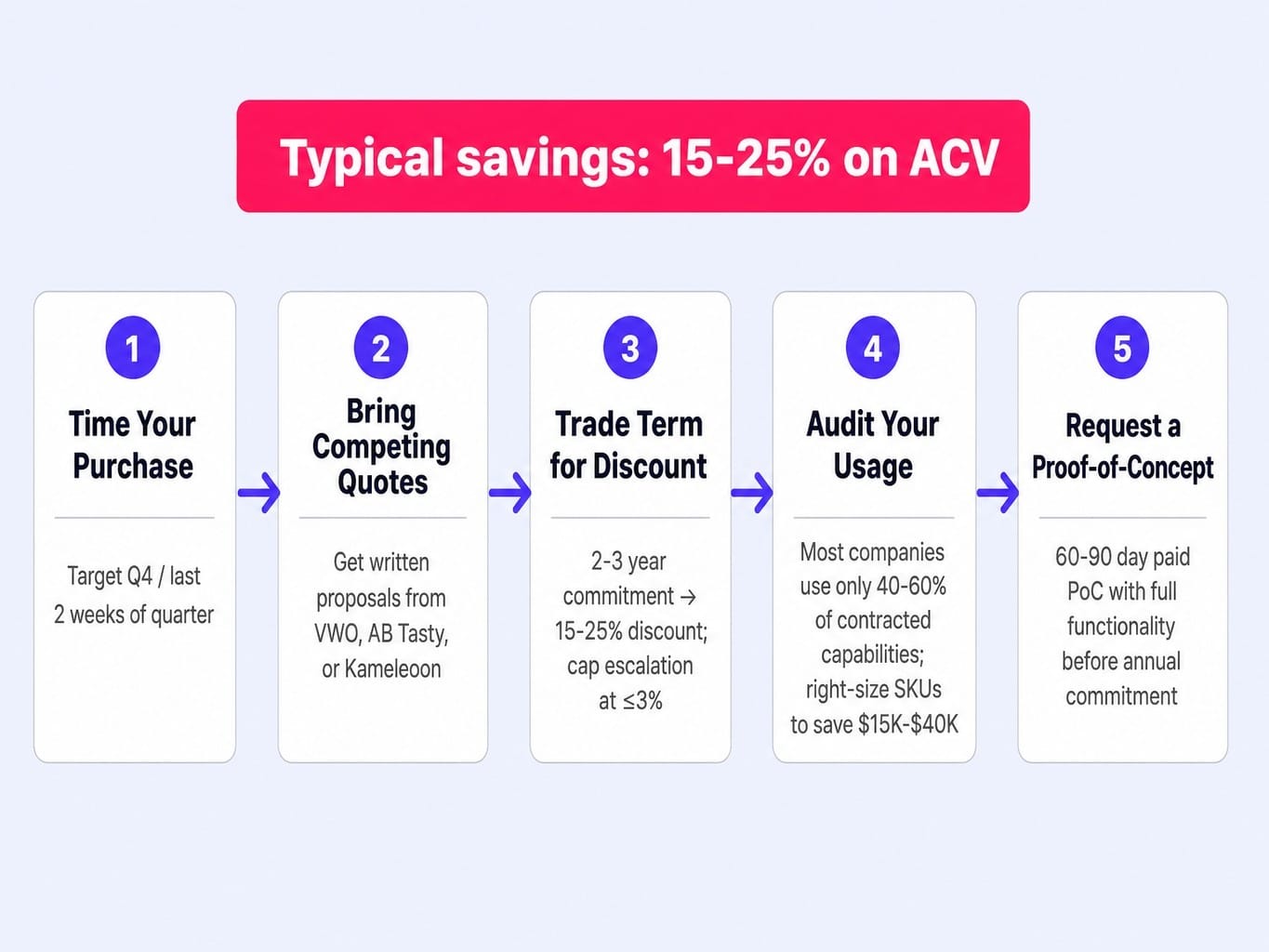
Optimizely's list prices are starting positions, not final offers. Buyers who come prepared to negotiate typically save 15–25% on their annual contract value. Your procurement team can use this playbook:
- Time Your Purchase. Optimizely's fiscal year ends in December. Negotiating in the last two weeks of a quarter, especially Q4, gives you maximum leverage as sales teams rush to meet quotas.
- Bring Competing Quotes. Get written proposals from VWO, AB Tasty, or Kameleoon. Even if you prefer Optimizely, having a documented alternative is the single most effective tool for gaining leverage.
- Trade Term for Discount (Carefully). Offer to sign a two or three-year contract in exchange for a 15–25% discount on the annual rate. However, you must insist on capping the annual price escalation clause at 3% or less, down from the standard 5-15%.
- Audit Your Usage Before Renewal. Most companies use only 40–60% of their contracted capabilities. Before renewing, conduct an audit. Are you actually using the Data Platform? Do you need all five seats in the Content Marketing Platform? Right-sizing your SKU bundle can save $15,000–$40,000 in annual spend.
- Request a Proof-of-Concept (PoC). Before committing to a full annual contract, ask for a 60-90 day paid PoC with full functionality and dedicated support. This lets you validate the tool's value and implementation complexity on your own terms.
Optimizely Alternatives: Pricing Comparison for B2B Teams
If Optimizely's pricing or operational requirements don't fit your team, these five alternatives serve different segments of the experimentation market—but each involves a tradeoff. The price difference at the entry level can be stark: VWO starts at ~$2,400 per year, a 15x difference from Optimizely's $36,000 minimum.
- Choose VWO when your team needs heatmaps, session recordings, and A/B testing in one platform and your budget is under $50K/year. Do not choose it if you need robust server-side experimentation. What you lose vs. Optimizely: Advanced audience targeting and enterprise-grade DXP integrations.
- Choose AB Tasty when your primary goal is AI-driven personalization and audience segmentation at an enterprise scale. Do not choose it if you're looking for a lower-cost Optimizely alternative, as their pricing is similarly enterprise-focused. What you lose vs. Optimizely: A broader, more integrated content and commerce platform.
- Choose Convert when your top priority is data privacy and compliance (GDPR/CCPA), and you need a fast, flicker-free testing tool. Do not choose it if you need a full suite of CRO tools like surveys or heatmaps. What you lose vs. Optimizely: The integrated data platform and advanced personalization features.
- Choose LaunchDarkly when your engineering team needs a powerful feature flagging and release management system. Do not choose it if you are a marketing team needing a visual editor for website A/B testing. What you lose vs. Optimizely: All client-side marketing experimentation and personalization capabilities.
- Choose Statsig when you are a data-mature product team that wants to run complex experiments and analyze results with a sophisticated stats engine. Do not choose it if you need a simple visual editor for marketing campaigns. What you lose vs. Optimizely: The user-friendly interface for non-technical users.
When the Bottleneck Isn't the Tool — It's the Bandwidth to Use It
This brings us back to the central tension. A mid-market SaaS company paying $65,000 a year for Optimizely but only running two tests a month isn't failing because of the tool. They're failing because their two-person marketing team can't design, develop, QA, and analyze experiments while also handling SEO, content, and paid search. The real bottleneck is execution bandwidth.
Adding another powerful tool doesn't solve this problem. Adding an execution layer does.
Spike AI is a marketing execution engine that closes the gap between insight and implementation. Instead of buying an expensive experimentation platform and struggling to staff it, Spike AI continuously identifies the highest-impact conversion improvements across your website, SEO, and ads—then ships them for you, every week. It delivers the optimization output of a $15,0-00/month CRO agency, running continuously, at a fraction of the cost.
See how Spike AI ships weekly CRO improvements without adding headcount
The Real Question to Ask About Optimizely Pricing
Optimizely's license fee, ranging from $36,000 to over $500,000, is the most straightforward line item in a complex budget. The license is a down payment on a much larger investment in implementation, staffing, overages, and renewal escalations that can easily double or triple your actual cost.
The question isn't "can we afford Optimizely?" It's "can we afford to operate it at the velocity that justifies the investment?"
Before you request a quote, audit your team's current experimentation velocity. Calculate what you're paying per experiment today. If that number is north of $1,500, the problem isn't your tool—it's your execution capacity.
Frequently Asked Questions
Does Optimizely offer a free plan or starter tier?
Yes, Optimizely offers a free Starter plan for Web Experimentation that doesn't require a credit card. It includes limited experiments and basic targeting but lacks advanced audience segmentation, server-side testing, and dedicated support. It's useful for evaluating the interface but not for running a real experimentation program.
Does Optimizely charge per seat or per tracked visitor?
Optimizely primarily uses traffic-based billing (Monthly Tracked Visitors or impressions) for its experimentation products, not per-seat licensing. However, Content Cloud and some administrative features may include seat-based components. Your contract will specify an MTU or impression cap—exceeding it triggers overage charges.
How does Optimizely One bundled pricing work versus buying individual products?
Optimizely One bundles multiple products (e.g., Web Experimentation + Content Cloud) into a single contract, often at a 15–25% discount compared to their combined list prices. The tradeoff is reduced flexibility; you're locked into a higher ACV and dropping a module at renewal is difficult without renegotiating the entire bundle.
What is the typical Optimizely annual contract value for mid-market companies?
Based on procurement data, mid-market companies buying a single experimentation product (with 300K–800K monthly visitors) typically pay $50,000–$120,000 per year. Multi-product mid-market deployments can range from $120,000 to over $300,000, excluding implementation and services.
Does Optimizely offer discounts for startups or nonprofits?
Optimizely does not publicly advertise a formal startup or nonprofit discount program. However, sales teams have discretion to offer reduced pricing for proof-of-concept engagements and early-stage companies. Your best leverage is always a competing quote combined with a multi-year commitment.
Are Optimizely feature flags priced separately from web experimentation?
Yes, Feature Experimentation (for server-side feature flags) and Web Experimentation (for client-side A/B testing) are separate products with independent pricing. Feature Experimentation is typically metered by monthly flag evaluations, not website visitors, and starts in the $50,000–$120,000/year range.