B2B SaaS Affiliate Marketing: A Guide to Building a Program That Lasts

TL;DR
- Most SaaS affiliate programs fail from a lack of partner activation and a weak conversion infrastructure, not from poor recruitment.
- Design commission structures that align partner incentives with customer retention, using models like churn-adjusted recurring commissions and clawback periods.
- Prioritize recruiting content affiliates who create new demand over coupon affiliates who often intercept and cannibalize existing demand.
- Invest in first-party, server-side tracking infrastructure now to build a competitive moat as third-party cookies become obsolete.
- Before launching, model your program's unit economics to ensure the channel is profitable based on your specific LTV and CAC, not just a competitor's commission rate.
Your team just launched the new affiliate program. The announcement goes out, the first wave of partners signs up through PartnerStack, and you hit 200 recruits in the first quarter. It feels like a win.
Six months later, the dashboard tells a different story. Fewer than 15 of those partners have generated a single qualified lead. A handful of coupon sites are driving some volume, but the top content creators you were excited about have gone silent. The program is technically live, but functionally, it's on life support.
This scenario is the default for most SaaS affiliate marketing programs. The hard part isn't launching or recruiting; it's designing the economics, activation sequences, and conversion infrastructure that keep partners productive.
This isn't another list of affiliate programs to join. This is a strategic guide for B2B SaaS leaders on how to build—or fix—an affiliate channel that drives real pipeline. We'll cover commission architecture, partner quality, cookieless attribution, and profitability modeling.
What SaaS Affiliate Marketing Actually Is—and How It Differs from Referral Programs
SaaS affiliate marketing is a performance-based channel where external partners—typically content creators, consultants, or niche publishers—promote a software product using tracked links and earn commissions on conversions they drive. It's a way to rent the trust and reach of others to acquire new customers.
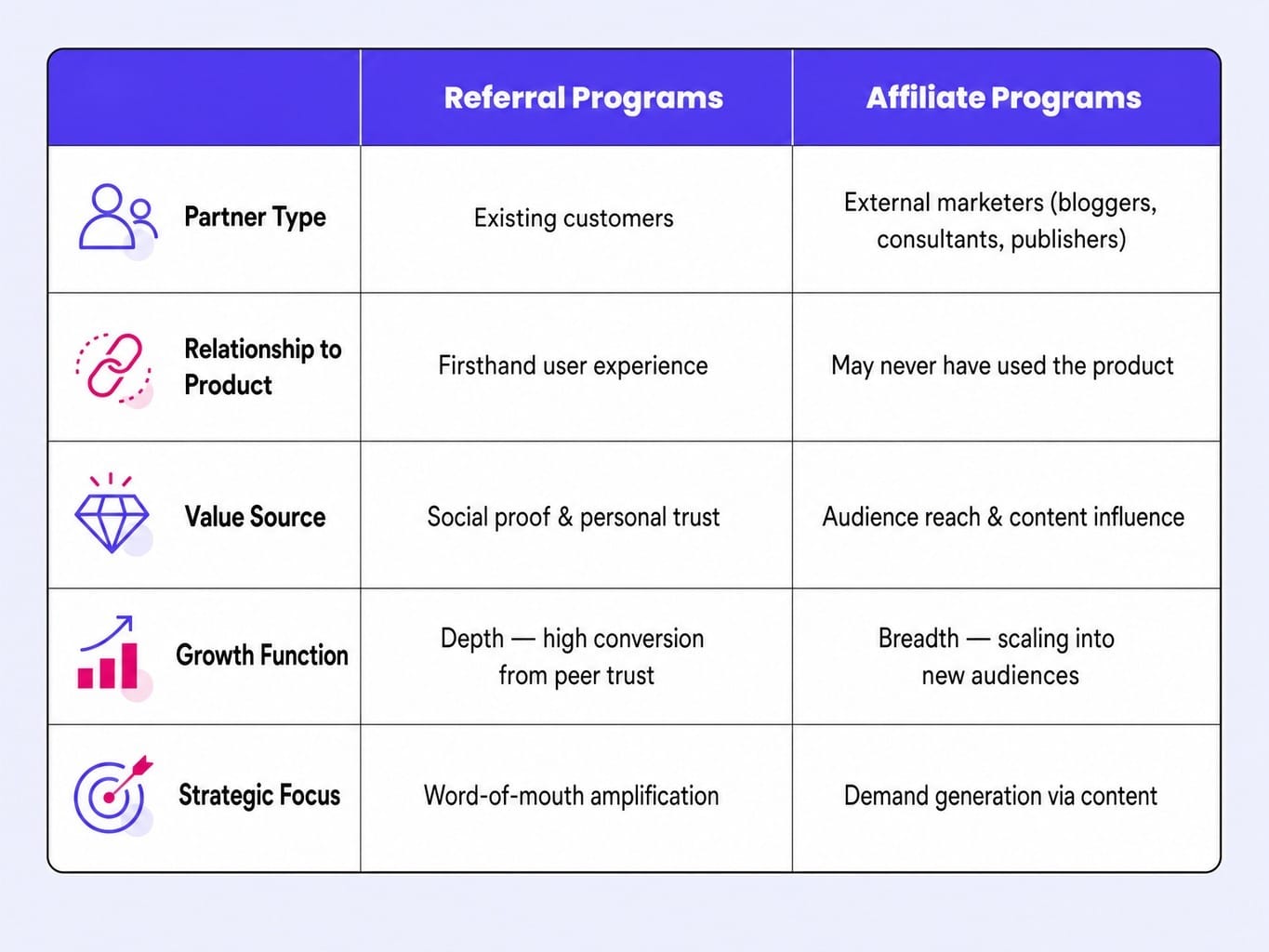
This is fundamentally different from a referral program. The distinction isn't about incentives, but about the partner's relationship to the product.
- Referral Programs compensate existing, happy customers for recommending a product to their peers. The value comes from firsthand experience and social proof. It's word-of-mouth, amplified.
- Affiliate Programs recruit external marketers who may never have used the product themselves. The value comes from their ability to reach and influence a specific audience the SaaS company can't access organically.
This distinction matters operationally. A referral from a trusted colleague who uses HubSpot daily converts at a high rate. An affiliate promoting HubSpot in a "best CRM" article is scaling reach into a new audience. One is about depth, the other about breadth. Platforms like PartnerStack or Kiflo PRM can manage both, but the strategy for each is entirely different. Misunderstanding this leads to recruiting affiliates but giving them the tools of a referral partner, a setup for failure.
Why Most SaaS Affiliate Programs Fail Within 12 Months
The bottleneck in SaaS affiliate marketing is almost never partner recruitment. It's partner activation. Most programs recruit aggressively, hand affiliates a tracking link and a logo kit, then wonder why the vast majority of partners never generate a single conversion. The problem is structural, not motivational. It's a widely recognized benchmark that fewer than 10% of affiliates in a typical program generate meaningful revenue. If 90% of your partners are dormant, you don't have a program; you have a mailing list.
I once audited a B2B SaaS affiliate program that had recruited over 400 partners in its first six months. The team was celebrating the recruitment numbers, but a closer look revealed that fewer than 30 had generated even a single trial signup. The program was failing quietly. This activation gap is where most programs die.
The Activation Rate Problem: Recruitment Without Enablement
SaaS companies often treat affiliate recruitment like a top-of-funnel marketing problem, assuming more partners will equal more revenue. It's actually an enablement problem. Activation rate by affiliate tier is the metric that matters, not total partner count.
True activation requires a system: a dedicated partner onboarding sequence that teaches the product's positioning, co-branded landing pages that speak to the affiliate's specific audience, and content templates or comparison frameworks that lower the barrier to publishing. Simply giving a partner a link is like hiring a salesperson and providing no training, no pitch deck, and no CRM. You can't expect performance when you haven't provided the tools for success.
The Conversion Infrastructure Gap
Even fully activated affiliates will underperform if the SaaS company's own conversion infrastructure is weak. Affiliates don't just send clicks; they send traffic to your landing pages, trial flows, and pricing pages. If those pages were optimized once at launch and never touched again, their performance has likely degraded.
This is the quiet killer of affiliate ROI. Affiliate-driven traffic often has different motivations and a lower initial intent than organic search traffic, meaning generic landing pages convert poorly. The real problem is that most lean marketing teams lack the bandwidth to create, test, and continuously optimize dozens of co-branded landing pages and segment-specific conversion paths. When affiliate-sourced traffic lands on pages that haven't been optimized in months, conversion rates quietly decay, and the program's apparent ROI drops below the threshold where it justifies headcount or tooling spend. This is precisely the kind of continuous optimization gap that Spike AI was built to close, because no team can manually refresh dozens of co-branded landing pages at the velocity affiliates need. Your program's performance ceiling is set by your website's conversion rate, not your partner count.
Read more: SaaS Landing Page Best Practices: What Actually Converts in 2026
Commission Structures That Retain Partners Long-Term
Most SaaS companies start by asking, "What commission percentage should we offer?" The real question is, "What commission structure aligns partner incentives with our goal of long-term customer retention?" The answer determines whether you attract affiliates who optimize for high-volume trial signups or those who refer qualified, high-LTV customers.
A recurring commission and a one-time bounty create fundamentally different partner behaviors. Recurring commissions incentivize affiliates to send higher-intent traffic and care about churn, while flat bounties incentivize volume and make affiliates indifferent to customer quality. The commission model is a behavioral design decision, not just a financial one.
Revenue Share vs. Flat-Rate Payouts: Aligning Incentives with Retention
The two dominant models are revenue share and flat-rate payouts.
Revenue Share (e.g., 20-40% recurring) incentivizes affiliates to refer customers who will stay and upgrade. Their income is tied directly to the lifetime value of the customer. This model, supported by platforms like Rewardful and FirstPromoter, works best when your product has strong retention (low churn), as the affiliate's potential earnings justify the effort.
Flat-Rate Payouts (e.g., $50-$200 per paid conversion) incentivize volume. This works well for controlling customer acquisition cost (CAC) precisely or for products with higher churn where a recurring promise is less attractive. Notion's affiliate program, for example, has used flat-rate payouts, attracting partners who can drive signups at scale.
The best structures often blend these, using MRR-weighted commissions that pay more for referrals to higher-tier plans. The key is to match the incentive to the desired partner behavior and your product's unit economics.
Churn-Adjusted Commissions and Clawback Periods
In 2026, the most sophisticated SaaS affiliate programs are moving beyond simple recurring commissions. They are implementing structures that protect program economics and filter for partner quality.
- Clawback Periods: This is a non-negotiable term in your affiliate agreement. If a referred customer churns or gets a refund within a set period (typically 30-60 days), the commission is reversed. This single clause eliminates a huge amount of low-quality traffic and affiliate fraud.
- Churn-Adjusted Commissions: Instead of a flat 30% for life, some programs use a rev share decay curve. For example, 30% for months 1-6, 20% for months 7-12, and 10% thereafter. This acknowledges that the affiliate's influence is strongest at the point of acquisition and diminishes over time relative to the product's own retention efforts.
These aren't just financial terms; they are quality control mechanisms. They signal to potential partners that you are building a sustainable, long-term program, not just chasing short-term signups.
Recruiting Affiliates Who Drive Pipeline, Not Coupon Clicks
Affiliate recruitment quality will always trump quantity. The most common mistake in SaaS is treating all affiliates as interchangeable, which leads to programs that look busy but don't drive incremental growth. The solution is affiliate segmentation.
For example, a B2B SaaS company I know discovered that 40% of its affiliate-attributed conversions were from coupon sites intercepting users who were already on the pricing page. The affiliate channel wasn't generating new customers; it was paying a commission on sales that were already about to happen.
Content Affiliates vs. Coupon Affiliates: The Incrementality Problem
There are two primary archetypes of affiliates in SaaS, and they serve completely different functions.
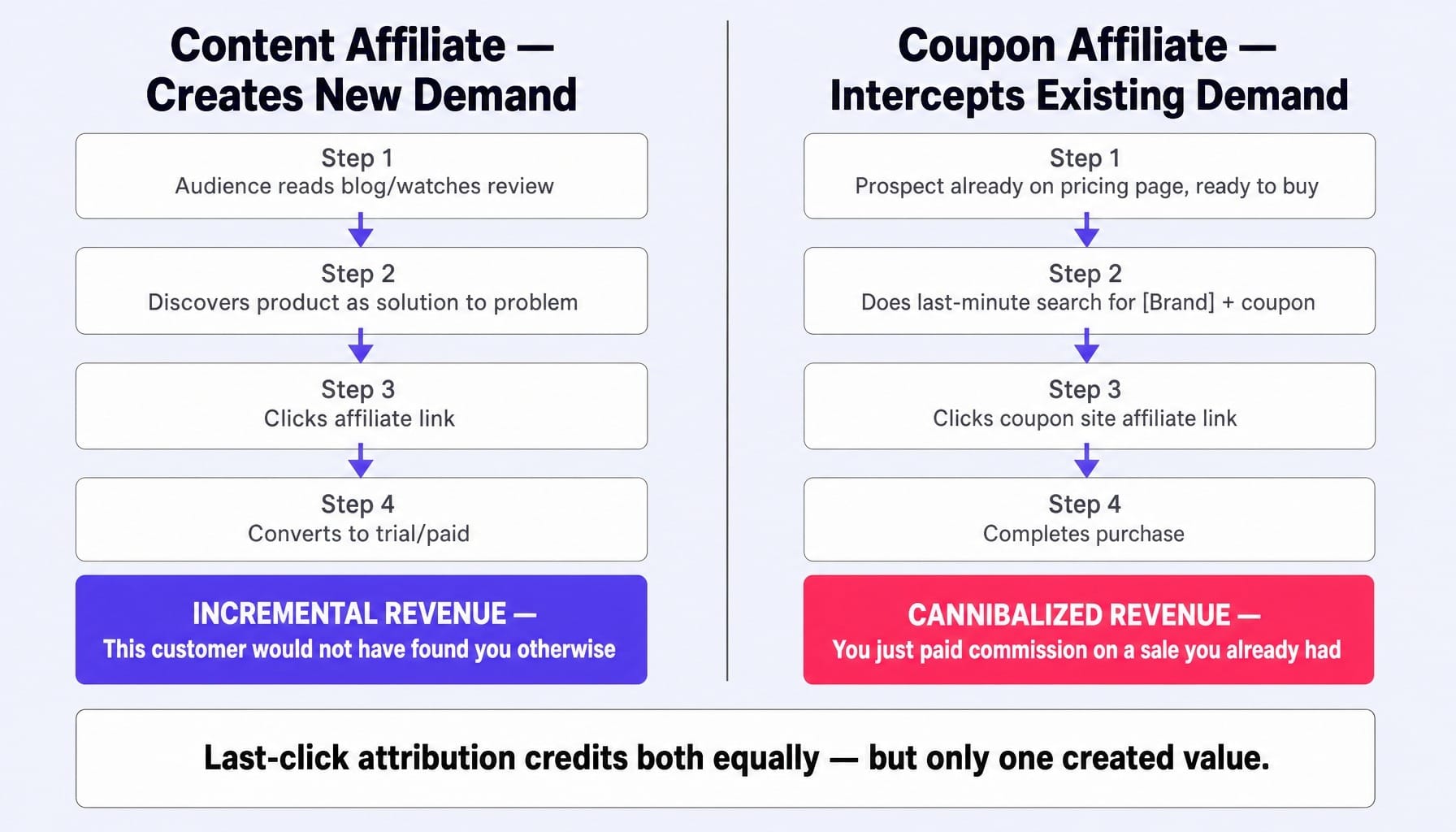
Content Affiliates (bloggers, consultants, YouTube reviewers, niche publishers) create demand. They educate audiences who aren't actively shopping for a solution, introducing your product as a solution to a problem. Their traffic is often top-of-funnel but high-intent. This is incremental revenue.
Coupon Affiliates (coupon directories, deal sites) intercept demand. They rank for "[your brand] + coupon" and capture users at the very last second of the checkout process. This is what's known as coupon leakage. A prospect decides to buy, does a last-minute search for a discount, clicks an affiliate link, and that affiliate gets credit for a sale you would have closed organically. Most affiliate dashboards, which rely on last-click attribution, will incorrectly credit the coupon site with the conversion, masking the fact that your program is cannibalizing its own revenue.
Where to Find B2B SaaS Content Partners Worth Recruiting
Finding true content partners requires looking beyond the big affiliate marketplaces. The best B2B SaaS affiliates are often people, not just websites.
- Niche Industry Newsletters: Find the newsletters your ideal customers read.
- Comparison Content Creators: Look for writers on G2 and Capterra, or YouTubers who do "vs." videos in your category.
- Consultants and Agencies: These are the gold standard. They already recommend tools to their clients and have immense trust.
- Your Own Power Users: Use tools like Crossbeam to find customers who also have blogs, podcasts, or newsletters.
Platforms like PartnerStack and Reditus have marketplaces that can help, but the highest-value partners almost always come from direct, manual outreach.
Attribution and Tracking When Third-Party Cookies Are Gone
Relying on traditional cookie-based affiliate tracking in 2026 is like building a house on a sinking foundation. Safari and Firefox already block third-party cookies, and with Chrome's phase-out, any program dependent on them is losing conversions.
Most SaaS affiliate platforms like Tapfiliate or FirstPromoter still default to client-side cookie tracking with 30- to 90-day windows. But that window is meaningless if the cookie is blocked or cleared. This is why affiliates are increasingly frustrated with programs where their referred sales go untracked.
The solution is first-party, server-side tracking. Instead of dropping a cookie in the user's browser, your server records the affiliate referral ID the moment the click happens. When that user eventually converts—days or weeks later—your system fires a server-to-server "postback" to the affiliate platform to credit the sale. This process is immune to cookie blocking.
Platforms like Everflow and impact.com have robust server-side postback infrastructure. Implementing it requires some engineering resources, but it creates a powerful competitive moat. As marketing attribution becomes less reliable elsewhere, affiliates will preferentially promote programs where they trust the tracking. In this new environment, your tracking architecture is more important than your cookie duration.
Modeling Whether Your SaaS Affiliate Program Is Actually Profitable
Most SaaS companies launch affiliate programs without ever doing the math. They copy a competitor's 20% recurring commission, sign up for a platform, and hope the economics work out. Hope is not a strategy.
Before you write a single line of code, you need to model the channel's profitability. The core formula is simple:
Profit = (Partner Cohort LTV x # of Conversions) - (Total Commissions + Platform Fees + Management Costs)
Let's run a scenario.
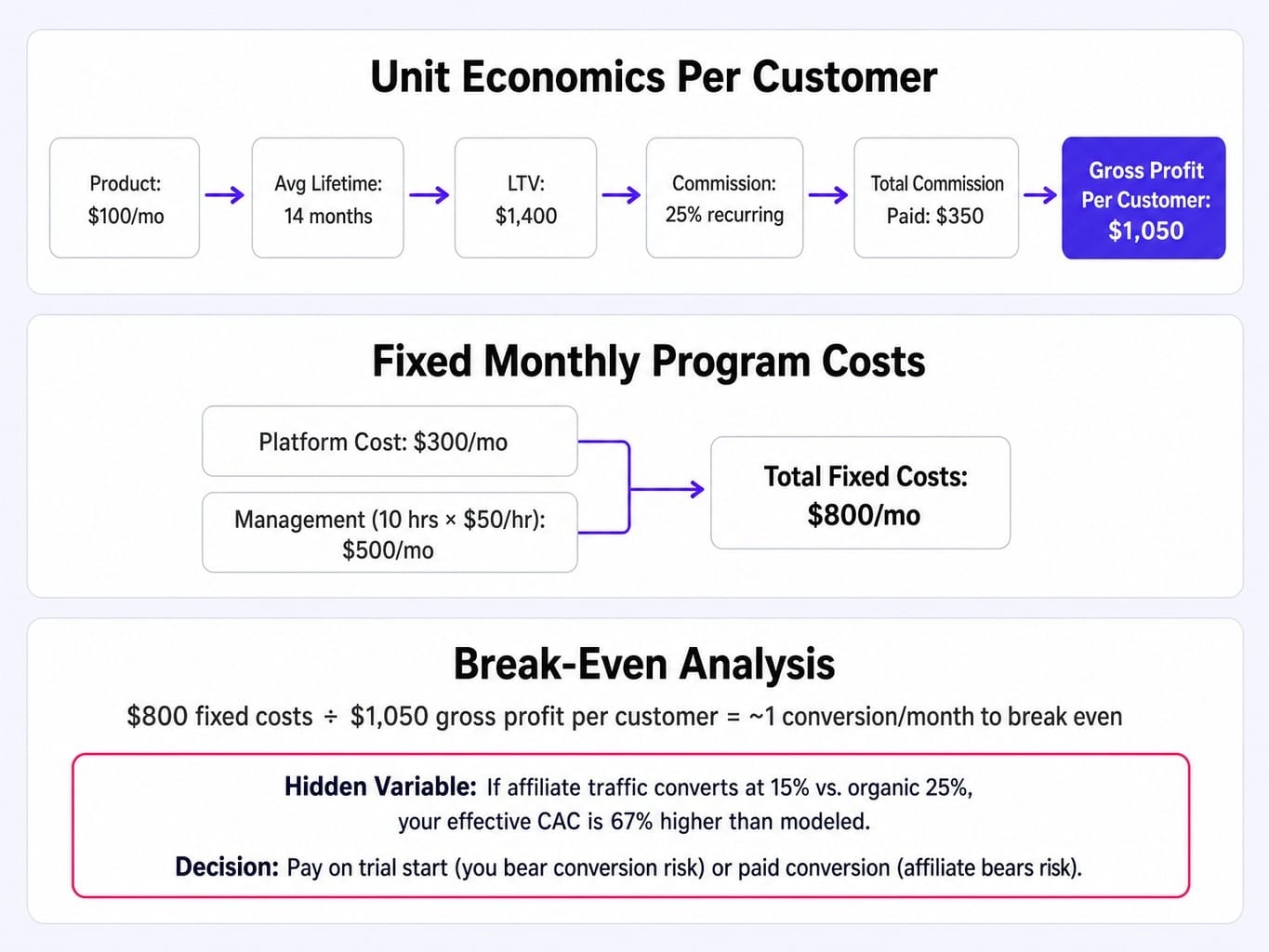
- Product: $100/month
- Average Customer Lifetime: 14 months (LTV = $1,400)
- Commission: 25% recurring (Total commission per customer = $350)
- Platform Cost: $300/month
- Management: 10 hours/month at a blended rate of $50/hr = $500/month
In this scenario, your fixed program costs are $800/month. Each conversion generates $1,050 in gross profit ($1,400 LTV - $350 commission). You need to generate at least one conversion per month just to start chipping away at your fixed costs.
But the real variable is the trial-to-paid conversion rate. If your organic traffic converts at 25%, but affiliate traffic only converts at 15%, your effective CAC for the affiliate channel is 67% higher than you think. This is why deciding whether to pay on qualified lead handoff (e.g., a trial start) versus a closed-won payout (a paid conversion) is so critical. Paying on trial shifts the conversion risk to you; paying on conversion shifts it to the affiliate. Your commission rate must reflect who is bearing that risk.
The Conversion Side of the Equation: Why Affiliate Traffic Underperforms on Unoptimized Pages
We've established that SaaS affiliate programs are complex systems. They fail because of activation gaps, misaligned incentives, attribution blind spots, and unmodeled economics.
But a single, quiet problem threads through all of these: the performance of your own website. You can design the perfect commission structure and recruit elite content partners, but if the landing pages they send traffic to convert at 1.8%, your program economics will never work.
This is the conversion infrastructure gap. Affiliates are sending you traffic—often with lower initial intent—that hits pages your lean marketing team hasn't had the bandwidth to continuously test and optimize. A page that worked six months ago is likely underperforming today, silently eroding the ROI of your entire affiliate channel.
Spike AI is designed to close this gap. It's not an affiliate marketing tool; it's the system that ensures the conversion infrastructure your partners depend on is always improving. Spike AI's marketing execution engine treats your website as a living system, shipping conversion improvements every week. It identifies friction on your key affiliate landing pages, tests new copy on your trial signup flow, and optimizes your pricing page—all without waiting for a quarterly CRO sprint or adding to your backlog.
This is the missing layer that makes your affiliate program investments compound rather than stagnate.
See how Spike AI continuously optimizes the pages your affiliates send traffic to
Your Program Is a System, Not a Campaign
Building a profitable SaaS affiliate channel in 2026 requires a fundamental shift in thinking. It's not a recruitment problem; it's an economics, activation, and conversion infrastructure problem.
The companies that win are those that treat their affiliate program as a product. They design commission structures that reward retention, recruit partners who create new demand, invest in first-party attribution, and—critically—ensure the conversion paths that traffic flows through are continuously improving.
Before you scale your partner count, model the unit economics. Audit the conversion rates on your top affiliate landing pages. Ask yourself if your team has the system in place to keep both sides of the equation—partner performance and website conversion—improving simultaneously. The answer will determine if you're building a revenue engine or just a very expensive mailing list.
Read more: Data-Driven CRO: Evolve Your Marketing Strategy for Revenue
Frequently Asked Questions
Can SaaS affiliate marketing work for enterprise-level products with long sales cycles?
Yes, but the structure changes. Enterprise programs typically pay a flat bounty on a qualified lead handoff (e.g., a booked demo), as closed-won attribution over a 6-month sales cycle is unreliable. Commissions are higher per lead ($200-$500+) to compensate for lower volume. The best partners are consultants who already advise your target buyers.
What legal terms should be included in a SaaS affiliate agreement?
At minimum: commission structure and payment terms (e.g., net-60), clawback provisions for churned customers, prohibited promotion methods (like brand bidding on paid search), content compliance rules (FTC disclosure), and termination clauses. Underinvesting in your affiliate agreement is a common and costly mistake that exposes you to fraud and brand damage.
How do you reactivate dormant affiliates who signed up but never promoted?
Segment dormant partners and send a reactivation sequence with a ready-to-publish content template, a time-limited commission bonus for their first conversion, and a link to a pre-built co-branded landing page. Most dormant affiliates aren't disengaged; they're stuck on the initial effort required to create promotional content. Reduce that friction.
How does affiliate marketing work for usage-based or consumption-priced SaaS models?
It's tricky because recurring revenue fluctuates. The most common solution is to pay a flat bounty per activated account (not just a signup) or a percentage of the customer's first 3-6 months of spend, often with a payout cap. This provides affiliates with predictable earnings while protecting your margins on high-consumption accounts.
How do you prevent self-referral fraud in a SaaS affiliate program?
Self-referral is when someone signs up as an affiliate just to get a commission on their own purchase. Detect it by matching affiliate and customer emails, flagging conversions where the affiliate and customer IP addresses are identical, and monitoring for patterns of single-conversion affiliates. Platforms like Everflow and impact.com have built-in fraud detection for this.
Should a SaaS company run its affiliate program in-house or through a network?
In-house platforms (like Rewardful or FirstPromoter) offer full control over data and partner relationships but require more management time. Networks (like PartnerStack or impact.com) provide affiliate discovery but charge higher fees and limit direct partner access. Most B2B SaaS companies under $10M ARR should start in-house to validate profitability before expanding to a network.